Showing posts with label Language and Politics. Show all posts

Saturday, October 29, 2011

"Occupy" Wall Street

Occupying Word Street


The public protest over economic inequalities known as "Occupy Wall Street" has been going on nearly a month now, with the original demonstration in Manhattan's Financial District spreading to cities around the world. Thanks to the success of the movement, the lingo of the protesters has spread quickly, with the verb occupy in particular becoming a kind of rallying cry.

Occupy and occupation first became part of the language of protest in September 1920, when factory workers in Italy held strikes against working conditions. About 600,000 workers took control of the factories, and the movement was known in Italian as l'occupazione delle fabbriche, or "the occupation of the factories." The earliest evidence in the Oxford English Dictionary for the relevant senses of occupy ("to gain access to and remain in...without authority, as a form of protest") and occupation ("the action of occupying a work place, public building, etc., as a form of protest") come from reports of the 1920 Italy protests. Another term for protest-style occupation, the sit-in, has been in use since 1937, though it really took off in the '60s, along with such spin-offs as the teach-in and the be-in.

Occupy Wall Street has its origins in a call for action on July 13 by Adbusters Media Foundation, an anti-consumerist group of "culture jammers" based in Vancouver. "On September 17," the announcement read, "we want to see 20,000 people flood into lower Manhattan, set up tents, kitchens, peaceful barricades and occupy Wall Street for a few months." Adbusters made an explicit analogy to the protests of the Arab Spring, asking, "Are you ready for a Tahrir moment?" That's a reference to Cairo's Tahrir Square, the focal point of Egypt's anti-Mubarak protests. Another group involved with the planning of the September 17 protest dubbed it the U.S. Day of Rage.


As with many other grassroots movements these days, Occupy Wall Street got the word out via social networking sites, such as Facebook, Twitter, Tumblr, and Meetup. On Twitter, the hashtag #occupywallstreet circulated in the leadup to September 17, often shortened to #ows. Protesters dug in for the long haul by taking over Zuccotti Park, a privately owned park not too far from Wall Street. (Zuccotti Park was originally known as Liberty Plaza Park, and the OWS crowd has tended to call it "Liberty Park.") As news spread of OWS, similar protests sprang up in other cities around the country, going by the labels Occupy Boston, Occupy Philly, and so forth. The website Occupy Together became a hub for coordinating the demonstrations in the U.S., while activists in cities around the world followed suit. Of course, there have also been parodies, like Occupy Sesame Street.

The demonstrators usually call themselves occupiers, though they've also been called occupants or even occupationistas. And with the growth of the movement, the verb occupy no longer requires "Wall Street" or any other object to follow it. About a week after the OWS demonstration began, in late September, people were already talking about "the Occupy protests" and "the Occupy movement." In a newspaper created for OWS, the Occupy Wall Street Journal, a list of "5 Things You Can Do Now" begins with #1: "Occupy! Bring instruments, food, blankets, bedding, rain gear, and your friends." To occupy can now be used as an intransitive verb meaning to take part in the Occupy protests. (Naturally, the hashtag #occupy has taken off on Twitter in recent weeks.)


Beyond the talismanic power of occupy, other words and phrases have become firmly linked to the movement. One popular slogan, "We are the 99%," began as a Tumblr feed with the message, "We are getting nothing while the other 1 percent is getting everything." The "99 percenters" have been met by the "53 percenters," conservatives who instead focus on the 53 percent of households that pay federal income tax.

At the center of the action, in Zuccotti Park, the leaderless (and some would say message-less) protesters have developed their own terminology and practices for their experiment in "participatory democracy." At the OWS "general assembly," participants have overcome the ban on amplified sound by using what has been dubbed "the human microphone" or "the people's mic": after a speaker says a few words, those nearby repeat what was said in unison. Then those a bit further away repeat what the first group said, amplifying the message across the entire crowd. To register approval for a point under discussion, the occupiers use a hand-signal system that has been called "jazz hands" or "twinkling": those in agreement wave their hands with fingers pointed upward in silent applause. This hand-signal system has been used in the past by grassroots groups in Europe, such as Seeds for Change and Climate Camp.

As the protests continue to spread around the world (Occupy protests are scheduled to take place in 25 countries on October 15), the political impact becomes more profound, as does the linguistic impact. If the movement does have lasting consequences, we could be looking at occupy as a strong contender for the 2011 Word of the Year.

Update: You can hear more of my thoughts about the word occupy on the National Public Radio show "On the Media."

Source: http://www.visualthesaurus.com/cm/wordroutes/3001/?utm_source=rss

Sunday, October 2, 2011

Language influences thought - The Economist - Lane Greene

Lane Greene of The Economist Johnson Blog, provides a mini lecture into how language influences thought.

He shows some psychological experiments to do with language that are worth a look.

Around halfway, he also challenges the notion that "Gen Y" is degrading the English Language, that in fact Jonathan Swift in 1712 said the same thing, that the English language is beyond repair and there should be an "Academie Anglaise". haha.

Tuesday, September 20, 2011

Political Language, Quotes, Australia

Plain speech can obscure truth as much as inflated language

Sarah Burnside
July 22, 2011
Opinion

Plain speaking: Julia Gillard and Tony Abbott ahead of the first leaders debate at the National Press Club last year.
Plain speaking: Julia Gillard and Tony Abbott ahead of the first leaders debate at the National Press Club last year. Photo: Getty Images
Dark connotations lurk behind our politicians' bland phrases.

Although there is consensus on little else in contemporary Australian political discourse, it is generally accepted that this is an age of deep disengagement from and cynicism with the political process.

In his book Sideshow, Lindsay Tanner traces the negative impacts of the media's entertainment focus and the 24-hour news cycle, documenting the sheer crushing banality of the 2010 election campaign and expressing distress at what ''the serious craft of politics … is becoming''. Similarly, Waleed Aly noted last year that in Australia ''we report politics as though it is sport, and sport as though it is politics''.

The current reporting on the carbon tax has seen an almost relentless focus on style, stunts and presentation: in addition to the tiresome criticism of Julia Gillard's appearance, witness the emphasis on her supposed woodenness, accent, choice of words and speaking pace. Against this superficial backdrop, the question of Gillard's credibility extends beyond the charge that she lied to the voters prior to last year's election - Laura Tingle notes that ''so much of the apparent anger about the carbon tax isn't about the carbon tax at all but about the Prime Minister herself''. This focus is perpetuated and reinforced as columnists delve into Gillard's public persona: exploring ambiguities, attacking perceived contrivances, and wondering endlessly who ''the real Julia'' might be, as if this mattered more than her policies.

This emphasis on authenticity has continued, and the Coalition deployed the theme of action over words during the 2010 election campaign; its ''action contract'' contained such items as ''reject Labor's massive new mining tax''. The message was clear though unswervingly negative, and it nearly worked.

Australians are not alone in distrusting verbose politicians; plain speech has long connoted sincerity. In George Orwell's 1946 essay Politics and the English Language, he lamented that it was ''broadly true that political writing is bad writing'' and charged that ''inflated'' political language camouflaged meaning:

''A mass of Latin words falls upon the facts like soft snow, blurring the outline and covering up all the details.

''The great enemy of clear language is insincerity. When there is a gap between one's real and one's declared aims, one turns as it were instinctively to long words and exhausted idioms, like a cuttlefish spurting out ink.''

Orwell's incisive essay is as relevant now as it was the day it was written. Political theorist Bernard Crick has suggested, though, that there are ''dangers in Orwell's much-praised plain style''; one can ''tell lies or spin stories in monosyllables and simple sentences'' as well as in long, archaic words. Crick argued that ''the plain style'' was ''no guarantor of truth'', provocatively suggesting that Orwell ''could be read by propagandists as sensible advice to keep the propaganda plain and simple''.

It is often overlooked that plain speech can also be used to obfuscate. John Howard - rarely associated with verbal flights of fancy - was accused of dishonesty for his part in the ''children overboard'' affair and the Iraq war.

Writing in 2004, the philosopher Raimond Gaita analysed the disquiet many felt about the Howard government's mendacity, and the way in which such people were dismissed as naive ''moralists'' by political commentators. Gaita noted: ''Lying in politics would not matter if truth did not matter to us.''

Corrupt political language often seems oblivious to both historical and contemporary reality - can our representatives, on both sides of the chamber, really be unaware of the dark connotations that lurk behind bland phrases such as ''the Nauru solution'' or the ''Malaysia solution''?

As Tanner notes, the ''routine misuse of language'' in political discourse is ''insidious'': terms such as ''regime change'' or ''collateral damage'' are ''bland phrases that hide the realities of an invasion, a massive loss of life, and widespread misery and destruction''.

Where is truth in the 2011 political scene? Although we might assume that it is to be found in plain, simple statements rather than in grandiose speechifying, this seems unlikely. Are ''great big new tax'', ''envy politics'', ''queue jumpers'' or ''stop the boats'' any more honest or meaningful than ''programmatic specificity''? Given the high living standards enjoyed by most Australians - in stark contrast to much of the world - are ''battlers'' and ''struggling families'' truthful descriptors?

As the debates over the carbon tax and other policies continue, and as coverage focuses ever more intently upon surfaces and symbols, we would do well to remember that cuttlefish ink may be squirted in abbreviated as well as extended form.

Sarah Burnside is a freelance writer with experience in law and policy, and a member of the ALP.

Source: http://www.theage.com.au/opinion/politics/plain-speech-can-obscure-truth-as-much-as-inflated-language-20110721-1hqtx.html#ixzz1YXWwvAYq

Monday, September 5, 2011

Israeli Military Doublespeak

Metaphor and Military Campaign Names

Posted on February 5, 2011
Filed Under Aphorisms, metaphor | 1 Comment

Another article by the always-interesting Tom Jacobs in Miller-McCune, this time about metaphor and military campaign names. An analysis of the names given to Israeli military operations between 1948 and 2007 found that more than 60% of them alluded to either the natural world or the Bible, metaphorical names intended to suggest that the campaigns were either forces of nature or sanctioned by a higher power. “The basic theoretical supposition is that military naming is a simple and useful mechanism that might be employed to blur undesired aspects—such as the human and economical costs—associated with the respective practices,” writes Dalia Gavriely-Nuri of Hadassah College Jerusalem, Bar-Ilan University, the researcher who conducted the study. Operation First Rain and Operation Lightning Strike suggests these operations are an “inevitable, natural event, rather than one worthy of public examination.” Of course, this practice is widespread. Hezbollah’s Operation Truthful Promise is “a noble-sounding name for the kidnapping of two Israeli soldiers,” Jacobs cites Gavriely-Nuri as pointing out. Operation Enduring Freedom anyone?

Source: http://www.jamesgeary.com/blog/metaphor-and-military-campaign-names/

Tuesday, May 31, 2011

Swearing Fines in Victoria

Big fines for those who cry foul

Josh Gordon
May 31, 2011
TO PUT it bluntly, we're all f---ed. It might be therapeutic to let off a stream of expletives if your team is getting flogged or if you hit your finger with a hammer, but it can also be illegal.

And under laws set to be introduced to State Parliament this week, Victoria Police will get permanent powers to slap potty-mouthed perpetrators with on-the-spot fines of up to $240 for using language deemed to be indecent, disorderly, offensive or threatening.

The crackdown — which extends the Baillieu government's ever-growing law-and-order agenda — means police will be able to issue infringement notices for offensive behaviour and indecent language similar to parking and speeding fines.

Attorney-General Robert Clark said the idea was to lower the police workload by allowing them to issue fines instead of tackling bad language using the court system.

"It frees up police time for other law enforcement activities and enables them to more readily issue penalties against those offenders who deserve them," Mr Clark said.

"By providing police with as many enforcement tools as possible, Parliament is sending a strong signal that people who engage in criminal behaviour can expect to be dealt with under the law."

Offensive language has been an offence in Victoria since 1966. Swearing — if it is deemed serious enough — can carry a penalty of up to two years' jail, and is even considered an offence if no one is present to hear it.

The new laws for indecent language will carry a fine of two-penalty units, equivalent to about $238.90.
Mr Clark said the laws would also allow police to issue infringement notices to people who commit "offensive behaviour" or to people who are "drunk, quarrel or violent", who refuse to leave a pub or club when asked to go and for allowing the unauthorised consumption of alcohol on a "party bus".

The move follows a three-tier trial that was previously due to end on June 30 but will now be made permanent.

The latest crackdown on anti-social behaviour follows a move to introduce mandatory minimum jail terms for youths aged 16 and 17 convicted of violent offences, despite concern among the legal profession.

Shadow attorney-general Martin Pakula said Labor would not oppose the bill because it had introduced the trial in 2008.

Source: http://www.theage.com.au/victoria/big-fines-for-those-who-cry-foul-20110530-1fctb.html

Monday, May 30, 2011

First names, offensive language, demeaning

Use of first names

Your friendly global villain

May 4th 2011, 18:15 by G.L. | NEW YORK
BREATHLESS American TV presenters, I notice, have been saying "Osama" rather than "Bin Laden" a little more often. The Newseum's daily cull of the world's front pages on May 2nd and May 3rd shows that while most used the surname, some "Osama is dead", "How Osama was killed" and "Usáma je mrtev" headlines are also scattered about.

What is it about very nasty people that makes us use their first names as though they were our buddies? And why some but not others? "Osama", "Saddam" and "Fidel" are common, yet no "Josef" or "Adolf". No "Muammar" either, not even after he started having citizens strafed from helicopters.
First-name terms are obviously a way to diminish a feared enemy, especially in the triumph of his death or downfall. But merely being a bad hat isn't enough, it seems: he has to be extensively demonised before meriting the treatment, so maybe Libya's mad, bad colonel just hasn't been in anyone's sights for long enough. And if a man is too evil—on the massacre-of-millions scale—then such jolly familiarity apparently becomes bad taste. Stalin was Uncle Joe once, before the truth came out.

Some first names are used more for convenience than for condemnation. Diplomats and journalists sometimes talk in their convivial insider way of "Bashar" (al-Assad), but that's mainly to distinguish him from his father, the Lion of Syria, whose troops massacred perhaps 20,000 at one sitting but was never "Hafez". On the other hand, some first names may be too common to use. "Robert" won't substitute for "Mugabe", and there are too many Omars besides al-Bashir and Augustos other than Pinochet.

Other villains with short familiar names aren't necessarily following the Osama-Saddam-Fidel pattern. Napoleon was a royal name, like Elizabeth or Victoria; Mao, of course, a surname; and Pol Pot a nom de guerre. Nicaraguans refer to "Daniel", but that's only in Nicaragua, where everyone knows which Daniel they mean, and both Mr Ortega's supporters and his detractors use it in equal measure. (For that matter, this is true of Mr Castro too.)

For the not-so-villainous, people may use first names out of love (Winston), but more often, again, out of need. Hillary is Hillary mainly to distinguish her from the other Clinton whose shadow she can never quite escape, though there is a trace of male chauvinism in it too. Bibi and Condi are nicknames, as was Monty, so I feel they don't quite count. And Newt... well, how can anyone resist Newt?

* Offensive language: titles. By using first name titles where social distance is great, it demeans the subject and reduces the indimidation.

Source: http://www.economist.com/blogs/johnson/2011/05/use_first_names

Monday, May 9, 2011

Obama address post-Bin Laden death

The White House Blog

Osama Bin Laden Dead
Posted by Macon Phillips on May 02, 2011 at 12:16 AM EDT

Tonight, President Obama addressed the Nation to announce that the United States has killed Osama bin Laden, the leader of al Qaeda.  Watch or read his full remarks below, and learn more from the transcript of the White House briefing call afterwards.

11:35 P.M. EDT

     THE PRESIDENT:  Good evening.  Tonight, I can report to the American people and to the world that the United States has conducted an operation that killed Osama bin Laden, the leader of al Qaeda, and a terrorist who’s responsible for the murder of thousands of innocent men, women, and children.

It was nearly 10 years ago that a bright September day was darkened by the worst attack on the American people in our history.  The images of 9/11 are seared into our national memory -- hijacked planes cutting through a cloudless September sky; the Twin Towers collapsing to the ground; black smoke billowing up from the Pentagon; the wreckage of Flight 93 in Shanksville, Pennsylvania, where the actions of heroic citizens saved even more heartbreak and destruction.

And yet we know that the worst images are those that were unseen to the world.  The empty seat at the dinner table.  Children who were forced to grow up without their mother or their father.  Parents who would never know the feeling of their child’s embrace.  Nearly 3,000 citizens taken from us, leaving a gaping hole in our hearts.

On September 11, 2001, in our time of grief, the American people came together.  We offered our neighbors a hand, and we offered the wounded our blood.  We reaffirmed our ties to each other, and our love of community and country.  On that day, no matter where we came from, what God we prayed to, or what race or ethnicity we were, we were united as one American family.

We were also united in our resolve to protect our nation and to bring those who committed this vicious attack to justice.  We quickly learned that the 9/11 attacks were carried out by al Qaeda -- an organization headed by Osama bin Laden, which had openly declared war on the United States and was committed to killing innocents in our country and around the globe.  And so we went to war against al Qaeda to protect our citizens, our friends, and our allies.

Over the last 10 years, thanks to the tireless and heroic work of our military and our counterterrorism professionals, we’ve made great strides in that effort.  We’ve disrupted terrorist attacks and strengthened our homeland defense.  In Afghanistan, we removed the Taliban government, which had given bin Laden and al Qaeda safe haven and support.  And around the globe, we worked with our friends and allies to capture or kill scores of al Qaeda terrorists, including several who were a part of the 9/11 plot.

Yet Osama bin Laden avoided capture and escaped across the Afghan border into Pakistan.  Meanwhile, al Qaeda continued to operate from along that border and operate through its affiliates across the world.

And so shortly after taking office, I directed Leon Panetta, the director of the CIA, to make the killing or capture of bin Laden the top priority of our war against al Qaeda, even as we continued our broader efforts to disrupt, dismantle, and defeat his network.

Then, last August, after years of painstaking work by our intelligence community, I was briefed on a possible lead to bin Laden.  It was far from certain, and it took many months to run this thread to ground.  I met repeatedly with my national security team as we developed more information about the possibility that we had located bin Laden hiding within a compound deep inside of Pakistan.  And finally, last week, I determined that we had enough intelligence to take action, and authorized an operation to get Osama bin Laden and bring him to justice.

Today, at my direction, the United States launched a targeted operation against that compound in Abbottabad, Pakistan.  A small team of Americans carried out the operation with extraordinary courage and capability.  No Americans were harmed.  They took care to avoid civilian casualties.  After a firefight, they killed Osama bin Laden and took custody of his body.

For over two decades, bin Laden has been al Qaeda’s leader and symbol, and has continued to plot attacks against our country and our friends and allies.  The death of bin Laden marks the most significant achievement to date in our nation’s effort to defeat al Qaeda.

Yet his death does not mark the end of our effort.  There’s no doubt that al Qaeda will continue to pursue attacks against us.  We must –- and we will -- remain vigilant at home and abroad.

As we do, we must also reaffirm that the United States is not –- and never will be -– at war with Islam.  I’ve made clear, just as President Bush did shortly after 9/11, that our war is not against Islam.  Bin Laden was not a Muslim leader; he was a mass murderer of Muslims.  Indeed, al Qaeda has slaughtered scores of Muslims in many countries, including our own.  So his demise should be welcomed by all who believe in peace and human dignity.

Over the years, I’ve repeatedly made clear that we would take action within Pakistan if we knew where bin Laden was.  That is what we’ve done.  But it’s important to note that our counterterrorism cooperation with Pakistan helped lead us to bin Laden and the compound where he was hiding.  Indeed, bin Laden had declared war against Pakistan as well, and ordered attacks against the Pakistani people.

Tonight, I called President Zardari, and my team has also spoken with their Pakistani counterparts.  They agree that this is a good and historic day for both of our nations.  And going forward, it is essential that Pakistan continue to join us in the fight against al Qaeda and its affiliates.

The American people did not choose this fight.  It came to our shores, and started with the senseless slaughter of our citizens.  After nearly 10 years of service, struggle, and sacrifice, we know well the costs of war.  These efforts weigh on me every time I, as Commander-in-Chief, have to sign a letter to a family that has lost a loved one, or look into the eyes of a service member who’s been gravely wounded.

So Americans understand the costs of war.  Yet as a country, we will never tolerate our security being threatened, nor stand idly by when our people have been killed.  We will be relentless in defense of our citizens and our friends and allies.  We will be true to the values that make us who we are. And on nights like this one, we can say to those families who have lost loved ones to al Qaeda’s terror:  Justice has been done.

Tonight, we give thanks to the countless intelligence and counterterrorism professionals who’ve worked tirelessly to achieve this outcome.  The American people do not see their work, nor know their names.  But tonight, they feel the satisfaction of their work and the result of their pursuit of justice.

We give thanks for the men who carried out this operation, for they exemplify the professionalism, patriotism, and unparalleled courage of those who serve our country.  And they are part of a generation that has borne the heaviest share of the burden since that September day.

Finally, let me say to the families who lost loved ones on 9/11 that we have never forgotten your loss, nor wavered in our commitment to see that we do whatever it takes to prevent another attack on our shores.

And tonight, let us think back to the sense of unity that prevailed on 9/11.  I know that it has, at times, frayed.  Yet today’s achievement is a testament to the greatness of our country and the determination of the American people.

The cause of securing our country is not complete.  But tonight, we are once again reminded that America can do whatever we set our mind to.  That is the story of our history, whether it’s the pursuit of prosperity for our people, or the struggle for equality for all our citizens; our commitment to stand up for our values abroad, and our sacrifices to make the world a safer place.

Let us remember that we can do these things not just because of wealth or power, but because of who we are:  one nation, under God, indivisible, with liberty and justice for all.

Thank you.  May God bless you.  And may God bless the United States of America.


Source: http://www.whitehouse.gov/blog/2011/05/02/osama-bin-laden-dead

Obama speech death Bin Laden

'We Removed the Taliban’?

May 2, 2011 2:23 P.M.
By Andrew C. McCarthy

One aspect of President Obama’s speech last night — part of the “If it’s on my watch I did it, if it’s on Bush’s watch we did it” theme — is particularly grating. Obama said:

Over the last 10 years, thanks to the tireless and heroic work of our military and our counterterrorism professionals, we’ve made great strides in [the war against al Qaeda]. We’ve disrupted terrorist attacks and strengthened our homeland defense.  In Afghanistan, we removed the Taliban government, which had given bin Laden and al Qaeda safe haven and support. 

I pass over for now the fact that “we” disrupted terrorist attacks and strengthened our homeland defense by tactics like interrogation and stepped up surveillance that Obama has disparaged. Obama brags that “we” removed the Taliban. But “we” did that a decade ago. In recent months, the Obama policy has actually been to negotiate with the Taliban — i.e., to encourage Karzai to negotiate with the Taliban — with an eye toward integrating the Taliban in Afghanistan’s final political settlement. And that was even before Karzai’s regime allowed 500 Taliban members — including scores of commanders — to escape from a prison in Kandahar a few days ago so they can rejoin the jihad.

We removed the Taliban?

Sunday, May 8, 2011

British Politics - Sexist Language

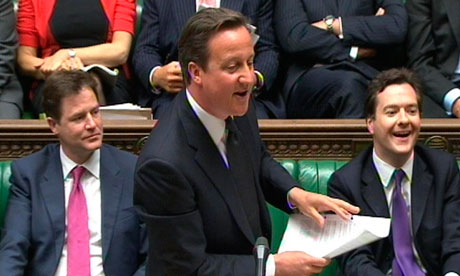
Calm down, dear? Do me a favour David Cameron – language matters

Libby Brook

Women's position in society is already being weakened by this government. Cameron's words should not undermine it further

David Cameron comment
George Osborne – although not Nick Clegg – finds David Cameron's 'Calm down, dear' highly amusing. Photograph: PA

When Michael Winner delivers his catchphrase "Calm down, dear" on the Esure insurance ads he does, on occasion, have the good grace to do so dressed as a fairy. For David Cameron at prime minister's questions this week there was no such self-ironising. He directed the borrowed injunction at the shadow Treasury secretary Angela Eagle while in costume as leader of the coalition. He did not even carry a string of sausages, which would at least have made explicit the official return to Punch and Judy politics that he was initially so keen to rid the house of.

For some, the incident was a simple case of mask slippage: Cameron's modern facade cracking under pressure to reveal the Eton-entitled, habitually sexist Bullingdon bully beneath. But, as it became clear that offence had been taken by a constituency bigger than Ed Balls – making easy feminist hay on behalf of the opposition – the debate revealed a response that was, if not polarised, then certainly non-equatorial.

Male sketchwriters and assorted Westminster aficionados either affected bemused indulgence on behalf of their slighted sisters or scented the whiff of political-correctness-gone-mad. The storm was argued back into its teacup. This was just a joke and a gender-blind one at that. The House of Commons is a bearpit and those participating have tacitly accepted that the usual rules of polite discourse need not apply. Edwina Currie was among former female ministers wheeled out to pooh-pooh the notion of "bleating about being a woman". Ergo, telling a female colleague to "Calm down, dear" is Not That Big A Deal.

To these assorted exculpations I reply: "Do me a favour, love!" (For those whose mental data cloud does not include a section marked Public Wallyfication, this refers to Sky Sports presenters Andy Gray and Richard Keys discussing the West Ham vice-chair, Karren Brady, off-air.) Because language really, really matters. It is fundamental to how we construct and convey meaning. And when that meaning is: "I am expressing paternalistic concern at your inability [as a woman] to rein in your emotion" then yes, that is sexist and yes, it is a big deal. To undermine her anger as hysteria, to reference her femaleness, is a particularly male way of putting a woman down.

In her seminal treatise Man Made Language, the feminist theorist Dale Spender makes the argument that language is a system that embodies sexual inequality. She offers evidence of the loss of prestige experienced when men are referred to in female terms ("don't be such a girl")***, and the way that words to describe women are consistently sexualised or imply over-emotion and weakness. (Nick Clegg, since the earliest coalition negotiations, has been described by critics as a "harlot", a "flirt" and "arm candy".) Spender noted that, while males have more control over meaning and more control over talk (one study found men were responsible for 98% of interruptions in mixed conversation), women are in a double bind: damned if they do and damned if they don't talk like a lady.

Language is about inclusion and exclusion. Whether certain men revert to sexist banter when they think they can get away with it, as was the case with Gray and Keys, is beside the point. What matters is that nowadays, in the majority of public spaces and, crucially, workplaces, such behaviour is policed by other men as well as women. What matters is that when women don't hear this kind of language on a regular basis they get the message that they belong and become more confident about speaking up. That this subtle but fundamental inclusion is not manifest in our own parliament is of profound concern.

To those who would at this point query the existence of my funny bone, I would respectfully suggest that humour is about context as well as content. "Cheer up, darling, it might never happen"? It already has, and here is the context in the spring of 2011. There are just four women cabinet ministers and one of those comes unelected from the Lords. All the decisions about cuts to benefits and services that are affecting women, and especially single mothers, disproportionately are being made with little female input.

Indeed, across the coalition benches as a whole, women are woefully underrepresented, with a recent Fabian analysis forecasting the complete demise of Liberal Democrat women in the house after the next election. And it's hard not to see this as evidenced directly in the slew of anti-woman proposals that have emanated from the government since last May: be that the bungled child benefit changes, alterations to abortion provision and anonymity in rape trials, or the current assault on equality legislation under the guise of Cameron's "Red Tape Challenge".

Meanwhile, David Willetts sees fit to blame feminism for working-class worklessness, the Telegraph posts a "whose boobs are these?" blog alongside a photo of a headless Labour MP, and the most visible woman anywhere near the government remains Samantha Cameron, who could this week be found baking cupcakes for a royal wedding street party. As women's position in society is weakened by recession, the government's response to that recession, and their representation within that government, it is frightening to see just how quickly the wider culture takes its cue to move backward. I see no reason to be calm about it.

Source: http://www.guardian.co.uk/commentisfree/2011/apr/28/calm-down-dear-david-cameron
http://englishlangsfx.blogspot.com/2011/05/calm-down-dear.html

***NOTE ALSO: "you hit like a girl"

Wednesday, April 27, 2011

Acronyms, Jargon + Plain English

Cutting out the capital letters

Apr 20th 2011, 14:01 by R.L.G. | NEW YORK

OVER at Language Log is a discussion of a new directive that is intended to get executive agencies to cut the jargon and acronyms in writing intended for the public. Johnson certainly applauds that effort. But Mark Liberman and other commentators note a few ironies.  One is that the  guidance itself is pretty confusingly worded, as is the underlying  statute (like many other statutes). Mr Liberman's peeve is the confusing scope of conjunctions in acts of Congress: how to interpret simple ands, ors and buts ends up taking up a lot of appellate courts' time.

The second irony, noted by Matt Negrin at Politico, is the name of the set of rules designed to cut masses of capital letters.  It is the Plain Language Action and Information Network. (Update: see correction below.) Get it?  PLAIN?  Ugh. This from the sausage factory that brought you the Uniting and Strengthening America by Providing Appropriate Tools Required to Intercept and Obstruct Terrorism Act of 2001. As David Rees wrote in his comic "Get Your War On", "I still can't believe they named that thing the fuckin' USA-PATRIOT Act.  Grown-ups did that. Never forget that."  If I were in Congress I'd sponsor a Prohibiting Naming Laws With Cute Titles Act, or the PNLWCT Act, avoiding initial vowels just to make sure that it's unpronounceable.

Mr Liberman says he doesn't mind acronyms. In technical writing (including statues) you have to refer to specific entities over and over, and some of them have long names.  But there is usually an easy way around this, which Bill Walderman notes and The Economist's style book prescribes: after first mention, use the main noun on second mention:  The European Commission, and thereafter "the commission"; the International Atomic Energy Agency and thereafter "the agency". And statutes or other technical writing can accomplish this with a bit of legalese in parentheses such as "(hereinafter 'the act')".  Only when you have competing acts or commissions in the same article or statute do you have to distinguish which one you mean each time.

Correction:  PLAIN isn't the rulebook, but the group of federal employees that has organised to fight for clearer langauge. It is not new, but hails from the 1990s. The group's website is here. Thanks to Ben Zimmer for the correction.


*Bill Walderman:
  1. One other choice: you can introduce short forms of reference, such as National Institute of Child Health and Human Development (hereinafter, the "Institute"); Metal Oxide Semiconductor Field Effect Transistor (hereinafter, a "transistor"). Actually, you don't need "hereinafter" or even the quotation marks. In a statute or regulation, you can use short-form defined terms with definitions that are limited in scope to a particular provision. ("For purposes of this section, the term "Institute" shall mean the National Institute of . . . "). Using a noun instead of an acronym can sometimes be more helpful to the reader than using an acronym or repeating a long-winded official name.
This proposition seems much easier to understand as readers would have to check back to see what NICHHD mean and that it actually referred to an institute. Is it easier to add a semantics onto an existing word, or remember a new 'word' and its semantics???

Source: http://www.economist.com/blogs/johnson/2011/04/acronyms_and_plain_language

Tuesday, April 26, 2011

Euphemisms of the year - American Dialect Society

Most Euphemistic Words of the Year

2010: Kinetic Event - Pentagon term for violent attacks on troops in Afghanistan.

2006: Waterboarding - an interrogation technique in which the subject is immobilized and doused with water to simulate drowning; reported to be used by U.S. interrogators against terrorism detainees.

2005: Internal Nutrition - force-feeding a prisoner.

2004: Badly Sourced - False.

2003: Pre-emptive Self-Defense - attack before a possible attack on oneself.

2001: Daisy Cutter - large bomb that explodes a few feet above the ground. Massacres everything in its path which resembles a daisy.

2000: Courtesy Call - an uninvited call from a telemarketer.

1998: Senior moment - momentary lapse of memory due to age.

1996: Urban Camping - living homeless in a city; Food Insecure - a country where people are starving


Source: American Dialect Society - Word of the Year 2010

Friday, April 15, 2011

British Influence Australian Courts decreasing

Victorian courts banish 'outdated' Queen

Paul Austin
December 17, 2009
    From New Year's Day, criminal prosecutions will be brought in the name of the Director of Public Prosecutions, rather than the Queen.

    If monarchists or traditionalists are offended, Attorney-General and Acting Premier Rob Hulls is unapologetic, calling it ''a further step to bring our legal system into the 21st century''.
    ''Referring to the Queen is outdated,'' he said last night. ''Substituting the DPP for the Queen or Regina reflects the legal and political independence from the United Kingdom and its monarch that has been achieved by Australia.''

    From January 1, law lists will read ''DPP vs Bill Smith'' instead of ''Queen vs Bill Smith''.

    It follows two controversial changes to the legal system that the then new Labor Government made in 2000: substitution of ''senior counsel'' for ''Queen's counsel'', and the removal of the requirement for new lawyers to swear an oath of allegiance to the Queen.

    Mr Hulls conceded the latest change might offend some traditionalists, but said it was crucial to modernise legal procedures. ''Our justice system should be based on modern, accessible, coherent, understandable laws, rather than just tradition,'' he said.

    Asked if this was preparing the ground for a republic, he replied: ''No. This is all about making our laws and legal procedures relevant. It's no more or less than that.''

    Removing the Queen's name from legal proceedings was consistent with the passage of the Australia Act under prime minister Bob Hawke in the 1980s, Mr Hulls said.

    That act removed the ability of the monarch to disallow or suspend federal or state laws in Australia, terminated the power of the British Parliament to legislate for Australia, and abolished appeals from Australia's High Court to the Privy Council.

    Mr Hulls said removing references to the Queen was part of the Government's commitment to simplify the legal system.

    Under the Criminal Procedure Act, effective from January 1, state laws will be written in plain English. For example, the word ''accused'' replaces ''defendant'', ''sentence'' replaces ''sentencing order'' and ''set aside'' replaces ''quashed''.

    ''Latin and Norman French words have been replaced by modern English words, and concepts now regarded as outdated, such as indictment by grand jury, have been abolished,'' Mr Hulls said.


    Source: http://www.theage.com.au/national/victorian-courts-banish-outdated-queen-20091216-kxhk.html

    Wednesday, April 6, 2011

    'Optics' + 'Metrics' - Military speak pt.2

    'Optic' nerve

    Political-speak takes a techie turn

    By Jan Freeman
    May 18, 2008

    PSST, SAID A friend, have you heard? Optics is the new metrics.

    She wasn't talking about the science of light and sight, but the latest word in political jargon: Optics as a synonym for appearance, how a situation will look to the public eye.

    Andrea Mitchell, for instance, said recently on "Hardball" that Barack Obama was "already concerned . . . about the optics" of the Rev. Jeremiah Wright before their recent split.

    Metric, as a fancy word for yardstick or benchmark, is more familiar; it had its big moment a few years ago, when Donald Rumsfeld, that rhetorically innovative secretary of defense, kept searching for the "metrics" by which we might measure progress (or the lack of it) in Iraq.

    But it wasn't new corporate jargon when he brought it to the "war on terror." The Oxford English Dictionary dates metric, meaning "system of measurement," to 1934, as a term of art in psychology.

    Optics, in its new sense, looks to be more recent than metrics, though it's not an easy term to search. It turned up in a 1987 wire story quoting Howard Baker, President Reagan's chief of staff, on Nicaraguan president Daniel Ortega's visit to Fidel Castro: "If he were an American politician, his advisers would be telling him they don't like the optics of it."

    Objections to it date back at least nine years, to a post on the American Dialect Society listserv denouncing optics as "the new PRspeak currently bandied about by D.C. techwonks." A current political website calls it an "annoying trendy word for this election."

    And yet, optics hasn't really made much headway in the lower 48; it's Canadians who've taken the usage to their hearts. Search Google News and you'll get plenty of examples, but almost all are datelined Toronto or Montreal or Winnipeg.

    I can't guess why our northern neighbors would be early adopters of optics, but the word's appeal seems plain enough. It invokes a whole set of tech-and-science terms like physics, statistics, and tectonics, as well as Greek-derived high-concept nouns like hermeneutics, aesthetics, and pragmatics, all with an aura of brainy precision.

    The only odd thing about the new optic is that its point of view has switched; optics used to be a property of the visual instrument, but now they belong to the lookee. If that mild weirdness didn't bother Canadians, though, it's not likely to slow down the spread of optics in this country. Look for it in a political analysis near you.


    Source: http://www.boston.com/bostonglobe/ideas/articles/2008/05/18/optic_nerve/

    'Optics' - Military's new buzzword

    Lexicon of war has a new buzzword

    Every modern conflict seems to throw up some new military-speak. The latest is 'optics'

    Lighted Bundle of Optical Fibers
     
    Optical fibres resemble fireworks, an explosion, or even the nightly anti-aircraft fire over Libya, leading some pundits to use the word 'optics' to describe public perception of modern war. Photograph: Roger Ressmeyer/Corbis

    From collateral damage to friendly fire and from axis of evil to mission creep, the language of war and diplomacy tends to attract jargon and euphemism as a battlefield attracts flies.

    And the buzzword of the Libyan saga so far appears to be optics - as used by unnamed ministers who have admitted that "the emotional optics of cruise missiles raining down, backed by coalition military briefings, [have] unwelcome echoes of Iraq".

    Elsewhere, others have warned against "the optics of waging war in another Arab state after the Iraq fiasco", and reached for "the optics of consensus".

    So what does optics mean? Put simply, it appears to be political shorthand for public perception; how the man in the street sees the strategies and actions of the powerful.

    Like so many buzzwords, optics seems to have originated in Washington, presumably deep inside the Beltway.

    In September 2009, the late US journalist William Safire noted that " 'optics' is hot, rivalling content".
    Its usage, however, is older even than that. An article in the New York Times magazine last year traced the phrase back to the tail end of the 70s.

    On 31 May 1978, the Wall Street Journal quoted Jimmy Carter's special counsellor on inflation, Robert Strauss, as saying that business leaders who went along with Carter's anti-inflation measures might be invited to the White House as a token of appreciation.

    "It would be a nice optical step," Strauss said. The Journal was not impressed by the idea: the following day, an editorial rebuffed Strauss's overtures with the line "Optics will not cure inflation."

    According to the author of a article in the Boston Globe almost three years ago, the continuing appeal of optics lies in its "associative resonance".

    The word, Jan Freeman wrote, "invokes a whole set of tech-and-science terms like 'physics,' 'statistics' and 'tectonics', as well as Greek-derived high-concept nouns like 'hermeneutics', 'aesthetics' and 'pragmatics', all with an aura of brainy precision."

    To the public, though, the frequent deployment of optics may end up having the opposite effect, smacking as it does of looking through a glass, darkly rather than through something clean and transparent.


    Source: http://www.guardian.co.uk/media/blog/2011/mar/22/optics-new-military-war-buzzword

    Monday, April 4, 2011

    Plain English Foundation - 2010

    Australian company, Plain English Foundation released its annual 'words and phrases of the year' for 2010.

    There was new business jargon, such as ‘thought showers’, ‘strategic staircases’, and
    According to Foundation Executive Director Dr Neil James, “The best you can say about


    See full list of words/phrases here.

    these words is that they dress up something simple just to sound impressive. At their worst,
    they are deliberately trying to obscure reality or paper over the unpleasant.”
    ‘disintermediation’. There was classic spin doctoring, such as ‘removal pathways’ (deportation) and  the ‘investment in human capital’ (a new tax). Our teenagers contributed ‘maggoted’ and text initialisms such as ‘HMU’. And not to be outdone, the academics this year came up with ‘agonistic respect’ and ‘flexibilising’. This year, the Foundation also decided to nominate a winner—a word or phrase that encapsulates the worst elements of our public language.

    “For our inaugural worst word or phrase of the year, we couldn’t go past the main slogan of the Australian Labor Party’s Federal election campaign: ‘moving forward’,” Dr James said.

    “Just when we thought this business cliché had dropped from use, Julia Gillard robotically repeated the phrase ‘moving forward’ more than 20 times during her announcement of the election,” Dr James said. “It showed how the election was driven more by focus-group research than political leadership. The public can tell the difference.”

    “The problem with a phrase like this is that it hints vaguely at progress without committing to anything concrete. Politicians can sound positive without being held to account for breaking a promise.”
    ‘Moving forward’ was a narrow winner in a strong field. See below for the full list of the Plain English Foundation’s worst words and phrases of 2010.

    Obama and Buzzwords

    ‘Make no mistake,’ Obama is a big fan of his own catchphrases

    .
    BY ANTHONY DECEGLIE AND JENNY MERKINMONDAY, MARCH 28, 2011
    .
    Statistics gathered by the Global Language Monitor reveal that Obama has said it 2,924 times since he was sworn into office more than two years ago.
    .
    Other signature Obama sayings include “Here’s the deal” (1,450 times) and “Let me be clear,” (1,066 times). In a nod to the tough financial times he has faced, the president’s fifth most popular motto is “It will not be easy.”

    Obama’s reheated rhetoric has recently come under fresh scrutiny. Parts of his speech warning Libyan dictator Moammar Gadhafi to honor the United Nations’ cease-fire pact were strikingly similar to the words spoken by President George W. Bush when he launched military strikes in Afghanistan.


    “Our goal is focused. Our cause is just. And our coalition is strong,” Obama said. Bush, nearly a decade earlier: “Your mission is defined. Your objectives are clear. Your goal is just.”

    Make no mistake, The Daily is hoping Obama lifts his creative game and “wins the future” (another rhetorical crutch) when it comes to this public speaking deal. Although we understand it will not be easy.

    Scale of Top Sayings (Source: The Global Language Monitor, as of March 25)

    #1 “Make no mistake” — 2,924 times
    #2 “Win the future” — 1,861 times; 9 times in his 2011 State of the Union address
    #3 “Here’s the deal” — 1,450 times
    $4 “Let me be clear” — 1,066 times
    #5 “It will not be easy” — 1,059 times

    Tuesday, March 8, 2011

    The King's Speech - Language and Politics

    Language-mangling pollies infesting every level of guvment

    Dean Frenkel
    March 2, 2011


    The secrets of speech are revealed not in what they say, but how they say it.

    Oscar winner The King's Speech explores a method of overcoming stammering, just one of many speech problems that could have been highlighted in the film. Indeed, there is still much to learn about talking skills; speech pathology gained scientific recognition barely half a century ago.

    Yet every time politicians speak publicly, they present evidence of their skills and deficiencies. They are perfect subjects for forensic speech analysis.

    Everyone's speech manner comprises their own collection of speech traits and skills. These include accent, personality, speech rate, idiosyncrasies, speaking style, command over words and more. They give clues to a volume of unstated information.

    All politicians have their own ''Achilles words'' - difficulties pronouncing certain words. Julia Gillard says ''speryeaker'' instead of speaker and ''beleryeve'' instead of believe. New South Wales Premier Kristina Keneally says ''vulnable'' instead of vulnerable, her Treasurer, Eric Roozendaal, says ''infrastrucha'' instead of infrastructure, while their Liberal opponents Barry O'Farrell and Gladys Berejiklian both have difficulties saying government. He says ''guvvament'', she says ''gumment'' while Tony Abbott says ''guvment''. Victorian Mary Wooldridge calls her own ministry ''communidy services''.

    Speech can be broken up into core skills and advanced skills. A few core skills are language, judgment, articulation, understandability, tone, thinking rate, and musicality (melody and rhythm). All core skills function at various levels every time we speak.

    Politicians, in particular, need excellent judgment when they open their mouths. Those who repeatedly make gaffes find it difficult to balance the cerebral with the intuitive (think Jeff Kennett).

    Composition is a language and processing skill that requires accuracy of expression, access to a subconscious storehouse of words, good word choice and syntax (think Bill Shorten). The thinking rate always needs to be faster than the speech rate, and there needs to be a functional correlation between the two.

    Everybody has some element of tone to their speech. It is the sum of the energy, sound, intent, colour, resonance and meaning. It is a central part of the delivery that forms impressions (think Anna Bligh). ''Impression'' provides something to stand out. It can be formed by a dominant single quality (say, Kevin Rudd's resonant edginess) or the sum of a fusion of qualities (Kristina Keneally). There can be no universality with impressions due to the large spectrum of speech components.

    ''Resonant placement'' depends on a combination of speech skills working together to project the whole voice. When the respiratory, vocal and articulatory muscles co-ordinate and function seamlessly, an excellent level of resonance can be achieved (think Geoffrey Rush).

    ''Speech musicality'' refers to speech melody and rhythm. It is central to the spell of holding the listener's attention. Having some melody in a speaking voice is an antidote to sounding monotonous. Most spoken melody patterns venture within one octave range, but more expressive speakers can extend beyond this. Speech rhythm is also important and is driven by the speech rate. If rhythm is lacking, the speech rate will be poor.

    More advanced speakers can access a collection of extra skills - wit, tact, charm, humour, nuancing, presence and likeability.

    Analysis of speech skills entails listening to the voice holistically, then weighing up the different skill components; rating the content, understandability, pitch resonance, articulation, speech rate, fluency, manner, volume control.

    Negative characteristics can be dismissed as an aberration if they occur just once, but if there is a pattern, there is an issue; patterns speak volumes. Voice analysis assesses each of the skills and identifies the energy, dominant component, strengths and weaknesses.

    Pitch and tone can reflect levels of sincerity and anxiety; restricted articulation and shaky voice tend to indicate higher anxiety levels. Relaxed articulation, fluency and a well-paced speech rate denote confidence (think Malcolm Turnbull). The energy of presentation usually reveals the level of passion for a subject (think Steve Irwin). Intent can express mood and present stances with a moral imperative (think Tim Flannery). Speech melody can indicate whether the words are voluntary and natural, or obligatory and automatic. Words that add up to nothing more than hot air can indicate something to hide or nothing to say.

    But there is one catch to speech analysis. The complexity of speech can lead to the possibility of making incorrect conclusions. Yet even when conclusions are accurate, the reasons behind them may not be obvious, as exemplified by Abbott and his unforgettable pregnant silence with Seven reporter Mark Riley - he was not having a stroke as many initially thought. The art of interpreting speech should always allow for margins of error.

    The King's Speech illustrates how important it is to speak well when the stakes are high. Politicians need to be especially adept because their advocacy can determine the destiny of many people. Speaking with excellent skills is important for the national interest. Just ask King George VI.

    Dean Frenkel is a vocal coach, an overtone singer and author of the forthcoming book Evolution of Speech.

    Source: http://www.theage.com.au/opinion/society-and-culture/languagemangling-pollies-infesting-every-level-of-guvment-20110301-1bd47.html

    Sarkozy and the French Language

    Sarkozy admits French language a hoax after Wikileaks exposé

    President not even sure what 'Assange' actually means

    After yesterday’s Wikileaks revelations, Nicolas Sarkozy has today confirmed that the “French language” is indeed a one thousand year old hoax. The president of France revealed that what purported to be his native tongue was in fact complete gibberish, admitting the French really speak English, except in the presence of the British. This comes as Wikileaks published cables sent by French diplomats to countries such as Spain, China and Russia which were all found to be written in English.

    During a speech given in received pronunciation, the French President came clean, stating that it all started off as a joke during William the Conquerer’s invasion to make the aggressors seem a bit more exotic. “What was initially a prank snowballed and after a few years we realised we’d look silly revealing the truth, so we had to keep up the façade,” said the Premier. “In the company of any Brits we would try to make convincingly “French” sounds, a mixture of guttural grunts and rapid-fire syllables.

    But as soon as we were on our own we’d all heave a huge sigh of relief and revert to English. We developed a heavy reliance on hand gestures to cover up when we ran out of likely noises, and the shrug was a particular boon if inspiration dried up. In the end we became quite the raconteurs, with an impressive array of supposed vocabulary. So what began as a game for the élites, became a hobby across all levels of society, and it shocked us that the Brits were so naïve as to not see through the charade.”

    Sarkozy claims Wikileaks will soon expose a number of other “languages”. “I mean, seriously guys, has anyone ever actually listened to “Arabic”? Je ne sais pas…..”

    Source: http://www.newsbiscuit.com/2011/02/16/sarkozy-admits-french-language-a-hoax-after-wikileaks-expose/