Showing posts with label code-switching. Show all posts

Thursday, September 8, 2011

Small talk - AmE vs. BrE

Accidental drifting – small talk in the UK

Posted by on July 27, 2011

We look back on a great month exploring small talk in English. Our final guest post, from fellow blogger and University of Sussex linguist Lynne Murphy, explores the key to making successful small talk in the UK (or more precisely, England).
____________

Earlier in the month Vicki Hollett advised Britons on engaging in small talk with Americans in the US. I’m here to offer the reverse. (Though I’ll stick to small talk in England, which I know better than the rest of Britain.)

Americans abroad have to fight the stereotype of ‘the Ugly American’, so when visiting England, you’re well advised to remember the following:

1. Getting to know the other person is not the initial purpose of small talk in the UK. The purpose is to pass the time without being socially awkward. This is reflected in what Kate Fox (in her excellent Watching the English) calls the ‘No-Name Rule’. She writes:
The ‘Brash American’ approach: ‘Hi, I’m Bill from Iowa’ […] makes the English wince and cringe. The American tourists and visitors I spoke to during my research had been both baffled and hurt by this reaction. ‘I just don’t get it,’ said one woman. ‘You say your name and they sort of wrinkle their noses, like you’ve told them something a bit too personal and embarrassing.’
And it is too personal for the beginning of a conversation in this culture. In making first social contact with an Englishperson, keep the focus away from yourself and your conversational partner. This is why talking about the weather is so common. If you’re daring, you can try other starters like Is this pub always so busy? or What a lovely spread (of food)! Do you know if Linda did it all herself?

2. In talking about the weather, the Englishperson will complain. If it’s rainy, then it’s too wet. If it’s sunny, then it’s too hot. If it’s overcast, it’s miserable. Do not take this as an invitation to complain about it more or contradict them with You call this hot? It’s 90°F where I’m from. Either mildly agree (Yes, it has been a bit much, hasn’t it?) or mildly disagree (I don’t know … I quite like it. It’s good for the plants.) While they may have started the complaint, they don’t really want to hear someone else complaining about the state of their home(land). (And that goes for anything else in England that you as a visitor might want to gripe about. Or anything else in any other country you’re visiting.)

3. Kate Fox emphasizes that the English goal is to “drift” into conversation, “as though by accident”. The usual American ploy of quizzing the other person on what they do for a living, whether they have kids, and so on, goes against this goal. This is why discussion of the immediate environment is so safe. But if the conversation warms up and you feel a connection is growing with the other person, you can move on to more personal topics, if they’re approached casually. One of the standard moving-on-to-the-personal topics is your conversation-partner’s holiday (vacation) plans.

Having broken at least two of these rules this week, I wish you luck and happy drifting!

Source: http://www.macmillandictionaryblog.com/accidental-drifting-small-talk-in-uk

Tuesday, September 6, 2011

Small Talk

Small talk is no small matter

Posted by on July 05, 2011


Today we say good-bye to green English and hello to small talk. During the month of July, we’ll be exploring small talk in English, starting with an introduction by regular contributor Stan Carey, freelance writer, editor and blogger.
_______________

For many of us, small talk is a daily occurrence. We engage in it with family, friends, loved ones and strangers. It happens at home, at work, on the move, and wherever we encounter other people. It’s no surprise, then, that our attitudes to it are very mixed. Some people take pleasure in it; some resent or even detest it. Others engage in it without feeling strongly about it or paying it much heed.

When we meet a stranger, for example at a business meeting, on a social occasion, or in a casual encounter, small talk serves a useful phatic function. It helps us tune in to other people’s accents and dialects, and to get used to their presence and the ways they express themselves. Before moving on to more contentious topics, such as finance or politics, we will have spent time sharing images and idioms and agreeing light-heartedly about various uncontroversial matters.

If the context is business, talking about travel and accommodation is apt to be both interesting and potentially useful to the parties involved. We can share tips, learn about one another’s tastes and habits, and bond over common frustrations and experiences.

The weather is perhaps the star of small talk. Comments about the weather can even replace greetings, so instead of “hello” we might remark to someone, in passing: “Grand day out”, or “Lovely evening.” In Ireland, we are blessed with what I would euphemistically call “interesting weather”. Never mind four seasons in one day: some days we are blessed with eight seasons by mid-afternoon. It is predictably unpredictable, and this variability makes it ideal for idle chit-chat. We need never tire of the tendency to talk about it.

Weather talk is neutral, but it’s worth bearing in mind that the suitability of subjects and modes of address varies considerably from culture to culture. So it’s worth doing a bit of research before continuing your small-talk habits in an unfamiliar culture. Small talk might be “informal conversation about things that are not important”, but this does not imply that small talk itself is not important!

Source: http://www.macmillandictionaryblog.com/small-talk-is-no-small-matter

Double Voice Discourse (Baxter) - Women management hedging

Women told to speak their minds to get on in boardrooms

Study shows that language used by female executives in meetings harms their prospects

Women – including those who work in senior positions for some of the country's leading firms – are held back from reaching the very highest levels in business because of the difficulties they find in striking the right tone of language during high pressure meetings.

The claim is made by linguistics expert Dr Judith Baxter, who undertook an 18-month study into the speaking patterns of men and women at meetings in seven major well-known companies, including two in the FTSE-100.

The research found that women were four times more likely than men to be self-deprecating, use humour and speak indirectly or apologetically when broaching difficult subjects with board members in order to avoid conflict. And it doesn't always work.

Baxter said such language, which the study describes as "double voice discourse" (DvD), was used because women were often heavily outnumbered on boards. As a result, senior women engage in a kind of linguistic second guessing, adjusting their language to make the right impact on colleagues. Examples included beginning comments with phrases such as "I am probably speaking out of turn, but…" and "Sorry to cut across you like that but…"

When employed effectively, this kind of language could be a useful tool to manipulate those around them, she claimed, but self-deprecation and an apologetic style were risky because striking a wrong note could lead to appearing defensive and weak.

Baxter, a lecturer in applied linguistics at Aston University, said women were left open to accusations that they were not fully in control of their arguments, which could lead to a complete loss of authority during meetings. "They have to work really hard to hit the right note with their colleagues", she said. "I have seen a woman use all the wrong linguistic strategies, and she lost the room".

Baxter said she had heard one woman director, who had spoken just twice in a meeting, say: "Sorry, sorry, I'm talking too much, I'm talking too much."

According to the annual Female FTSE Board report from Cranfield University School of Management, the proportion of women on the boards of FTSE-100 companies is only 12.5%, a marginal rise on the previous year.

Baxter said: "I found very few differences between men and female leadership language, but there was this one key difference, which I call double-voice discourse. Women use this when they are facing criticism or when handling conflict. While men tend to direct and straight talking and if they are confrontational it is regarded as nothing personal, women avoid being directly confrontational and use a range of strategies to preserve a range of alliances, if not friendships, to achieve their agenda.

"I am not saying that women are more sharing and caring than men. I am not saying they are more altruistic. They are doing it to achieve their own agenda."

But Baxter added that the difficulty in mastering such language not only made it difficult for women to progress, but may put a lot of women off aiming for the top positions.

Baxter said women appeared to use DvD only when greatly outnumbered by men. Karren Brady, West Ham United FC's vice chair and star of BBC show The Apprentice, did not need to use the linguistic tricks, she had noticed.

But Helena Morrissey, 44, recently named one of the most influential woman in the City, who oversees investments worth £47bn as well as her family of nine children, said she recognised Baxter's findings from her own experiences. "It is hard to generalise because there is a spectrum, but actually the women I have worked with over the years certainly don't seek confrontation and would tend to try to avoid it, which would be consistent with this pre-empting of criticism and anxiety, I suppose; hedging, using humour to soften things.

"There are some men who enjoy a good fight, enjoy confrontation, but I don't think I have met any women who want to spark an argument, while I have seen men in the context of mainly male-orientated boardrooms or senior discussion almost seem to push somebody to have that discussion in a quite confrontational way. It is not only that women speak differently, but they are also trying to avoid what will happen next, and this is their style to get there."

Morrissey, the chief executive of money management firm Newton, said she did not want women to start acting like men, but they should be conscious of their language.

"It may be seen as a bit of weakness on the part of women, because you are not playing the game in the same way. Maybe subconsciously there is a feeling that this person isn't as decisive, can't hold her own, is unsure of her arguments," she said.

"Don't say 'you aren't going to like this'; just say it and know that is not making yourself be like the man. You will get your point across and no one is going to think badly [of you]. Well they might, but that is all part of the discussion and the hammer and tongues."

Source: http://www.guardian.co.uk/uk/2011/jun/19/women-language-boardroom-study

Wednesday, April 27, 2011

Accent changes according to surroundings

Remembrance of accents past

Apr 25th 2011, 12:37 by R.L.G. | NEW YORK
MOST people whose accents shift around are a bit sheepish when they realise it, or talk about it. Tourists who visit other countries find themselves mimicking the local rhythm or a few sounds, and when they see they're doing it, get embarrassed. (It's so common that they really shouldn't be.) And I've noticed people who have moved far from home lapse back into a more home-inflected accent when they talk to family. I do the same myself; I think I speak a sort of General American most of the time, but I get distinctively southern-inflected talking to family in Georgia, whose English is not demurely "inflected" but is full-on (lowland) southern English.

Both of these are examples of "accommodation": we tend to talk like the people we're talking to. It's true of other features like speed or volume. Talking to a motormouth, most people speed up themselves, for example.

But I noticed something interesting when trawicks at the Dialect Blog featured "transplants", people who have lived away from home a long time. Exhibit A is Bill Bryson, a journalist and author from Iowa who has lived most of his adult life in England. I hadn't realised just how English Bryson's accent had become until I heard the first clip. Around :21, he says "it is, you know, it is, it is, every bit" with a pronunciation of the t sound that sounds extremely English.


But later, he starts to describe a hockey jersey he had played with as a child as part of a superhero costume. At about 1:16, you can hear him say "it" again and again, referring to the jersey. It sounds quite different, sometimes still British-influenced, but often sounding perfectly American. This is just one example of my overall impression: telling a story that happened in America, he sounds clearly more American than he had at the beginning of the interview. He almost certainly didn't think about doing it, but the memory of Iowa is reflected in his speech.

I've noticed the same many times. An Irish colleague who has lived in New York for a long time can sound nearly American most of the time. But when I stick my head in her office and ask about language back home in Ireland, I could always swear that even the thought made her accent shift towards a much more Irish one. I wondered for a while if it was my imagination. Now the Bryson video makes it seem obvious: we accommodate not only to where we are and whom we're talking to, but where we are and whom we're talking to mentally, too.

Source: http://www.economist.com/blogs/johnson/2011/04/accent

Sunday, April 10, 2011

Language change + peeves - Opinion

Language clarity can be a mark of individualism

Brendan Black
March 11, 2011

    I'm not ashamed to admit that I love dictionaries, not only for correcting spelling or meaning, but also as a repository of history. Perusing an old dictionary is like a vertical tasting of wine, where it is possible to see semantic "growth" (if any), such as with "gay", "cool", "shit" or "junk". They are a useful way to help annoy others by dropping into conversation such words as "sacerdotalism", "de rigueur", "onomatopoeia" or "Schadenfreude". They are a reminder that English has been influenced by many other languages, such as Latin, French and Greek, and has developed beyond its origins in the Germanic language family. But mostly, they illustrate that we have many wonderful words at our disposal, if we care to learn and use them.

    Since the advent of the internet, the art of careful, considered, "asynchronous" letter-writing has all but disappeared, replaced by the possibility of (or necessity for) 24-hour, "synchronous" communication, full of acronyms, misspellings and misuses, and seemingly the need, in many people, to speak or write in as few letters, words or sentences as possible (oh, the irony).

    What do we lose when we put brevity before eloquence, sloppiness before precision, speed before deliberation? Of course, that's a value judgment, as Facebook status updates, text messages, Tweets and forum posts are generally concerned with relaying information, not poetry or prose, and are usually informal. Yet some say that our current predilection for using digital means to converse is resulting in (or caused by — chicken and the egg) the dumbing-down of society. We shall see if the film Idiocracy becomes truly prophetic and if we end up going full circle, communicating again with grunts.
    It is doubtless that at all stages of history, changes in language have been met with resistance, with those using less traditional, more current forms seen as "mentally deficient" or incapable of coherent language use — even without any evidence of their full engagement with literacy. It seems nothing's new, only the changes appear to be happening at a more rapid pace and people seem to be getting more annoyed about it. Or accepting, depending on your point of view. Changes in the "appropriate" accent and register for Australian television can be seen in the move from Received Pronunciation (also known as "BBC English") and relatively formal spoken language in the 1950s to an abundance of presenters speaking with broad, "ocker" accents and informal language varieties.

    As I stated in a recent article, all languages change, mainly to suit the needs of their users, and English is no different. But while informal varieties move further and further away from standard English, we still have a plethora of beautiful, useful words at our disposal — and standard English is in relatively little danger of being "destroyed", due in most part to it being a standardised, fairly inflexible language variety. Again, the beauty of words is subjective, as some may derive great pleasure from Wordsworth or Dylan Thomas, or from hearing "mellifluous" or "efflorescence", while others think "poo" and "fart" are golden.

    If I can try to convince people of anything, language-wise, it would be that a desire to expand one's vocabulary does not mean poring over dictionaries, becoming a "nerd", or attending postmodern poetry recitals in burnt-out warehouses. It means opening oneself to the beauty and power of language, whether it be through poetry, prose, film, literature or any other medium where language is celebrated as an end in itself (and that might include Playboy, I mean, of course the articles). With a greater propensity to use or understand language, one can better understand and discuss the world. It's no surprise that many of the authors, poets and screenwriters who best delineate human experience also have a tremendous grasp of how to use language — to excite, to shock, to persuade.

    Judging by some of the comments to my last article, people have strong views on "proper" language use, even in informal environments. While I feel that language change is a natural process, I, too, feel frustrated when people make simple mistakes, such as confusing "there", "they're" and "their", or not realising (or caring) what punctuation is. I've seen blocks of words from teenagers (and adults) that resemble stream of consciousness blather by Absinth-infected writers, only without the wit.

    With so much communication now taking place online, it seems the rules have changed; spelling words incorrectly, shortening them or using no punctuation does not matter, as people will still work out what we're saying, and only a minority will care about the errors. I agree with this, to a point. A failure to use clear language can mean our point is unclear or we are judged as being careless, illiterate or worse. The judgment of others may seem irrelevant to some, but when trying to acquire gainful employment, for example, decisions can be made on even the smallest details, and one's literacy level is not immune.

    A life spent in informal speech or writing means that words like accept/except, affect/effect, then/than, to/too dessert/desert, passed/past, and stationary/stationery are easily confused. I've lost count of how many times I've seen should, would or could with "of" rather than "have". Some may class these as capital offences, or pettiness on my part, but the real "crime" seems to be a loss of conviction in one's words, where "close enough is good enough".

    I realise that any efforts of mine to urge others to value literacy will be welcomed by some yet met with resistance or indifference by others; I won't convince them to value words, just as they won't convince me "dat rytin lyk dis" is quicker, easier or a useful way to express individualism.

    Brendan Black is a Melbourne writer who has a background in linguistics study.


    Source: http://www.theage.com.au/opinion/society-and-culture/language-clarity-can-be-a-mark-of-individualism-20110311-1bqn0.html

    Tuesday, March 15, 2011

    Text talk and Standard English

    “Standard English” and Social Power


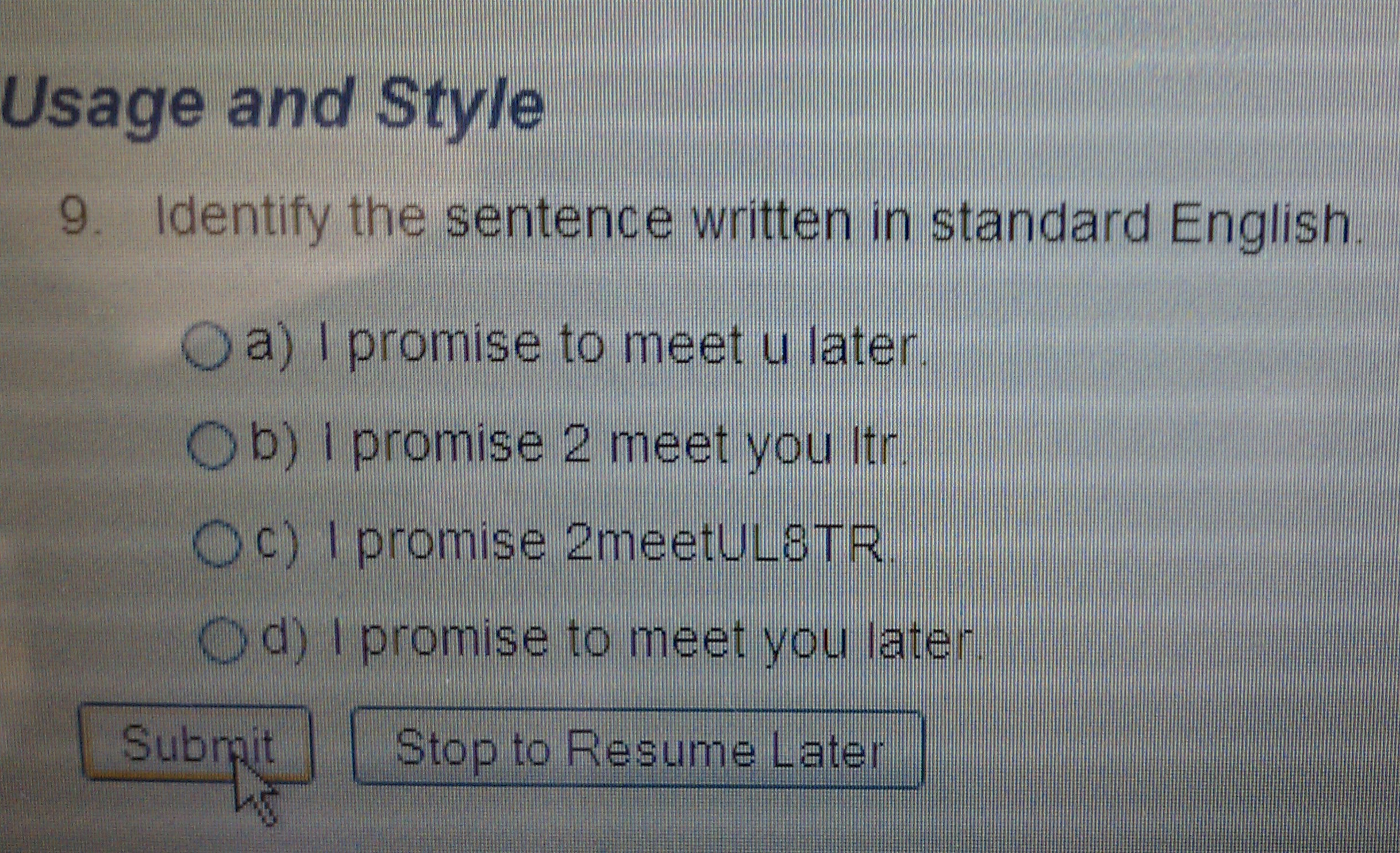
    Malia Green, taking a writing diagnostic test while enrolled in Junior College, came across the following question:


    The question was part of Pearson’s MyWritingLab, self-described as “a complete online learning program [that] provides better practice exercises to developing writers.”

    I have heard rumor that young people have been adopting shorthand tweet-type language as “standard English,” using it in communications with professors and in their academic papers.  The inclusion of this question in Pearson’s test suggests that this may, indeed, be a widespread phenomenon and that young adults may not necessarily know the difference between the English most of their parents grew up with and the English they have encountered in this brave new world.

    Despite the fact that each of the answers will make sense to anyone familiar with text-ese, the correct answer on the Pearon’s test is clearly d).  So, are the answers a) through c) actually wrong?  Who gets to decide what “standard English” is anyway?

    The whole thing reminds me of the controversies over African American Vernacular English, better known as “ebonics,” in the 1990s.  The idea that some people “talk right” and some people do not is an excellent way to justify prejudice.  Perhaps an employer largely chooses not to hire black people, not because they’re black, of course, but because they don’t “talk right.”  Is the outcome significantly different?  And who decides what “talking right” sounds like anyway? Well, the people who have the power to do so… and they typically side with themselves.

    So, is text-ese wrong?  Only according to those who are making the rules (and Pearson’s tests).  And what do you want to bet that those young people who are taught to differentiate between the kind of English they are allowed to use in texts and the kind they are allowed to use in “proper” communication are class privileged, on average?  And disproportionately white, accordingly?

    So, who decides the future of English?  And will “2″ and “u” be words in it, or not?


    Source: http://thesocietypages.org/socimages/2011/02/02/standard-english-and-social-power/

    Register

    Hey Professor

    Posted by Stan Carey on March 15, 2011 


    Stephen wrote an entertaining post recently about linguistic registers. In communication, a register generally has to do with what Macmillan Dictionary defines as “the type of language that you use in a particular situation or when communicating with a particular group of people”. (It can also refer to voice quality in phonetics, which is similar to its meaning in music theory.)

    In sociolinguistics, register is often about how formal your language is. By convention, there are situations where formality is expected. Introduced to someone for the first time, we might offer a casual “How’s it going?” or a less breezy “Hello, how do you do?” It depends on what seems appropriate. We tend to make this decision automatically if we are tuned in to cultural norms. In unfamiliar languages, it can be easy to forget the T–V distinction if we’re not used to applying it.

    Someone I know who began tutoring in university told me something that surprised me: some of her students seem to have little or no awareness of these nuances in their correspondence. They use the same colloquial expressions and tone in emails to their professors that they use in text messages to their friends. For example, they might begin semi-formal emails with the words “Hey Professor”, and see nothing untoward about this.
    In other words, they seem to lack what’s called “code switching” ability. Many people have a local dialect they replace with more standard English in certain circumstances. This is an example of code switching. Other examples are what bilingual people do when they change languages, and the way people switch between work jargon and a more everyday variety of speech.

    As I wrote in a comment on the Sociological Images blog, where the subject was raised, I would have thought switching registers would come naturally to third-level students. Evidently not, in some cases. As Stephen noted, it’s a tricky area. Language usage is closely tied to cultural notions of correctness that can be outdated or dubious, and English does seem to be becoming less formal generally. (See Baba Brinkman & Professor Elemental’s popular rap about this.) I have no time for pompous formality, but I’m not sure that “Hey” is the best default address to professors unless they have indicated its acceptability. Am I getting old?


    Source: http://www.macmillandictionaryblog.com/hey-professor

    Tuesday, March 8, 2011

    Sarkozy and the French Language

    Sarkozy admits French language a hoax after Wikileaks exposé

    President not even sure what 'Assange' actually means

    After yesterday’s Wikileaks revelations, Nicolas Sarkozy has today confirmed that the “French language” is indeed a one thousand year old hoax. The president of France revealed that what purported to be his native tongue was in fact complete gibberish, admitting the French really speak English, except in the presence of the British. This comes as Wikileaks published cables sent by French diplomats to countries such as Spain, China and Russia which were all found to be written in English.

    During a speech given in received pronunciation, the French President came clean, stating that it all started off as a joke during William the Conquerer’s invasion to make the aggressors seem a bit more exotic. “What was initially a prank snowballed and after a few years we realised we’d look silly revealing the truth, so we had to keep up the façade,” said the Premier. “In the company of any Brits we would try to make convincingly “French” sounds, a mixture of guttural grunts and rapid-fire syllables.

    But as soon as we were on our own we’d all heave a huge sigh of relief and revert to English. We developed a heavy reliance on hand gestures to cover up when we ran out of likely noises, and the shrug was a particular boon if inspiration dried up. In the end we became quite the raconteurs, with an impressive array of supposed vocabulary. So what began as a game for the élites, became a hobby across all levels of society, and it shocked us that the Brits were so naïve as to not see through the charade.”

    Sarkozy claims Wikileaks will soon expose a number of other “languages”. “I mean, seriously guys, has anyone ever actually listened to “Arabic”? Je ne sais pas…..”

    Source: http://www.newsbiscuit.com/2011/02/16/sarkozy-admits-french-language-a-hoax-after-wikileaks-expose/

    Principle of Appropriateness and Register

    Calling the register

    Posted by Stephen Bullon on March 03, 2011

    I’ve just bought a newly-published book about life in an English Grammar School in the 1940s. Long, long before my time (obviously), and not the usual sort of memoir that attracts me. But this one is slightly different, not only because the school in question is the one that I went to many years later, but because the author had by then returned as a member of staff and was my form teacher when I was in 2B. (Aged 13. They call it year 8 now.)

    Of course, when you’re 13 and some ancient pedagogue (though he was only, I now realise, 33) plasters red ink all over your best attempt at creative writing, you get the feeling that he must be an oracle and can do no wrong in matters of English grammar and style. So it’s quite an eye-opener to see an extended stretch of his prose laid out before me, and quite tempting to read it with red pen in hand.

    One of the things I remember about his English lessons was that he made great efforts to get us to understand the importance of appropriate register. This is a tricky area, and the difficulties are shared by young native speakers as well as learners of English as a foreign language. How do you express willingness or enthusiasm for example? Are you keen on something? Dead keen on it? Exceedingly enthusiastic about it? The sort of exercise he would give us would be to take a job advertisement and ask us to write two different versions of an application, one in very informal (and thus inappropriate) English, and one in formal, much more appropriate English.

    In our enthusiasm, we would usually overegg the pudding on the formal version and dream up something unbelievably pompous along the lines of:
    Dear Sir,
    With regard to your advertisement in the local newspaper of the 10th inst, I should like to avail myself of this opportunity to submit for your kind consideration my application for the post of head chef in your esteemed establishment’s kitchen. As you will see from the enclosed CV, I have long had a passion for haute cuisine and am cordon bleu trained …
    and then gleefully translate it into something even more inappropriate such as:
    Hi,
    I clocked your ad in the local rag last week and I’m well up for the gig. I’m dead keen on all kinds of grub and can knock up a mean beans on toast …
    It was certainly more fun than conjugating Latin verbs – a bothersome task that was inflicted both on the author and later on me by the same ‘Mac’ McIver.

    Source: http://www.macmillandictionaryblog.com/calling-the-register

    Monday, March 7, 2011

    OKAY!

    'OK' took over the world18 February 2011 Last updated at 10:49 GMT

    It crops up in our speech dozens of times every day, although it apparently means little. So how did the word "OK" conquer the world, asks Allan Metcalf.

    "OK" is one of the most frequently used and recognised words in the world.

    It is also one of the oddest expressions ever invented. But this oddity may in large measure account for its popularity.

    It's odd-looking. It's a word that looks and sounds like an abbreviation, an acronym.

    We generally spell it OK - the spelling okay is relatively recent, and still relatively rare - and we pronounce it not "ock" but by sounding the names of the letters O and K.

    Visually, OK pairs the completely round O with the completely straight lines of K.

    Continue reading the main story
    International OKs
    Native American Choctaw: Okeh - it is so
    Scottish: Och aye - oh yes
    Greek: Ola kala - all is right
    German: ohne Korrektur - without [need for] correction
    Finnish: Oikea - correct
    Mandinka: O ke - that's it
    So both in speech and in writing OK stands out clearly, easily distinguished from other words, and yet it uses simple sounds that are familiar to a multitude of languages.

    Almost every language has an O vowel, a K consonant, and an A vowel. So OK is a very distinctive combination of very familiar elements. And that's one reason it's so successful. OK stands apart.

    Ordinarily a word so odd, so distinctive from others, wouldn't be allowed in a language to begin with. As a general rule, a language allows new words only when they resemble familiar ones.

    Clever coinages may be laughed at and enjoyed, but hardly ever adopted by users of the language.

    So it was in Boston, Massachusetts, USA, in the late 1830s, when newspaper editors enjoyed inventing fanciful abbreviations, like "WOOOFC" for "with one of our first citizens" and OW for "all right".

    Needless to say, neither of these found a permanent place in the language. But they provided the unusual context that enabled the creation of OK.

    On 23 March 1839, OK was introduced to the world on the second page of the Boston Morning Post, in the midst of a long paragraph, as "o.k. (all correct)".


    OK may have originated from a comical misspelling How this weak joke survived at all, instead of vanishing like its counterparts, is a matter of lucky coincidence involving the American presidential election of 1840.

    One candidate was nicknamed Old Kinderhook, and there was a false tale that a previous American president couldn't spell properly and thus would approve documents with an "OK", thinking it was the abbreviation for "all correct".

    Within a decade, people began actually marking OK on documents and using OK on the telegraph to signal that all was well. So OK had found its niche, being easy to say or write and also distinctive enough to be clear.

    But there was still only restricted use of OK. The misspelled abbreviation may have implied illiteracy to some, and OK was generally avoided in anything but business contexts, or in fictional dialogue by characters deemed to be rustic or illiterate.

    Indeed, by and large American writers of fiction avoided OK altogether, even those like Mark Twain who freely used slang.

    But in the 20th Century OK moved from margin to mainstream, gradually becoming a staple of nearly everyone's conversation, no longer looked on as illiterate or slang.

    Its true origin was gradually forgotten. OK used such familiar sounds that speakers of other languages, hearing it, could rethink it as an expression or abbreviation in their own language.

    Thus it was taken into the Choctaw Native American language, whose expression "okeh" meant something like "it is so".

    "Modern English translations of the Bible remain almost entirely OK-free”

    US President Woodrow Wilson, early in the 20th Century, lent his prestige by marking okeh on documents he approved.

    And soon OK was to find its place in many languages as a reminder of a familiar word or abbreviation.

    But what makes OK so useful that we incorporate it into so many conversations?

    It's not that it was needed to "fill a gap" in any language. Before 1839, English speakers had "yes", "good", "fine", "excellent", "satisfactory", and "all right".

    What OK provided that the others did not was neutrality, a way to affirm or to express agreement without having to offer an opinion.

    Consider this dialogue: "Let's meet again this afternoon."

    Reply: "OK."

    Compare that with: "Let's meet again this afternoon."

    Reply: "Wonderful!" or "If we must."


    Martin Van Buren was a big part of OK's initial takeoff OK allows us to view a situation in simplest terms, just OK or not.

    When someone falls down, the question is not "how well are you feeling?" but the more basic "are you OK?".

    And any lingering stigma associated with OK is long since gone. Now OK is not out of place in the mouth of a US president like Barack Obama.

    Speaking to schoolchildren in 2009 he said: "That's OK. Some of the most successful people in the world are the ones who've had the most failures."

    The word would also easily slip from the mouth of a British prime minister like David Cameron.

    And yet, despite its conquest of conversations the world over, there remain vast areas of language where OK is scarcely to be found.

    You won't find OK in prepared speeches. Indeed, most formal speeches and reports are free of OK.

    Modern English translations of the Bible remain almost entirely OK-free. Many a published book has not a single instance of OK.

    But OK still rules over the vast domain of our conversation.

    Allan Metcalf is the author of OK: The Improbable Story of America's Greatest Word.

    Source: http://www.bbc.co.uk/news/magazine-12503686

    Sunday, March 6, 2011

    English as a Global Language

    Sarkozy admits French language a hoax after Wikileaks exposé

    President not even sure what 'Assange' actually means

    After yesterday’s Wikileaks revelations, Nicolas Sarkozy has today confirmed that the “French language” is indeed a one thousand year old hoax. The president of France revealed that what purported to be his native tongue was in fact complete gibberish, admitting the French really speak English, except in the presence of the British. This comes as Wikileaks published cables sent by French diplomats to countries such as Spain, China and Russia which were all found to be written in English.

    During a speech given in received pronunciation, the French President came clean, stating that it all started off as a joke during William the Conquerer’s invasion to make the aggressors seem a bit more exotic. “What was initially a prank snowballed and after a few years we realised we’d look silly revealing the truth, so we had to keep up the façade,” said the Premier. “In the company of any Brits we would try to make convincingly “French” sounds, a mixture of guttural grunts and rapid-fire syllables.

    But as soon as we were on our own we’d all heave a huge sigh of relief and revert to English. We developed a heavy reliance on hand gestures to cover up when we ran out of likely noises, and the shrug was a particular boon if inspiration dried up. In the end we became quite the raconteurs, with an impressive array of supposed vocabulary. So what began as a game for the élites, became a hobby across all levels of society, and it shocked us that the Brits were so naïve as to not see through the charade.”

    Sarkozy claims Wikileaks will soon expose a number of other “languages”. “I mean, seriously guys, has anyone ever actually listened to “Arabic”? Je ne sais pas…..”

    [posted 16 Feb 2011]

    http://www.newsbiscuit.com/2011/02/16/sarkozy-admits-french-language-a-hoax-after-wikileaks-expose/