Showing posts with label Marketing. Show all posts

Sunday, October 2, 2011

Language influences thought - The Economist - Lane Greene

Lane Greene of The Economist Johnson Blog, provides a mini lecture into how language influences thought.

He shows some psychological experiments to do with language that are worth a look.

Around halfway, he also challenges the notion that "Gen Y" is degrading the English Language, that in fact Jonathan Swift in 1712 said the same thing, that the English language is beyond repair and there should be an "Academie Anglaise". haha.

Friday, September 30, 2011

Opinions to FCUK sign

Hot Topic: Clever or offensive?
FCUK
Robert Doyle wants the FCUK sign removed. Picture: Jay Town Source: Herald Sun

Melbourne Lord Mayor Robert Doyle's call for a giant FCUK billboard to be pulled down has drawn mixed reactions from readers.

I WHOLEHEARTEDLY agree with Robert Doyle ("Tear it down now", SHS, September 4). The company chose the name because it knew it would get added mileage out of every reference and it is placed where it is on purpose. Tear it down.
Neville W., via web

-----
Not about sex
THE sign has been in the same spot for almost 10 years. Why all of a sudden is this sign a huge problem?
This sign has nothing to do with sexualisation.
The local council doesn't have a leg to stand on when it comes to forcing the company to remove the sign.
Ricky Bobby, via web

------

Ad exposure
SERIOUSLY, it is not offensive unless you are narrow-minded.
I know what FCUK stands for as a brand and I am not offended at all.
I am actually more offended by the thoughtless action of our Mayor over his comments about the Albert Park GP.

Lift your mind out of the gutter. I have never considered it is the transportation of two letters.
It is a legitimate brand and this editorial and the article by the Mayor have been perhaps the most valuable advertising exposure the brand could have had.
Michael Fitzpatrick, via web

-----
Go get dressed
WHAT is going on in this world? This is a world-renowned fashion brand.
It has a right to advertise as does every other organisation.
You could move into reality and visit an FCUK store and buy yourself some decent clothes.
Adam, Brunswick

-----
A little late
ROBERT Doyle must be feeling insecure about something in his political position if he has only now decided to make a song and dance about this sign.
The sign has been in situ for five to six years or more and he only now shows offence/concern about its placement. I'm sorry, but it's a little late to be shouting from the rooftops about this.
The fact that you have waited this long shows how little true concern you have, Robert.
But then again they say there is no such thing as bad publicity, don't they?
Shane Brightman, via email

-----
Name offends
EXCUSE me, the issue is not the billboard. This is only a consequence.
The brand name is offensive.
If this had been rejected at the point of registration there would be no billboard.
Kevin McCann, via email

-----
Focus on good
YES, Melbourne City Council, deal with the transport issues, provide parking, work more efficiently.
But yes, people of Victoria, speak up against the cheapening of our culture and of personal standards.
We all experience our own tendencies toward depravity. The shame is when we give up and focus on the gutter, rather than the good.
Ken, via web

-----
All over Europe
I CANNOT believe that you want taxpayers' money to bring down a brand name that is everywhere in Europe.
After being away from Australia for 10 years, this is the sort of cringeworthy news that you feel is so important. Oh, and when you finish pulling down signs that offend, you should you start banning books such as Go the F--- to Sleep.
There must be something more important to write about than some silly sign.
By the way FCUK makes T-shirts too. Do you want to ban them?
Frank Jagger, via email

-----
Heard at school
ANY publicity is good publicity. Why worry about one word that is probably heard in every school playground?
FCUK is only obscene if you are small-minded.
Worry more about the violence shown on TV or the movies than one word that is in general use.
If you are old enough to remember the 1960s the word "bloody" had to be bleeped out on radio when they played Snoopy and The Red Baron. Times change.
R. Thomas Heathmont, via email

-----
Let kids be kids
IT does not even take a stretch of the imagination for an eight-year-old to see what FCUK is actually intended to convey.
It is just as offensive as the "Do you want sex to last longer?" signs and radio advertisements that are in highly conspicuous places and on the radio at prime school transport times.
How do we shield our children from such things when they are in your face in this manner? I want my kids to be kids for as long as possible.
Michelle, via email

-----
Keep it clean
VOTE "yes" to pull it down.
Isn't it odd and perplexing that we all expect to see and hear the good in each other, yet willingly abuse accepted societal norms under the guise of preserving so-called "freedoms"?
Exercising the freedoms won for us by previous generations carries with it some, as I see it, obvious responsibilities, but sadly everyone seems to take the path of least resistance.
Thus we have giant FCUK signs, with no consideration for all those decent-minded people trying to raise children who don't swear.
Rod, via email

-----

Silly Lord Muck
I USED to be a fan of Robert Doyle and thought he was doing a good job as Lord Mayor but honestly, FCUK (French Connection UK) has been around for longer than 15 years now as a fashion label.
Is this the first time he has noticed it?
Dean McNeil, Melbourne

-----
Just bad taste
PLEASE add my support to have this offensive sign pulled down ASAP.
It isn't clever, just very bad taste.
Pauline Cullen, via email

Source: http://www.heraldsun.com.au/ipad/hot-topic-clever-or-offensive/story-fn6bn88w-1226133813405

The Age response to FCUK sign

Signs of the times

Karl Quinn
September 21, 2011

The French Connection UK billboard visible from the Tullamarine Freeway. Photo: John Woudstra

WHEN Robert Doyle recently denounced the massive FCUK billboard on the side of a warehouse building in North Melbourne as ''an insulting and gratuitous blot on our urban landscape'', he was articulating a view shared by many Melburnians. And when, a few days later, it was reported that the sign was to be replaced by a less ''offensive'' one - the clothing company's acronym giving way to its fuller name, French Connection UK - it appeared the lord mayor had struck a victory for righteousness.

It was quite a result given that he had (correctly) claimed in the Sunday Herald Sun on September 4 that his council had ''no control over the content of the sign - or indeed of any sign''.

Sources have revealed to The Age that French Connection was in fact already well into discussions with the City of Melbourne about changing the sign when the lord mayor penned his opinion piece. It appears his exhortation to ''pull down this sign'' was made safe in the knowledge that it was already going to happen.

And yet there's no denying Doyle was on to something when he expressed his distaste for the oversized double entendre that greets Melburnians at the northern entrance to the Bolte Bridge, and it taps into something far broader than just that one sign. The fact is, Australians are being subjected to more outdoor advertising than ever before - and some of it we just don't like.

A 2007 AC Nielsen survey conducted on behalf of the Outdoor Media Association found 13 per cent of Australians have a negative view of outdoor advertising, which includes billboards, hoardings and ads on buses, trams and public transport shelters, among other things . (Forty-nine per cent were ''supportive'' of the medium and 38 per cent were neutral.)

Since that survey was conducted the industry has grown substantially. Between 2002 and 2008, the sector grew ''by a massive 74 per cent'', according to the OMA.

In 2010, revenues rebounded from the dark days of the global financial crisis to a record $477 million, up 19 per cent on the previous year. In other words, outdoor advertising in Australia is booming. But compared with other forms of advertising, so too are the complaints.

Outdoor advertising represents about 4 per cent of the total advertising market, yet in 2010 four of the 10 most-complained-about ads were on billboards. Only three of those 10 cases were upheld - that is, decided against the advertiser - and two of them were billboard ads.

The Advertising Standards Bureau, the complaints-handling arm of the self-regulating advertising industry, investigates about 500 cases a year across all forms of advertising. About 50 of these cases, or 10 per cent, are upheld. But of the 10 billboards that were most complained about between January 2010 and July 2011, five were upheld. That's a 50 per cent strike rate - five times the overall average.

If there's something special about the billboard as a medium that makes it more likely to offend, it's the fact you can't turn it off - and you can't decide who sees it. In the words of the Senate review of the National Classification Scheme, whose report was tabled in June: ''Lack of choice about whether a person is exposed to outdoor advertising distinguishes this form of advertising from other mediums.''

The Senate's legal and constitutional affairs references committee noted there had been calls for a blanket G rating to be applied to all outdoor advertising ''on the basis that it is visible to a general audience'' and recommended that ''to the extent possible, the National Classification Scheme should apply equally to all content, regardless of the medium of delivery''.

That would be a disaster, insists Fiona Jolly, chief executive of the Advertising Standards Bureau. ''I would never advocate for a regulatory system when self-regulation works so well,'' says Jolly, who has previously advised the Attorney-General's Department on censorship matters.

If all ads were to be classified, they would first need to be seen, and that would be a highly costly exercise. According to the industry's peak body, the Australian Association of National Advertisers, more than 30,000 ads were produced for the outdoor market in 2010. ''It would not give any better community outcomes that would justify the use of taxpayers' money,'' says Jolly.

She cites the low level of complaints - the most-complained-about ad of 2010 attracted just 220 submissions to the ASB - as proof that the advertising industry understands the sensitivities of the wider community.

But critics of the system insist the rate of complaints is a poor measure of what the community really thinks. A Victorian government report into the portrayal of women in outdoor advertising in 2002 cited research that found the rate of conversion from someone being offended to someone actually making a complaint was incredibly low.

''Of the female respondents who had seen something inappropriate in outdoor advertising (37 per cent), almost two in every three (62 per cent) had thought about complaining, but only 4 per cent of those who thought about complaining did so,'' the report said.

Even the regulator concedes there's no way of knowing what the real rate of offence is. ''We tried and in the end came to the view that one complaint is the tip of the iceberg really, but how big or deep that iceberg is you can't tell,'' says Jolly.

The failings of self-regulation are not just numerical, says Melinda Tankard Reist, a writer and founder of the lobby group Collective Shout, which campaigns against the objectification of women and the sexualisation of children in advertising and the media.

''The self-regulatory system simply means advertisers and marketers can get away with anything,'' she says. Her particular concern is with the proliferation of images of women and teenage girls in highly sexualised or suggestive poses, and the fact that such images are on view for everyone, including young children, at all times.

''If a man were to put up images of naked or semi-naked women in the workplace, that's considered sexual harassment, but if they're up on a billboard or the side of a bus, somehow that's considered OK. It's a double standard and you wouldn't get away with it anywhere else,'' Tankard Reist says.

Collective Shout operates from a leftist-feminist position, but finds itself in the same camp as certain Christian groups and the family lobby in calling for tighter regulation of the industry.

But regardless of where these groups are coming from, the industry view is that they are misguided. ''When we're talking about exposure for children I think billboards are the least of our worries,'' Todd Sampson, chief executive of advertising agency Leo Burnett said on The Gruen Transfer on September 8.

''We're better off trying to world-proof our children rather than childproof the world, because it's just not going to happen.''

The regulation stick was, however, wielded in the Reclaiming Public Space report tabled in the House of Representatives in July.

In the introduction to this report, the chairman, Labor's Graham Perrett, attacked what he identified as the advertising industry's lack of responsiveness to community concerns. ''If the industry does not demonstrate over the next few years that self-regulation can appropriately operate within the bounds of community expectations for appropriate outdoor advertising, then the committee strongly recommends that the Australian government institute regulatory measures.

''This report has listened to the Australian community and, on behalf of the Australian community, it says enough is enough. It is time to reclaim our public spaces.''

But despite the tough talk, the report ultimately opted to maintain the self-regulatory regime, albeit with a threat to move to regulation if the industry is unable to demonstrate by June 2013 that it has lifted its game.

As chief executive of the Outdoor Media Association, Charmaine Moldrich says she has already begun to act on some of the issues raised in the report. The OMA is running education sessions on community standards for its members (who control the billboard spaces, but not their content), and advisory and content review services have been in place since August.

But Moldrich insists this isn't a case of the industry being forced to act. ''I think it would have happened without the reviews because we'd been talking about it at boardroom level for a while. It's about a mode of doing business that makes your industry look good out there in the community. I don't think we were driven by the stick of regulation so much as the carrot of success.''

She insists the media focuses disproportionately on the rare negatives in outdoor media rather than positives, for example the OMA's funding of public infrastructure such as bus shelters and rubbish bins, and its donation of $15 million a year of ad space to public service and charitable campaigns.
''What we're really talking about here is how powerful billboards are,'' she says.

''They're on 24/7. It's the largest broadcasting medium as the media fragments. The fact you can't turn it on or off is a strength, and in a very small amount of cases it's a weakness; but most of the stuff that's sold on the medium is completely benign. It's the stuff that makes up a capitalist society. It's advertising, and if you find it offensive, I'm not sure where you want to live.''

The OMA insists the numbers prove that most of the time, the industry is spot on in its interpretation of community standards. In 2010, just 66 billboard ads attracted complaints. Of those, only seven were upheld. ''In other words, 99.98 per cent of outdoor advertisements in 2010 were in accordance with prevailing community standards,'' the OMA said recently.

What's more, Moldrich adds, some of those complaints were very narrowly focused. ''There were vegetarians who complained about a lamb ad … people who complained about the anti-smoking ads because their children were horrified because mummy once smoked. Some got hundreds of complaints, some only got one, but the moment you complain you set off the system.''

The billboard that triggers the most popular outrage is the Australian Medical Institute's Longer Lasting Sex ad. The funny thing is, it was banned by the ASB in 2008 (that it lingers so clearly in the memory attests to its power as a longer-lasting source of irritation).

Another frequently invoked ad, for Windsor Smith shoes, was last seen in 2000 (at which time the company declared the outrage it had provoked was ''the best branding exercise we could have ever asked for'', and valued the coverage at $4 million).

The ASB's Fiona Jolly and the OMA's Charmaine Moldrich are adamant that the fact that such old cases are always dragged up proves just how much the industry has moved on.

And to Moldrich, the fact that another Australian Medical Institute ad - ''Be a man and … hold your load'' - was among 2010's most complained about billboards (it was upheld) in no way undermines that argument. ''Ultimately, people in a democracy know they can complain to someone,'' she says. ''That's why you have vocal minorities getting so much airplay at the moment, whether it's about the carbon tax or lamb ads.

''I don't have a problem with that. We live in a democracy, that's how it works and there are good things about it and bad things about it. But it's a system that's working.''

Karl Quinn is entertainment editor.


Source: http://www.theage.com.au/victoria/signs-of-the-times-20110920-1kjca.html#ixzz1ZRLsugof

Opinion: FCUK sign

Neither clever nor funny, it's just offensive
ROBERT Doyle is right. The FCUK sign that besmirches our cityscape should be torn down.

As the Lord Mayor says in his column on Page 3 of today's Sunday Herald Sun, the giant billboard is neither clever nor funny. It is just offensive.

That it shouts from the wall of a warehouse facing one of the city's busiest thoroughfares makes the 45m long and 15m high sign even more offensive.

As Cr Doyle writes: "It is an insulting and gratuitous blot on our urban landscape."

It's a fair bet a reasonable person - particularly parents who drive past the sign with their kids in the back seat - would agree with the Lord Mayor.

And they should not be dismissed as wowsers. A major concern for parents is the increasing sexualisation of our children. Television is laden with inappropriate imagery bombarding our young.

And this sign does exactly that. Children should not be exposed while looking out of the window of a car to what is effectively nothing more than an anagram of a swear word.

In such a highly sexualised culture as ours, it's hard enough for parents to shield children from inappropriate influences. This sign makes their job even harder.

We urge Cr Doyle to bring on a legal fight and pull the sign down. Force the FCUK owners to front the Victorian Civil and Administrative Tribunal and tell parents why their offensive sign should stay.

Maybe then, when brought to account, they'll see reason.


Source: http://www.heraldsun.com.au/opinion/editorials/neither-clever-nor-funny-its-just-offensive/story-e6frfhqo-1226128846593

FCUK sign Melbourne, "take it down"

Tear down 'offensive' FCUK sign says Robert Doyle

Melbourne Lord Mayor Robert Doyle

  • From: Sunday Herald Sun


  • September 04, 2011 12:00AM


  • Robert Doyle
    Melbourne Lord Mayor Robert Doyle wants the FCUK sign removed. Picture: Jay Town Source: Herald Sun

    IT'S always a pleasure returning to the world's most liveable city. But on Friday - after a quick trip to Canberra - as I drove towards the Bolte Bridge, there it was. As big and offensive as ever.

    It is on the left: 45m long and 15m high.

    FCUK.

    Honestly.

    Do the advertisers think this is clever? That the transposition of two letters somehow makes this a sophisticated word play rather than a cheap obscenity?

    It is not clever. It is not funny. It is an insulting and gratuitous blot on our urban landscape.

    When this sign was first brought to my attention, we did some investigation at the City of Melbourne. It appears it migrated to us from the City of Moonee Valley when a local government boundary changed in 2008.

    Moonee Valley Council gave the sign a planning permit in October 2002.

    We couldn't find any documentation. When we inquired further, we found that the Moonee Valley permit was valid only until 2006. We immediately asked that the sign be taken down.
    A lawyer acting on FCUK's behalf advised the City of Melbourne that his client had engaged planning consultants to apply for a permit extension.

    Changes to State Government regulations back in 2001 mean that FCUK can now apply to extend its original permit until October 2022.

    We got outflanked by astute lawyers. The moment they applied for an extension of the "existing" permit, they were protected and the sign can remain, even though it has not had a valid permit since 2006.

    The thing that makes me most angry, though, is we have no control over the content of the sign - or indeed any sign. Content is not regulated by our planning system. It is governed by the Advertising Standards Board.

    The many surveys by the Advertising Standards Board into its own activities consistently find that the board's decisions about what is appropriate are far more permissive than community standards.

    So what can we do about FCUK? We could try refusing a permit extension for the billboard. But that can only be on planning grounds under the planning scheme, because it is a "major promotional sign".

    It seems inexplicable, but apparently those 2001 changes to state planning law mean the company can claim a valid permit (even though it expired in 2006) and apply for an extension for 10 more years.
    We can refuse the extension and wind up in VCAT, where we will probably lose.

    Because of slippery law, changes to guidelines, previous City of Moonee Valley oversight and a continuation of self-regulation, I wonder if there is anything we can do about the content of the sign, which remains offensive and inappropriate.

    It is designed to titillate and embolden the 11-year-old boy who looks up the anagram of this word in the dictionary as an amusing pastime.

    My feeling is that we should try to refuse the permit.

    Or maybe we can be clever: allow a permit for the sign, but make it the size of a postage stamp.

    But in the end, perhaps our best recourse is people power.

    To paraphrase Ronald Reagan in 1987: "Pull down this sign."


    Source: http://www.heraldsun.com.au/news/more-news/tear-down-offensive-fcuk-sign-says-robert-doyle/story-fn7x8me2-1226128850796

    Monday, September 19, 2011

    Overused Business Gobbledygook words LinkedIn

    LinkedIn Reveals the 10 Most Overused Job-Hunter Buzzwords
    LinkedIn has just posted the 10 most overused, tired and trite buzzwords that get slapped onto resumes and professional profiles around the U.S. and 11 other countries.
    According to our LinkedIn profiles, a great many of us tend to describe ourselves as motivated team players with extensive experience.

    Ironically, “innovative” is the second-most clichéd word found in LinkedIn profiles. You’d think we’d be able to be more innovative with our vocabularies, no?

    Sadly, those of you who took a more creative approach to describing yourselves have been penalized in the past as well. All the LinkedIn “ninjas” got called out earlier this year along with “evangelists” and “gurus” for using these rising menaces of career-oriented buzzwords.

    Still, the most common words in LinkedIn profiles are less flashy and more conservative. We’re calling ourselves “motivated,” “results-oriented” and “problem solvers.” And this isn’t just in the U.S.; words like “motivated” and “dynamic” popped up as the most overused terms from Brazil to India.


    Compelling descriptions, headlines and keywords are some of the most important aspects for job hunters to consider when creating and editing their LinkedIn profiles, and it’s one of the easiest aspects, too — much easier than getting a slew of recommendations or spending quality time on the site’s Q&A section.
    In the comments, we’d love to get your tips and suggestions for finding and using better self-descriptors on LinkedIn, resumes and other professional networks. What unique terms do you use to describe yourself professionally?

    Source: http://mashable.com/2010/12/14/linkedin-resume-buzzwords/

    Wednesday, April 27, 2011

    Branding and strange phonetics...

    Need a lawyer? Try...

    Apr 26th 2011, 21:50 by R.L.G. | NEW YORK

    IMAGINE you are trying to think of a name for a legal-services auction site. (A client needs a simple will; he describes it on the site, and lawyers bid on the job.)  What did you come up with? 
    All right, now think of another. Then another.  Do this one billion times.

    Was any of the billion names you came up with ShpoonkleI'll bet it wasn't. But it was someone's name for exactly such a company. Today's deadline day so no time for more commentary here; just read Nancy Friedman, a branding and company-naming expert, on why your first billion tries did not produce Shpoonkle.
    Addendum: Deadline having passed, I realised on my trip home why you probably didn't come up with "Shpoonkle": it's forbidden by English phonotactics (basically what sounds can be strung together in a native English word.  "gork" is nonsense, but obeys English phonotactic rules; "gkor" is nonsense and violates the rules.)  The sh- sound plus another consonant like p* can't begin a native English word: we have shmuck, shmutz, schmaltz, shmendrick, Sturm und Drang and so on. But they're all German or Yiddish, which is why Big Legal Brain mockingly called Shpoonkle "the new Yiddish-language lawyer bidding and matching service". It's one thing to come up with a name that violates English orthographic rules, I suppose. Flickr and PwC and Yahoo! have all in their way done their worst, and haven't suffered too much for it, because their names remain naturally pronounceable. It's another thing to violate English's rules of pronunciation; I have tried and failed to think of a company that has done so successfully with their brand name in English. If anyone can think of one, let us know in the comments. Otherwise, I leave you with the words of Robert Niznik, Shpoonkle's founder:
    Some people don’t like change, others don’t like what they don’t understand or better yet don’t want to understand... Well, get ready, Shpoonkle is here and we are ready for the mainstream.  Kleenex, Blog, Xerox, and yes even Internet were silly names people mocked and thought were ridiculous too. Now these words are part of our every day language.
    Shpoonkle: could it be the next internet?

    * I originally wrote that sh + consonant is forbidden, but Ben Zimmer notes that of course shr- is allowed, as in "shrimp" and "shriek". r is unusual in being a "liquid" consonant, often barely noticeable in itself and only seen in its colouring of a neighboring vowel.

    Source: http://www.economist.com/blogs/johnson/2011/04/branding

    Thursday, March 31, 2011

    Gender based language stereotypes

    Word Cloud: How Toy Ad Vocabulary Reinforces Gender Stereotypes

    by admin on March 28th, 2011

    I’ve always wanted to do a “mash-up” of the words used in commercials for so-called boys’ toys. I did a little bit of this in my book, but now, thanks to Wordle, I can present my findings in graphic form. This is not an exhaustive record; it’s really just a starting point, but the results certainly are interesting.

    A few caveats:


    I focused on television commercials alone (not web videos or website toy descriptions).

    The companies represented here are the big ones who can afford TV advertising. I looked most closely at the kinds of toys I have seen advertised during prime cartoon blocks on TV. (For example, Teletoon in Canada runs an Action Force block of shows in the after-school time slot and a Superfan Friday on Friday evenings.)

    I included toys targeted to boys aged 6 to 8.

    If a word was repeated multiple times in one commercial, I included it multiple times to show how heavily these words are used.

    I hyphenated words that were meant to stay together, like “special forces” and “killer boots.”

    For the record, my boys’ list included 658 words from 27 commercials from the following toy lines: Hot Wheels, Matchbox, Kung Zhu, Nerf, Transformers, Beyblades, and Bakugan.

    By way of comparison, I also looked at girls’ toys. The girls’ list had 432 words from 32 commercials. Toy lines on this list include: Zhu Zhu Pets, Zhu Zhu Babies, Bratz Dolls, Barbie, Moxie Girls, Easy Bake Ovens, Monster High Dolls, My Little Pony, Littlest Pet Shop, Polly Pocket, and FURREAL Friends. (I have a full list of references for both list, with links, if anyone would like to see it.)


    The results, while not at all surprising, put the gender bias in toy advertising in stark relief. First, the boys’ list, available in full size at Wordle:


    Now the girls’ list, also available in full size at Wordle:


    Source: http://www.achilleseffect.com/2011/03/word-cloud-how-toy-ad-vocabulary-reinforces-gender-stereotypes/

    Saturday, March 12, 2011

    Damn you Mr. Marketing

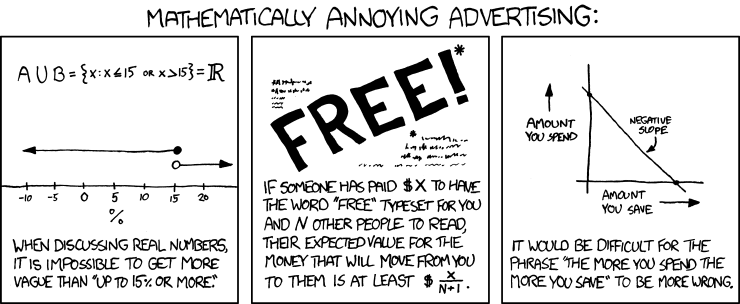
    Adspeak
    The most recent xkcd:


    (As usual, click on the image for a larger version.)


    I'm not sure that Randall is right about the first panel. It's true that "up to X or more", for some number X, seems by simple compositional semantics to cover the entire number line. But if a store were to raise its prices by 10% across the board, I believe that all rational people would regard the statement "You will save up to 15% or more on your purchases" as false, despite the fact that -10 is on the real line (and on Randall's representation of it).

    And lawyers also use "false" differently from logicians, I think. Thus NY Code - Section 350-A says that

    The term "false advertising" means advertising, including labeling, of a commodity, or of the kind, character, terms or conditions of any employment opportunity if such advertising is misleading in a material respect. In determining whether any advertising is misleading, there shall be taken into account (among other things) not only representations made by statement, word, design, device, sound or any combination thereof, but also the extent to which the advertising fails to reveal facts material in the light of such representations with respect to the commodity or employment to which the advertising relates under the conditions prescribed in said advertisement, or under such conditions as are customary or usual.

    In this case, then, the law and ordinary language might be in reasonable alignment.

    I say "might" because phrases of the form "up to * or more" are very common in advertising. And I know from experience that the named percentage or amount is often associated with a small number of options in weird sizes and styles, but I've never heard of a regulatory complaint about such ads.

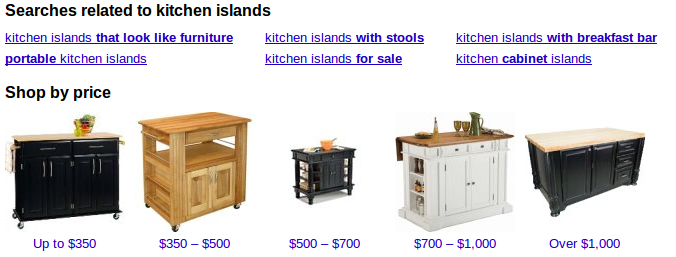
    Analogous phrases occasionally occur in journalistic writing, e.g. this Consumer Reports article on kitchen remodeling:

    Whether it's a permanent unit with furniture-style looks or a small portable one on casters, an island adds work and storage space. The style should complement your cabinets, but it needn't match exactly. A wood island can add warmth to a white kitchen, and a painted finish can inject color into an all-wood one. Be sure that there is at least a 42-inch clearance around the island to ensure easy access and smooth traffic flow. Prices start around $150 and go up to $1,000 or more.

    In such cases — and perhaps in the more honest ads as well — something really is being communicated, namely an approximate statement about a distribution.  I conclude from the last sentence of that Consumer Reports paragraph that if I shop for kitchen islands, I should expect to find plenty of options in the range from $150 to $1,000, with a perhaps-long tail of higher-priced offerings.  And indeed, this is exactly what I find:


    Source: http://languagelog.ldc.upenn.edu/nll/?p=3020

    Friday, February 18, 2011

    English in India

    India Faces a Linguistic Truth: English Spoken Here
    NEW DELHI — In a recent Hindi film, the actress Katrina Kaif holds a thin white bed sheet against her bare body and sings, in English: “I know you want it, but you’re never gonna get it.”
    That what has become one of the country’s popular Hindi songs opens with an English sentence is unremarkable for Indians. So is the truth that Hindi films are now written in English — the instructions in the screenplays are in English, and even the Hindi dialogue is transcribed in the Latin alphabet. Mumbai’s film stars, like most educated Indians, find it easier to read Hindi if it is written this way.

    Almost all advertising billboards in India are in English. There is not a single well-paying job in the country that does not require a good understanding of the language. Higher education here is conducted entirely in English. When Hindustan Pencils makes cheap pencils, which its sells to rural children for a rupee apiece (about 2 cents), the company prints the brand name, “Jobber,” in English. “A villager has more respect for a brand that is written in English,” said Dhruman Sanghvi, a company director.

    English is the de facto national language of India. It is a bitter truth.

    Many Indians would say that India’s national language is Hindi. They would say it with pride if they are from the north and with a good-natured grouse if they are from the south. But this is a misconception. The fact is that, according to the Indian Constitution, the country does not have a national language.

    In the years that followed the nation’s independence from the British in 1947, there were efforts to hoist Hindi as the national language, but regional linguistic sentiments were high. In the southern state of Tamil Nadu, men immolated themselves to protest what they thought was the colonizing power of Hindi. As a compromise, Hindi was downgraded to one of the two official languages in which the government would conduct its business.

    The other official language was English, which has long been considered a default language, a foreign language. But this is no longer true. Since independence, the influence and reach of English have grown immensely. It is impossible to arrive at a credible figure for the number of Indians who understand English (a lot), who can read it (many) or who can write it (very few). But what is indisputable is that in India today, English has the force and quality of a national language.

    Alarmed at the power of English, India’s cultural elite and politicians have tried, through public policy and sometimes violence, to promote Indian languages. In Mumbai, for instance, every shop is required to announce its name in Marathi even though most of the people in the city can read English but not Marathi. In the recent past, thugs have beaten up shopkeepers who did not comply with the requirement.

    Accepting that English is the national language would have benefits that far outweigh soothing the emotions of Indian nationalism. It is to emphasize this point that Chandra Bhan Prasad has built a temple to the Goddess English in an impoverished village in the northern state of Uttar Pradesh.

    People like Mr. Prasad, who want to liberate the poorest segment of the population, the Dalits, through the extraordinary power of English, view Indian culture and all related sentiments with suspicion. It was that same culture that had once deemed the Dalits “untouchable,” relegating them to the lowest of the low in the caste hierarchy.

    In Mr. Prasad’s temple, there is an idol in robes, wearing a wide-brimmed hat. Very soon, Mr. Prasad said, he would encourage young Dalit couples to include a ritual in their wedding ceremony in which they would sign the letters A, B, C and D on a piece of a paper. “That would be a promise they make that they will teach their children English,” he said.

    He also plans to adopt an Islamic tradition and fix a loudspeaker in the temple from which a recorded voice would chant the English alphabet, from A to Z , every day at 5 a.m. All these are just symbolic gestures, he said, and the best he can do in the absence of genuine political support for making English the national language.

    The chief beneficiaries if English attained this status would be the children who attend the free schools run by the central and the state governments. An overwhelming majority of such schools are not taught in English. Indian politicians, whose own children attend private English-language schools in India and abroad, want their constituents to marinate in their mother tongues.

    Sanjay Tiwari, the son of an illiterate security guard, was a victim of this attitude.

    Until the age of 16, he studied in Hindi and Marathi-language schools. Then, he taught himself English, “and escaped.” He is now a marketing executive who makes a reasonable living in Mumbai, “only because I can speak in English.”

    Low-income Christians, who have easy access to English-language schools run by churches and convents because they are granted tuition-waivers and discounts, have benefited immensely over the years. It is not surprising that Christians are disproportionately represented in Bangalore’s call centers.

    Raj Thackeray, a pugnacious politician in Mumbai, is enraged by the diminished status of Marathi and the predominance of English in the city. His supporters have been known to beat up people who they believed disrespected the Marathi language. He wants everybody in Mumbai to learn Marathi.

    Mr. Thackeray derives his political clout from other Maratha men like himself who hope to push Marathi as the most important aspect of life in their state.

    When asked why his own son goes to one of the best English-language schools in Mumbai and not to a Marathi-language school, he replied that the question was not important and was politically motivated.
    His followers would no doubt follow his example if they could. For all their laments about the siege of the Marathi language, they would probably put their children in English-language schools, too, the moment they could afford to do so.

    Source:

    Monday, February 7, 2011

    Buzzwords in Marketing

    HAS 'SOCIAL MEDIA' GONE STALE?

    The Creative Group Survey Reveals the Most Overused Catchphrases Among Advertising and Marketing Professionals

    MENLO PARK, Calif., Jan. 13, 2011 /PRNewswire

    "Social media" isn't just a trend taking the world by storm; it's also the term advertising and marketing executives ranked as the most annoying industry buzzword in a survey by The Creative Group. Also high on the list: "synergy" and "ROI," which rankled respondents in a similar survey conducted in 2006.

    The national study was developed by The Creative Group, a specialized staffing service providing creative, advertising, marketing and web professionals on a project and full-time basis, and conducted by an independent research firm.

    Advertising and marketing executives were asked, "In your opinion, what is the most annoying or overused buzzword in the creative/marketing industry today?" The top-ranked responses include:
    1. "Social media/social networking"
    2. "Synergy"
    3. "Free"
    4. "Innovative/innovation"
    5. "ROI/return on investment"
    6. "Extra value/value added"
    7. "Model(s)"
    8. "Telemarketing"
    9. "Social media expert"
    10. "Resolve"
    11. "Moving forward"
    12. "Branding"
    13. "Multitasking"
    14. "Going green"
    15. "Proactive"
    16. "Think out of the box"
    17. "Culture change"
    18. "End of the day"
    19. "Interactive"
    20. "24/7"
    21. "Integrated/integration"
    22. "Viral"
    23. "The big idea"
    24. "Leverage"
    25. "Unique"
    "Certain terminology has become firmly ingrained in the way advertising and marketing professionals think and speak, and often helps colleagues communicate ideas more quickly," said Donna Farrugia, executive director of The Creative Group. "But when professionals need to grab attention or have an important message to deliver, excessive use of buzzwords can cause people to lose interest and tune out."
    The Creative Group offers four tips for eliminating jargon in your communications:

    1. Translate your thoughts. It's typical to think in the lingo you use every day. But when putting your ideas to paper or in an e-mail, take the time to explain the concepts in terms that your audience will easily understand.
     
    2. Edit, edit, edit. Many buzzwords are unnecessary. Think carefully: Does a phrase like "at the end of the day" really add to what you're trying to say? Probably not.
    3. Break bad habits. We all rely on certain phrases when we speak. If the ones you gravitate toward are on the list of annoying buzzwords, think of alternatives that convey the same meaning.
    4. Show instead of tell. Rather than relying on buzzwords, use concrete examples to convey your thoughts. For instance, instead of discussing your fully "integrated" marketing strategy for a product rollout, describe the various elements and how they work together.