Monday, February 14, 2011

Impugnity/Impunity + Diffuse/Defuse

Bomb-diffusing and detention with impugnity

Sometimes it's hard to distinguish a spelling mistake from an eggcorn.  Either way, I've always been impressed by the possibilities for analytic creativity afforded by the English orthographic system. And somehow these little morpho-analogical poems are more impressive when they appears in serious publications.


Reader RA recently sent in this example from Peter Allen, "France evacuates 6,000 Parisians after unexploded World War Two bomb discovered", The Telegraph, 2/6/2011:

Military experts worked from around 8am to noon to diffuse it, with the all clear being given early in the afternoon. […]

A spokesman for the mayor's office in Boulogne said: "The bomb was originally found by builders carrying out work in late January, but experts have only been able to start diffusing it today. The area is now completely safe."

In addition to these two instances in the body of the article, the photo caption at the head of the article also uses "diffuse", so this was not a simple slip of the fingers.


Arnold Zwicky entered defuse/diffuse into the Eggcorn Database back in 2004, with the comment that

This eggcorn involves a metaphor shift: the problem or situation at hand likened a noxious substance that can be rendered harmless by scattering it about and thereby diluting it, instead of to a bomb that must be defused.

As of 2004/12/23, Google finds 18,400 hits for [_”diffuse the situation”_] This shows that the eggcorn is entering the mainstream, probably because the underlying analogy appears compelling to many.

The Telegraph's example is not metaphorical, but instead deals with literally defusing an actual bomb. So the metaphorical shift must have entered the mainstream so thoroughly that the result of the re-analysis (or at least its spelling) has diffused back to the original word.

I wonder whether Peter Allen and his editors think that defuse is spelled "diffuse" — which would hardly be the weirdest thing about English spelling — or whether they think that there's a figurative sense of diffuse that means to render a bomb harmless. Either way, it's impressive to see bomb-diffusing in the newspaper with the highest circulation among broadsheets in the UK.

An anonymous reader sent in this one from Stephen Smith, "America, Meet Omar Suleiman, the New 'Transitional' Man in Cairo", Reason 2/8/2011:

When the opposition Wafd Party asked Suleiman if he was considering lifting the decades-old state of emergency, which allows the government to arrest and detain with impugnity, the longtime intelligence chief responded incredulously, "At a time like this?"

This one isn't in the eggcorn database yet. And again, I'm not sure whether Mr. Smith thinks that impunity should be spelled "impugnity", or was simply led by normal typing-substitution processes to spell it that way, as opposed to thinking that impunity "exemption from penalty" is a nominalized form of  impugn "to assail, dispute, find fault with".

In favor of the latter (eggcorn) theory is the fact that the meaning would work given a negation more or less: thus an extra negation would tell us that impugnity might mean something like "the property of not being assailed, disputed, or faulted", which is within spitting distance of impunity. And there's neither any verbal form spelled "impune" nor any nominal form spelled "impugnity", so the paradigms are open to merger on both sides.

There are four other examples of "impugnity" on Reason's web site, in articles or blog posts by four different authors. However, there are hundreds of examples of "impunity", so that the more creative spelling can't be seen as a house style.

In any case, Smith is far from the first writer — or even the most distinguished one — to use this (spelling of this) word. Thus in David Mamet's The Wicked Son we find

To suggest that the rational thinker is exempted, either through identification with the aims of killers, or through a laudable withholding of judgment, posits a position of impugnity. This feeling of impugnity — as the terrorists have limited themselves neither geographically, nor to a degree of consanguinity — is madness.

There are five instances of "impugnity" in this book, showing that a local slip of the fingers was not the cause.
And Erving Goffman wrote in Interaction Ritual that

A fundamental trait of personal character from the point of view of social organization is integrity, meaning here the propensity to resist temptation in situation where there would be much profit and some impugnity in departing momentarily from moral standards.

In this case, the book contained no other instances of "impugnity", but two of "impunity", suggesting a typesetter's (perhaps eggcorn-influenced) slip of the fingers as the cause.

Source: http://languagelog.ldc.upenn.edu/nll/?p=2953

What does that EVEN mean?!

What does this "even" mean?

"How the heck will Kinect swimming even work?" is a nice example of a use of even that I think is genuinely new. At  least, certain expressions like "what does that even mean?" and "how does that even work?"  have recently become common, and I can't find clear examples of them that are more than about 15 years old. But perhaps we should see this as rolling the clock back to the 16th century, and taking things up where they left off when even began a five-century detour as a scalar particle.

According to the OED, even started out meaning "flat, level, uniform", passed through related notions like "equal, coincident, balanced, exact", and eventually came to be used "in weakened senses as an intensive or emphatic particle", which might be "Prefixed to a subject, object, or predicate, or to the expression of a qualifying circumstance, to emphasize its identity". Thus

a1616 Shakespeare Tempest (1623) iii. i. 14 These sweet thoughts, doe euen refresh my labours.

This version of even was used hundreds of times in the King James bible, for instance

Gen. 34:29 And all their wealth, and all their little ones, and their wiues tooke they captiue, and spoiled euen all that was in the house.

We have no record of anyone complaining about the striking loss of literal precision.

At some point in the 16th century, even developed the OED's sense 9,

Intimating that the sentence expresses an extreme case of a more general proposition implied (= French même). Prefixed (in later use often parenthetically postfixed) to the particular word, phrase, or clause, on which the extreme character of the statement or supposition depends.
This use, now the prevailing one in Eng., is foreign to the other Germanic langs. It is rare in purely dialectal speech, and (though a natural development of 8) seems not to have arisen before the 16th c. Cotgrave 1611 does not give even among the equivalents of French mesme.

This is the "scalar particle" sense whose modern analysis was initiated by Larry Horn's 1969 paper "A Presuppositional Analysis of 'Only' and 'Even'", CLS 5, and fully developed by Lauri Karttunen and Stan Peters, "Conventional Implicature", 1979.  K&P consider the sentence

Even Bill likes Mary.

and argue that besides asserting that Bill like Mary, this sentence presupposes that

(a) Other people besides Bill like Mary; and
(b) Of the people under consideration, Bill is the least likely to like Mary.

This points in the direction of a formal reconstruction of the idea in the OED's observation that this sense of even is "intimating that the sentence expresses an extreme case of a more general proposition".

(We'll pass over the formal part, and also ignore for now the fact that even associates with focus, so that e.g. "Kim even taught Leslie Tibetan" means something different from "Kim even taught Leslie Tibetan", where boldface denotes intonational focus.)

This same scalar-particle analysis of even works with verbs, as in the title of Slavenka Drakulic's book How We Survived Communism and Even Laughed. Thus this presupposes that there are other things besides laughing that we did (or might have done), and that of the activities under consideration, laughing is the least likely (or at least is well out towards the edge of likelihood).

But there's a class of (I think) recent uses of even that resist this sort of treatment as "intimating … an extreme case of a more general proposition", and instead seem to be purely emphatic.  I associate this with the speech of young women, as in this passage from Rhoda Hayter, The Witchy Worries of Abbie Adams (2010):

How'd you like to be innocently walking in the door one day with an armload of books for your kitten and hear this in your head: "Father's going to owe me a lot of dimes soon"? How random and creepy is that ???? What does something like that even mean???

But like many such stereotyped associations, this one seems to be false.

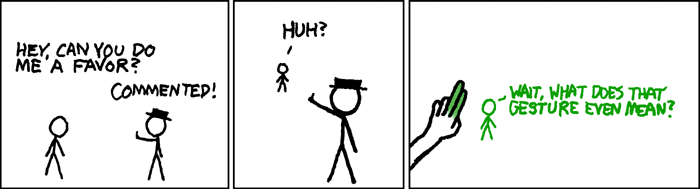
Randall Munroe, the author of xkcd, is relatively young but not female:


And judging from his picture as well as his C.V., Owen J. Flanagan, the James B. Duke Professor of Philosophy at Duke University, is neither young nor female, but p. 265 of his 2002 book The problem of the soul: two visions of mind and how to reconcile them contains this passage:

And we might have the urge to say it is objectively true that friendship, love, kindness, and compassion are great goods. But what does this even mean?

Ian Ayres, the William K. Townsend Professor of Law at Yale University, is similarly middle-aged and male, but he started his Freakonomics post "Selling my addiction", 9/29/2010, with this:

An unusual auction began late yesterday on eBay. I’m selling my “right to regain weight.” Why would anyone in their right mind be willing to pay me cash to buy this right? What does this even mean?

The earliest example that I've been able to find is Carl Herko, "It's time for some serious fun", Buffalo News 11/25/1993:

The Top 10 adult toys? Now, that is a holiday gift category full of (heh-heh) possibilities! And (nudge-nudge) peril.

What does that even mean, adult toys? It's not an easy term to define, like kids' toys or pornography, where you know it when you see it.

No sirree, an adult toy is something altogether different. To some adults, it might be nothing more than a parlor game big people play; Trivial Pursuit, perhaps.

The specific phrase "what does that even mean?" has become fairly common in the news media and in books, but most of the hits are from the past decade.  Since it's used by older people like Ayres and Flanagan, you might think that it was around 50 years ago — Flanagan was born in 1949 — but I don't remember this expression from my youth, and I can't find any convincing examples before the 1993 quote given above. No doubt there are some out there, but it does seem that the spread of this variety of even is relatively recent.

As far as I can tell, this purely-emphatic version of even is a polarity item, in that it only works in a range of contexts including negation and questions.


Source: http://languagelog.ldc.upenn.edu/nll/?p=2943

Polarity Items - words that are sensitive to the presence of other expressions in the same sentence.

--> Negative Polarity = must be in a negative sentence.
eg. 'John doesn't have any potatoes'
     *'John has any potatoes'

--> Positive Polarity = must be with non-negative sentence.
eg. 'John liked it somewhat'
     *John didn't like it somewhat'

Thursday, February 10, 2011

Analysing political language

"We Are All in This Together": analysing coalition cobblers

Today's Guardian features a great bit of polemic from George Monbiot that would make a nice bit of textual analysis for ENGA2. He starts with a reference to something David Cameron said about a tax cuts being off the agenda for the time being before looking at how a change in tax law means that some of the richest companies (the ones who got us in this mess) will now get exactly that. The whole piece is good (and pretty shocking) but it's the last two paragraphs that strike me as particularly effective:

Our political system protects and enriches a fantastically wealthy elite, much of whose money is, as a result of their interesting tax and transfer arrangements, in effect stolen from poorer countries, and poorer citizens of their own countries. Ours is a semi-criminal money-laundering economy, legitimised by the pomp of the lord mayor's show and multiple layers of defence in government. Politically irrelevant, economically invisible, the rest of us inhabit the margins of the system. Governments ensure that we are thrown enough scraps to keep us quiet, while the ultra-rich get on with the serious business of looting the global economy and crushing attempts to hold them to account.

And this government? It has learned the lesson that Thatcher never grasped. If you want to turn this country into another Mexico, where the ruling elite wallows in unimaginable, state-facilitated wealth while the rest can go to hell, you don't declare war on society, you don't lambast single mothers or refuse to apologise for Bloody Sunday. You assuage, reassure, conciliate, emote. Then you shaft us.

The use of pronouns, positioning of author, reader and government, the mixture of sentence lengths and syntactical patterns within them, all strike me as pretty effective and worth a closer look.

It's clear what Monbiot's agenda is here, so it's hardly what you'd call biased: he makes no attempt to hide his political colours, so it's not as if he's trying to trick us. Anyway, I think it's a neat example of how a writer deploys a whole range of linguistic techniques to make a convincing and passionate argument.

Below, I've put together a fairly simple list of bullet points for the kinds of language techniques you might want to look for in a text like this. If you're interested in finding out more about developing these approaches then have a look at emagazine 42 from December 2008 in which David Hyatt outlines a framework for critical literacy. Or go straight to the daddy of it all, Norman Fairclough, and his excellent book Language and Power.


A suggested framework for representation and language analysis

Pronoun use – which pronouns are used and how is the reader addressed? Are pronouns used to include and/or exclude? Is synthetic personalisation used to create a “faked” relationship with an imagined “ideal” reader?

Active/passive constructions – which voice is used within the text and how is agency handled? Can we see who is doing what to whom?

Modification – are adjectives used to evoke evaluation? How are adverbs used to present ideas? Are we being pushed in a particular direction by the ways in which nouns are modified?

Metaphor – are metaphors used in the text to present one idea in another’s terms?

Nominalisation – are processes and actions turned into nouns? Does this obscure agency (i.e. who carried out a process, or even that a process happened)?

Register and lexical choice – does technical, specialist or academic language create an impression of an educated and knowledgeable writer? Does a colloquial register seem to “bridge the gap” between reader and writer, creating a more believable tone?

Graphology – does the text present information in a graphical or pictorial form which might anchor particular meanings? Does the use of bullet points or headings “close down” other possibilities for discussion?

Rhetorical devices – does the author structure an argument and use language in such a way as to create a persuasive and convincing effect?

Sentence and clause linking – does the use of particular grammatical structures signal dependent relationships between elements in a sentence?

Sentence and clause structure – does the use or variation of particular sentence lengths and structures help create emphasis?

Tense and aspect – how does the use of past, present or future tense affect the meanings of the text? Does the use of aspect – progressive or perfective – affect meanings?

Subject positioning – from which perspective are events or issues perceived and recounted? Is one position given particular prominence and credibility?

Source: http://englishlangsfx.blogspot.com/2011/02/we-are-all-in-this-together-analysing.html

Tuesday, February 8, 2011

Can we survive a day only communicating through social networking?

From The Age M-Magazine:
 
My tweet surrender
February 6, 2011
 
Is it possible to communicate effectively for a day without actually speaking? We asked three Melburnians to try it out.
 
We've all heard people bemoaning the decline of communication (and civility, for that matter) because of social media - "Don't people talk to each other any more?" is a common refrain. So M decided to take the idea to the extreme: we set three people the task of communicating only via texting and social media for an entire day, to see how feasible it is to conduct daily life without speaking to another person. And although the results were amusing, those who fear the End of Civilisation As We Know It might be heartened by them, too.
 
 
SAMMY J, Comedian
 
Hi, you've called Sammy J. I'm not allowed to talk today, but please send me a text message and we'll take it from there.
 
It's 8.15am and I've just sealed my fate, staring down the barrel of a day without speech. The observant reader will note that by recording this message I've already failed my own challenge, but let's not start out on a negative.
 
I'm feeling pretty good about the day ahead. My penchant for yabbering is matched only by my history of commitment to ridiculous experiments, like when I gave up chocolate in year 9, or when I stared unnervingly at a colleague on a plane for more than an hour. Both events lost me friends, but today I'm determined to escape unscathed.
 
My wife bids me farewell as she leaves for work and I offer a cheery silent wave from the sofa. For a second I glimpse in her eyes the deep, mournful mix of pity and regret that comes from marrying a self-employed comedian - then the door closes behind her, and it's time to put some undies on.
 
The morning continues in a frighteningly normal fashion. By 10am I've cleared my inbox, updated my Facebook status and sent/received 13 texts. Four of these are from my father who's spotted a federal MP at a local restaurant, giving him an early lead in our annual Pollie Watch contest. The remaining messages cover topics as diverse as the surprising quality of Disney's Tangled, and whether James can lend me his 1987 keytar to use in a show.
 
Then, at 10.38am, the phone rings. I watch it vibrate on my desk, battling the urge to answer. Not to worry, I tell myself. It's just Richard. He'll hear the message and text me if it's urgent. The phone stops ringing. Long pause. He's calling me again. Oh dear. I only have myself to blame. My previous voice greeting announced that I had Hillary Clinton on the other line and would the caller please keep it snappy, so it's no wonder he doesn't believe the message. Still, I'm in this for the long haul, so I text him and explain that I can't talk today but that he could contact me on Facebook. No response. I am dead to Richard.
 
At 11am, Heath McIvor arrives at my place. He is better known as Randy the purple puppet, with whom I've had the privilege of working these past few years, and we're in the guts of production for our new show, Bin Night. I've worded him up about today's experiment, so we've agreed to set up our laptops and discuss the budget via instant messaging. This is a bad idea. Within seconds we are each sneaking ridiculous items into the budget and waiting to see how long it takes the other to notice. Heath inserts $450 to cover anal bleaching of the puppets; I budget $2000 for Guy Sebastian to nibble on our toes between scenes. An unproductive meeting.
 
Having a PO box gets me out of the house and makes me feel like it's the 1940s; best 70 bucks I ever spent.
At 2pm there is a notice to collect a parcel. I line up, smile and point to the notice. I have a good rapport with this lady and she seems bemused by my silence. I'm attempting to look shy and friendly, but instead appear rude and dismissive. There will be no friendly banter today. I'll explain myself next visit.
 
By late afternoon I've missed a few more calls, and most people have willingly followed up with a text message. My responses are becoming incoherent as I apologise for not answering, explain this experiment and attend to the reason for their call all within the space of 160 characters. This is not enough for Derek - who is recording the music for our show and needs to know what we mean by "ship-to-shore style nautical vibe" - so the conversation spills online where I try to source examples from YouTube. By now I'm quite relieved we're not talking on the phone; if we were, I suspect he would politely inform me that he's a very busy man who doesn't have time for this shit.
 
My wife arrives home. She is much enjoying the ability to say whatever she likes without fear of rebuttal, and proposes we make it a permanent arrangement. I assure her via text that this will not be the case.
 
The verdict? What started as a curiosity in the morning became a complication by lunchtime, a nuisance by the afternoon and a shackle by the time I went to bed. I may not have much to say, but I'll be damned if the digital age stops me from saying it any time soon.
 
 
CAL WILSON, Comedian
 
I can still remember, back in the mists of time, when the first of my friends got a (gasp) mobile. How we mocked her. Whenever she'd take a call, we'd all fall silent and watch her with judgy eyes as she said things like, "I'm walking up the stairs, isn't that amazing?" and "I know, I'm totally outside on the street". Then we all bought toy mobiles, and every time she got a call we'd whip them out and pretend we had calls too. A month later, I got a real one and I've had one glued to my ear ever since.
 
It was the same with texting. I remember using this exact phrase: "Text? Why would you text someone
when you can just speak to them?" Now I have giant overdeveloped thumbs and can SMS 400 words a minute.
 
Facebook is another new addiction, but my true love is Twitter. I mocked it early on, high-fiving my friend Dave who said, "Facebook is a conversation, Twitter is an idiot standing on a chair shouting", but, like any good romance, the one you start out hating is the one you end up loving. At this point, Twitter is crushing me to its manly chest, covering me in burning kisses and I'm having its baby. Now, while I think I've made the
point that I love Twitter, I was dubious about the practicality of interacting solely through social media for a whole day.
 
My 20-month-old son was exempt from this, which was lucky, because he refuses to tweet and he hates Facebook. As most of our conversations involve lots of enthusiastic repetition on both our parts (Him: "Door! Door!" Me: "Yes, it's a door!" Him "Dooooor!" Me: "That's right! A door!") it wouldn't be like cheating anyway.
 
But when to do it? I kept putting it off (rather ironically, as my Melbourne Comedy Festival Show is called The Great Intender and is about procrastination). Not Wednesday; we were flying back from New Zealand - what if a customs officer wanted to question me and all I did was Facebook him? Status update: Cal Wilson now knows what an internal examination feels like. Lol.
 
Then, Thursday, my husband had laser eye surgery (@CalsHusband: CAN YOU READ THIS OK, SQUINTY?) Friday, I had an audition. Again, actually speaking seemed prudent. Saturday looked like it was going to work. Husband and son had stayed with the grandparents overnight while I was auditioning in Sydney, so it was ideal just to text to say I'd pick them up. Then I got petrol: as I live in Sunshine (Melbourne's premier "Punchline Suburb"), our petrol station is totally pre-pay. I couldn't just fill the tank, then mutely wave money at the nice lady behind the counter. I contemplated texting my husband to tell him to ring me so I could hand the phone over and he could tell the nice lady that I wanted 50 bucks of unleaded, but frankly it was 8.39am, and I don't think any of us were ready for that. I bailed and used my actual voice to ask for petrol, feeling cheap and ashamed.
 
Picking up the boys, I addressed all comments to my son, and his father just eavesdropped. I then texted the husband while next to him in the car, suggesting brunch, then once at the cafe, successfully Facebooked him my order.
 
And then we tried to have a conversation on Twitter, which was tedious and impractical. Not to mention obsolete: at one point husband tweeted "watch out he's spilling his milk" followed by "too late". It must have looked pretty bad, both of us sitting there texting furiously while seemingly ignoring each other, with the child left to his own devices, eating scrambled eggs with his hands and putting his eggy fork into someone else's coffee.
 
Afterwards, while putting my son to bed, I Facebooked his dad to get WoofWoof and Duckie, and a friend immediately commented, "Can you two keep your sexy foreplay talk to yourselves please?" Then came the trickiest part of the day - the phone interview I was doing with the boys from Talking Poofy (Adam Richard, Scott Brennan and Toby Sullivan) for their podcast. I'd texted beforehand to say that while they could speak to me, I would be tweeting my answers, and that to make it easier, I also had a pig noise for "yes" and a sheep noise for "no" (thank you, son's cuddly toys).
 
The phone rang. "Oink-Oink. Oink-Oink," I answered. Was I really not going to talk? "Baaaaaaaaaaa." And so it went on. The guys would ask a question, oinking or bleating appropriately, I would type furiously, and a few seconds later, one of them would read out my answer. The delay between thought, tweet and reading out destroyed any sort of timing and transformed jokes into non-sequiturs, which became bizarrely funny.
And then after such triumph, I flubbed it: I was so chuffed at how the interview had gone that I went and told my husband all about it before I realised what I was doing.
 
Overall, the experiment left me feeling like a 15-year-old girl who won't get off her phone, and resulted in a swath of messages from Facebook friends and Twitter followers asking if I had been hacked, lightly concussed or taken ill.
 
Clearly, social networking is unsatisfactory for face-to-face encounters, but after the oddly successful interview, I would say you can conduct your life on Facebook and Twitter, provided you have animal noises for backup.
 
 
MIC LOOBY, Writer
 
At first glance I liked the look of this challenge. Finally, a legitimate excuse to ignore the real world. I pictured a day of lounging at home, tapping idly at a keyboard, ignoring ringing phones, absenting myself from domestic dramas and generally doing what everyone assumes freelance writers do for a living anyway.
If I got peckish, I had official permission to order in food from some cyber-savvy restaurant. If I got lonely, I'd trade witticisms with my online friends. But in the name of science and bravado, I thought I'd better get out of the house.
 
In retrospect, it was foolish to assume free Wi-Fi flows like tap water. The two places I knew of, a cafe and a bar, were both shut. Apparently, technophile hipsters in my area don't rise until at least midday. A search on my phone insisted a fast-food family restaurant was the only other nearby source. But even I have my standards.
 
Then I remembered the local library. Saved, by a building dedicated to old-world papery communication. Again I was tempted to stay put. I was in a public place, I had free internet at my fingertips and being unable to converse didn't seem to offend any of the crazy people sitting nearby.
 
But a meeting with my unsuspecting publisher beckoned. On my way, I texted him to say he was part of a social media experiment and that we wouldn't be able to talk in the old-fashioned way. I also asked him to order me a coffee, since I wouldn't be able to ask for one myself. The single word he chose to respond with was not very social.
 
Mercifully, a coffee was waiting for me when I arrived, along with one scowling publisher and a message on my phone telling me that if I'd been one second longer he would have left. I emailed my apologies. He fired back, correcting a wayward apostrophe in my previous message. We swapped silent sentences, prodding at our phones, which were almost touching across the table. As conversations go, it was hard work. Although I did learn that my publisher's two-year-old daughter had spoken her first full sentence that morning. Hyped on technology, I told him she probably should be Facebooking by now. My publisher responded by leaving. It was going to be a long day.
 
Without an intermediary, even a grumpy one, relying on social media in the real world can be awkward. Something as simple as paying for a coffee involves a degree of guilt. Unless, of course, you like being a tool. Banned from real-world niceties, I had to ignore the cheery greeting of the staff at the cafe register. I pretended to be checking my phone as I handed over my money. I think I got away with it. Which suggests that being an utter knob is socially acceptable as long as you're engrossed in your own little digital world.
 
For my next move, I consulted my people. Having asked my Twitter followers (all 439 of them, not that I'm counting) for thoughts on how I might spend the day, I expected a barrage of bright ideas. I got one response, from an old friend. I declined his suggestion that I Skype my own prostate check-up.
 
Another errand presented itself. My driver's licence needed renewing and online bureaucracy suddenly seemed appealing. But to update my photo ID, the VicRoads website insisted I front up in person. Couldn't I send in a jpeg straight from my phone? What sort of antiquated outfit was this?
 
Busy checking emails on my phone, I was almost run down by a courier van outside the licence renewal office. I wanted to yell but remembered my social network vows. The courier company's website address loomed on the side of the van, but instant access was a little tricky. I considered asking the driver if I might friend him on Facebook so I could post a message on his wall along the lines of YOU NEARLY KILLED ME, YOU IDIOT! But the moment had passed.
 
I still wanted to scream though. Combining real and virtual worlds was all very well on my own terms, but this mute, extremist version was getting to me. Besides, my phone needed charging and my laptop seemed to be getting heavier by the minute.
 
An urgent communique arrived as I skulked home. It was from my spouse, who'd been away battling a heatwave and our two small children. "Have lost the will to parent," she wrote. Funnily enough, kiddie bedtime was no more problematic than usual. Which made me realise just how often we get by without traditional verbal communication.

Our reward was Thai takeaway, ordered online. I found myself tipping generously to make up for not saying hello, thank you or goodbye to the delivery man. As the sun set I messaged my poor exhausted beloved, asking her to pass the remote. We'd survived another day. Too easy.


Source: http://www.theage.com.au/technology/technology-news/my-tweet-surrender-20110205-1ahpt.html

Barack Obama + syntax

"We're gonna each of us be responsible …"


At about 7:21, the president says:

That's saying to Americans, we're gonna each of us be responsible for our own health care.


Daniel's comment:

I know that the split infinitive is a non-error, and I know that most often it is an adverb that splits an infinitive. Sometimes a pronoun is possible, as in "He tried to himself make the presentation to the committee." This morning I was watching The Early Show which played a few moments of Mr. Obama's interview with Bill O'Reilly. In his remarks, Mr. Obama said, "We are going to each of us be responsible for our own health care." This is the first I had caught someone uttering such a phrase in an infinitive. He seemed to speak without hesitation or self-consciousness so that I believe that it was a very natural act. Have I merely been inattentive? Is this common enough that it goes undetected?

(Daniel's use of "caught" suggests that he's not totally sold on that non-error business…)

First, let's note gonna has become a sort of modal auxiliary in colloquial English, and I doubt that Daniel would have noticed the more formal phrasing "We will each of us be responsible for our own health care".

But even if we treat "going to be" as containing an infinitive, it shouldn't be suprising to find certain kinds of quantification of the infinitive's subject. Some relevant examples from COCA:

… the company asked the four experts to each write separate opinions because they " don't all agree on everything, "
that's when they made the risky decision to each withdraw $6,000 from their 401 (k) s
… the state governments themselves have ordered utilities to each acquire the specified amount of 300 megawatts renewable capacity.
… it had selected three contractors to each perform a 7-month preliminary design effort to refine the Navy's LCS concepts.
… parallax can cause drivers in two different traffic lanes to each be absolutely positive that they are the one in the correct lane for the tollbooth.
In preparation for this activity, the instructor obtains enough 24-piece puzzles for a group of 2-3 to each have one.

I'm not a syntactician, but I'm pretty sure that this all has something to do with the phenomenon traditionally known as "quantifier floating", and also with the quantified NPs  that sometimes appear in subject position in imperatives, which normally (like infinitives) lack a subject there:
Don't everyone step forward at once!
All of you just take a seat.

[Note, as usual, that this is not a writing clinic — the topic is not how Mr. Obama's phrase might or should have been re-worded, but rather what its structure is and what other constructions it's related to.]


Source: http://languagelog.ldc.upenn.edu/nll/?p=2950

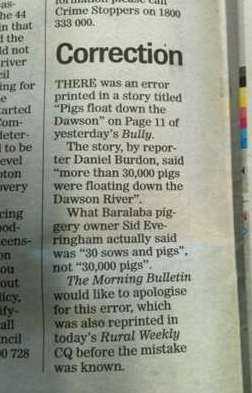
30,000 pigs down the Dawson River!?

Correction of the Year?


Will Sturgeon writes on The Media Blog:
It is a little surprising that the reporter didn't think to check. "Crikey, that's a lot of a pigs mate, are you sure you mean 30,000?". Similarly, if they really thought there were 30,000 pigs floating down the river, why did they only put it on page 11? That would be Biblical!
The obvious source of the error is a mishearing of the initial fricative in sows and [saʊz ənd] as thousand [ˈθaʊzənd]. But beyond that, I think the misunderstanding between the reporter and piggery owner could have been amplified by the use of pig in its specific or "marked" form — that is, meaning 'a young member of the domesticated subspecies Sus scrofa domesticus' rather than the general or "unmarked" version, 'any member of Sus scrofa domesticus.' As the Oxford English Dictionary explains under sense 2a of pig, the more specific sense of the word is "chiefly used in periods when and regions where the usual words for an adult pig are swine, hog, sow, or boar." (The sense is now mainly restricted to North America, according to the OED.) So if the hapless reporter wasn't expecting the semantic distinction of sow vs. pig as used in animal husbandry, then it would be much easier to construe the remark as referring to pigs in the general sense.

Still… 30,000?

Update: Here's a link to the original uncorrected text of the story, as noted by Eugene Volokh.


Source: http://languagelog.ldc.upenn.edu/nll/?p=2951

Bay Area Slang: Top 100 words

Slang  + denotation of the language in the Bay Area of California


Lovestruck language - sociolinguistics

In response to The Independent newspaper article:


Get a room


The language of lovers is often pretty sickening. It's even worse when you hear it murmured into a hands free mobile by the lovestruck man sitting next to you on a train, like I had to put up with this morning. But it's not just the babytalk-style phonology, or the wrinkling of the nose, or even the giggles of love, it's the vocabulary as well: snugglebunny, lickle lovebucket, poo poo poppet andagreeable bitch, being some examples. Actually the last two aren't his (and neither are the first two, to be fair) but Jonathan Swift's.

Now, some research  from psychologists in the USA suggests that people are attracted to those who have similar speech patterns. That may not be particularly surprising (unless you're Paula Abdul) but what's quite interesting about this is that the patterns seems to apply to online style as well as as spoken. 

Research by the same team at the University of Texas has also indicated that language style matching (LSM) is apparent between couples when they're at their happiest in a relationship.

This is related to accommodation theory in sociolinguistics, where people change their speech style to either converge towards or diverge from other speakers around them. The extremes of divergence are noticeable in teenagers when they sometimes make deliberate efforts to avoid the speech styles of their parents, or in students with strong regional dialects who make a conscious effort not to blend in when they live in a different area, but it's not really much of a surprise to find that the closer we are emotionally, the closer we get linguistically.

This could make an interesting Language Investigation at A2: recording conversations between people who have been together for different lengths of time and identifying specific linguistic features that match or don't match.


Source: http://englishlangsfx.blogspot.com/2011/02/get-room.html

WEDNESDAY, FEBRUARY 02, 2011

Taboo

Swift's flirtatious game of self-censorship

By Rob Sharp, Arts Correspondent
Friday, 28 January 2011

Jonathan Swift, known for his satirical contributions to literature, sometimes flirted with the obscene. His most famous letters are riddled with crossings-out, which academics previously attributed to 18th-century editors censoring the clergyman's bawdy lines. Swift called women "bitches", "huzzies" and complained about their looks.

Now, an Oxford University academic claims the Gulliver's Travels author was simply indulging in a "playful form of self-censorship" by crossing out his own words, using an elaborate "baby language" to captivate his most famous correspondent, Dublin spinster "Stella", or Esther Johnson.

"Swift had an intriguing life, he wrote satires about religion and politics, but they reveal little about his own feelings," said Dr Abigail Williams, an 18th century English fellow and tutor at St Peter's College, Oxford. "These letters provide a window into his personal life."

The 65 missives, from 1710 to 1713, are collected in The Journal to Stella, first published in 1766. Dr Williams studied the original letters in the British Library with digital imaging software, separating different components of the complex handwriting.

"The consistency of the ink used for both the letter-writing and the crossings out was very similar," she said. "Also, the whole practice of crossing out stopped when Swift got ill in the spring of 1712, showing a relationship between his state of mind and the appearance of the letters."

Dr Williams believes Swift was playing a "flirtatious game" with Stella, and another female correspondent, Johnson's living companion Rebecca Dingley, which involved denying "full disclosure" of the words written. "The reader has to undress the text to enjoy it fully," she said.

Dr Williams said Swift also used a form of "baby language" to imitate the speech of small children by changing the consonants in familiar words. He writes: "I am sorry for poo poo ppt, pray walk hen oo can" (I am sorry for poor poor poppet, pray walk when you can). The academic asked her three-year-old son to read out such lines to aid in her translation.

The last words of The Journal to Stella are "agreeable bitch", which Swift uses as a term of endearment towards his correspondents. He calls the women "naughty girls", "huzzies" and "insolent rogues", describes the women in unflattering detail, and refers to the "horror" and "filth" of the female body.

The letters are being retranscribed by Dr Williams for a Cambridge University edition, to be published next year.

His way with words

* Swift's "baby language" attempted to imitate the speech of small children. He wrote: "I expect a Rettle vely soon; & that MD is vely werr, and so Nite dee MD" ["I expect a letter very soon, and that my dears are very well, and so night dear my dears"].

* He developed abbreviated pet names for himself and the two addressees: Esther Johnson was "ppt", Rebecca Dingley was "dd" and he was "pdfr".

* He also wrote: "When I write plain, I do not know how, but we are not alone, all the world can see us. A bad scrawl is so snug, it looks like a PMD" [PMD was his abbreviation for all three of them].


"errors" - 'almost/nearly unique'

Keeping it Old School


Most of the links I put up here are to fairly recent news stories about language, but this one is nearly 16 years old. That means it's possibly older than some of you who use this blog for your AS levels. Wow.

Anyway, I stumbled across this Miles Kington article from The Independent of December 1993 while doing some research on attitudes to grammatical errors (which more often than not, aren't really "errors" at all) and it's a good read.

It's about people's language peeves and how they are often not really very well rooted in linguistic reality. My favourite bit concerns the guidance that we're often given about the adjective unique. In Strictly English, Simon Heffer pompously tells us that phrases like almost unique or nearly unique are "vacuous" because "something is either unique or it is not". Kington sees it differently:

Now, this to me is the kind of pedantic rule-of-iron that a third- rate schoolteacher falls back on. Not only that, but it is demonstrably untrue. For example, if there were two unicorns left in the world, and one was very ill, then the other one would be nearly unique . . .

Source: http://englishlangsfx.blogspot.com/2011/02/keeping-it-old-school.html

THURSDAY, FEBRUARY 03, 2011

Monday, February 7, 2011

The Onomatopoeic - "Nom"

Nom

Posted by Stan Carey on February 02, 2011 


The slang term nom is used to convey the enjoyment of eating something tasty, or even just thinking about it. It’s often seen in phrases like “nom nom” and “om nom nom”. There are variant spellings, such as “nyom” and “nyum”, but nom (give or take an om and some extra noms) has become the norm. It’s an onomatopoeic expression, evoking the sound of food being gobbled up with gusto.

As well as its familiar use as an interjection, nom is also seen as an adjective (“this cake is the nommest”), a noun (“let’s have noms!”), and a verb (“Come on over, we’re nomming (on) marshmallows”). Om nom nom was popularised by the Cookie Monster in Sesame Street – there’s an interview with him here about his distinctive eating style – and it got a new lease of life as an internet meme, particularly in ‘lolcat’ images.

Though nom is certainly popular with animals, or rather in our surreal fantasies of them, its application has spread to all sorts of objects, animate and otherwise. Wherever there’s a suggestion of hungry happy eating or swallowing, no matter how fantastical, you can just add eyes and teeth and you have om nom nom nom. The expression is commonly extended to anything considered figuratively “good enough to eat”. For example, if you search Twitter for nom + the name of an attractive actor, you’ll see what I mean.

Nom also serves as a common abbreviation of nominate and nomination; both can be seen in this tweet from BBC Comedy: “Oscar noms soon. Will Ricky Gervais be nommed for his role in The King’s Speech?” But the foodie sense is really where our appetite for the word lies, and this nom shows no sign of fading. In the American Dialect Society’s Word of the Year poll for 2010, nom won the “Most Useful” category and was a runner-up in the overall Word of the Year category, pipped to the post by app. Mark Peters summed up my feelings about this when he quipped: “You can nom an app, but you can’t app a nom.”

Source: http://www.macmillandictionaryblog.com/nom

Wary/Weary?

Wary and weary

Posted by Beth Penfold on February 01, 2011 

Two words that seem to get commonly mixed up are wary and weary. These two words have very different meanings and so are not interchangeable, but it doesn’t stop people from doing it. Most often, people use weary when they mean wary. Here are some annoying sentences that have insulted my ears recently:
I’m quite weary of their dog, it looks really aggressive.
Since I got knocked off my bike, I’m weary of the roads around here.
I’d be weary of her if I were you, she’s got a nasty temper.
Perhaps I’ve got this wrong though. Perhaps there is a new atmosphere of extreme apathy pervading us all and things we used to find scary are now merely tiresome. What trouble we’d all get into if we really were weary of being wary and it’s always foolish not to be wary of feeling weary, especially when driving your car.

Source: http://www.macmillandictionaryblog.com/wary-and-weary
Watch Rapconteur Baba Brinkman versus hip hop emcee Professor Elemental in a rap battle ’tween British and Canadian English. The video has been put together by the inimitable Tommy Nagle; you’ll need to do some pausing and rewinding to get the most out of it. Jamie Simmonds was responsible for the instrumentals. Teachers please note, we’ve got some resources coming within the month for you to use with this video in class so keep your eyes on the blog!


Download the script for ‘What’s Your English’ by Baba Brinkman and Professor Elemental.

Source: http://www.macmillandictionaryblog.com/goodbye-2010-hello-2011

Buzzwords in Marketing

HAS 'SOCIAL MEDIA' GONE STALE?

The Creative Group Survey Reveals the Most Overused Catchphrases Among Advertising and Marketing Professionals

MENLO PARK, Calif., Jan. 13, 2011 /PRNewswire/ 

"Social media" isn't just a trend taking the world by storm; it's also the term advertising and marketing executives ranked as the most annoying industry buzzword in a survey by The Creative Group. Also high on the list: "synergy" and "ROI," which rankled respondents in a similar survey conducted in 2006.

The national study was developed by The Creative Group, a specialized staffing service providing creative, advertising, marketing and web professionals on a project and full-time basis, and conducted by an independent research firm.

Advertising and marketing executives were asked, "In your opinion, what is the most annoying or overused buzzword in the creative/marketing industry today?" The top-ranked responses include:
  1. "Social media/social networking"
  2. "Synergy"
  3. "Free"
  4. "Innovative/innovation"
  5. "ROI/return on investment"
  6. "Extra value/value added"
  7. "Model(s)"
  8. "Telemarketing"
  9. "Social media expert"
  10. "Resolve"
  11. "Moving forward"
  12. "Branding"
  13. "Multitasking"
  14. "Going green"
  15. "Proactive"
  16. "Think out of the box"
  17. "Culture change"
  18. "End of the day"
  19. "Interactive"
  20. "24/7"
  21. "Integrated/integration"
  22. "Viral"
  23. "The big idea"
  24. "Leverage"
  25. "Unique"
"Certain terminology has become firmly ingrained in the way advertising and marketing professionals think and speak, and often helps colleagues communicate ideas more quickly," said Donna Farrugia, executive director of The Creative Group. "But when professionals need to grab attention or have an important message to deliver, excessive use of buzzwords can cause people to lose interest and tune out."
The Creative Group offers four tips for eliminating jargon in your communications:

1. Translate your thoughts. It's typical to think in the lingo you use every day. But when putting your ideas to paper or in an e-mail, take the time to explain the concepts in terms that your audience will easily understand.
 
2. Edit, edit, edit. Many buzzwords are unnecessary. Think carefully: Does a phrase like "at the end of the day" really add to what you're trying to say? Probably not.
3. Break bad habits. We all rely on certain phrases when we speak. If the ones you gravitate toward are on the list of annoying buzzwords, think of alternatives that convey the same meaning.
4. Show instead of tell. Rather than relying on buzzwords, use concrete examples to convey your thoughts. For instance, instead of discussing your fully "integrated" marketing strategy for a product rollout, describe the various elements and how they work together.
 

Number of words in English passes 1,000,000

Number of Words in the English Language: 1,008,879

Published: February 3rd, 2011

The number of words in the English language is :  1,008,879.   This is the estimate by the Global Language Monitor in early February 2011.

The English Language passed the Million Word threshold on June 10, 2009 at 10:22 a.m. (GMT).  The Millionth Word was the controversial ‘Web 2.0′. Currently there is a new word created every 98 minutes or about 14.7 words per day.

Google Validates GLM’s No. of Words in English Prediction

Though GLM’s analysis was the subject of much controversy at the time, the recent Google/Harvard Study of the Current Number of Words in the English Language is 1,022,000.  The number of words in the English language according to GLM now stands at:  1,008,879.  The difference between the two analyses is .0013%, which is statistically insignificant.

Google’s number, which is based on the counting of  the words in the 15,000,000 English language books it has scanned into the ‘Google Corpus,’ mirrors GLM’s Analysis.  GLM’s number is based upon its algorithmic methodologies, explication of which is available from its site.

Google Validates GLM’s Number


Source: http://www.languagemonitor.com/global-english/number-of-words-in-the-english-language-1008879/

Saturday, February 5, 2011

'DikiLeaks' and Twitter

Twitter reveals unsettling truths about 'DikiLeaks'

Sheenal Singh
December 28, 2010
 
What a strange mixture of amusement and misery a few nudie pictures on Facebook, a young girl and a few high-profile football players can cause.

It's hard to tell whether the "DikiLeaks" scandal has outstayed its welcome in the media headlines or if the legal troubles are only just beginning. But the topic sure is trending hot on Twitter. And it's here that one stumbles across dry, witty takes on the scandal with users casually stretching their literary muscle with outrageous puns and, of course, more "dick jokes".

But some can be unexpectedly insightful. The "DikiLeaks" Twitter trend has turned into a veritable forum pithily posing important moral questions that others have failed to ask.
Advertisement: Story continues below

@Steph-Philbrick tweets "Bingle nude pic: LOL BOYS WILL BE BOYS! Riewoldt nude pic: SRS BUSINESS SUE SHIT OUT OF UNDERAGE GIRL."

On first glance, the comment appears to be a casual observation. But if you scratch the surface, comparing how the media and alleged victims were treated and represented in public discussions reveals some unsettling truths.

Lara Bingle made headlines in March this year when a nude photo of the model was published in Woman's Day. Bingle proceeded to sue AFL footballer Brendan Fevola, who allegedly took the photo during a brief relationship in 2006. Bingle's reputation and relationship with Australian cricketer Michael Clarke toppled quickly and very publicly. When she subsequently sold her story for a pretty penny to the same magazine responsible for publishing the photos, Bingle was morally condemned and labelled (among other more colourful adjectives) a fame-seeking missile. Fevola on the other hand remained reasonably unharmed. All legal charges against him were cleared.

But when famous Saints Nick Riewoldt and Nick Del Santo were unerringly exposed on Facebook by a 17-year-old girl, their legal eagles were quick to demonise the teenager. Who knows whether it's because the football club had a better public relations strategy than Bingle or because the Saints players were rightly victimised, but combining the cult of youth with that of depraved womanhood seems to be paying off. And they've lined up to sue her for every civil liberty infringement under the sun – breach of copyright and confidence, mental distress and trespass.

The "girl-who-cannot-be-named" has been turned into a folk devil. She represents (apparently) the kind of conniving and unstable woman that football players cannot trust. Her actions have been put down to stupidity, immaturity, maliciousness, and the well-worn desire to earn 15 minutes of fame. Or the more shrewd implication that the girl has a penchant for causing trouble and a sadistic tendency to take delight in the pain she causes others. And let's not forget the moral fodder provided by the fact that she's estranged from her parents and dresses in all-black.

If her primary goal was to stir trouble, then she's certainly achieved that. But she's adamant that through her actions she's taking a stand against football players and a culture that has wronged women in general. Who knows what's right or wrong at this stage. What is more concerning is the way the teenager has been denied some measure of protection in the legal mess that has ensued.

@countrhegemony notes "Interesting how the big lawyers & celebs were all there to defend Assange, but where are they for 17 yr old of #dickileaks [sic] imbroglio". @lesliecannold asks "have any lawyers agreed to help the teenage girl estranged from parents now up against big legal guns of saints?" For the record she now does have representation.

Twitterers have also keenly noted that in the troubled relationship between sex and sport, it's almost always the woman who is silenced or demonised for getting caught up in (gasp) a sex-related scandal. And sure it's true that it is a gross invasion of a person's privacy to publicise these kinds of images. But what is incredibly frustrating in this debate is the way the teen's actions have been judged by references to her apparently disturbed mental state. And so continues society's deeply ingrained response in attributing harm committed by a woman to recklessness and insanity rather than reason.
 

German borrowing from English

English 'leakens' into German

Helen Pidd, Berlin, February 3, 2011
    But the latest English word to creep into the Deutsche sprache is the verb ''leaken'', which has just been voted Anglicism of the year in Germany.

    Proving the international influence of WikiLeaks, Germans have quickly shunned their old way of describing information secretly passed on to others and adapted the English verb ''to leak''. So they talk of the ''geleakte Dokumente'' as an alternative to the somewhat unwieldy ''durchgesickerte Unterlagen'' of yore.
    The jury awarding the prize for Anglicism of the year was chaired by Anatol Stefanowitsch, a professor in linguistics at Hamburg University. ''The word has really established itself in the German language over the past year and has enriched our vocabulary,'' he said.

    Another WikiLeaks-inspired word was third - ''whistleblowers'', a category of people for whom there was previously no precise German term.

    Other contenders for the prize were technology-related. Second was ''entfreunden'', a literal translation of ''to unfriend'', which has become common on social networking sites. Further shortlisted words included ''shitstorm'' and ''scripted reality''.

    The German Language Association (Verein Deutsche Sprache), aims to ''confront'' the Anglicisation of the German language and ''remind the people of Germany of the value and beauty of their native language''.
    Holger Klatte, a VDS spokesman, said: ''There seems to be this attitude that English is somehow 'better' than German, that German somehow sounds old-fashioned. We believe that linguists should make more effort to develop German alternatives to new English words.''

    Mr Klatte said because there was already a German alternative to leak - durchsickern, or to percolate - there was no need for the English word.

    Sometimes, English words seem to get lost in translation. A mobile phone is known as ''ein Handy'', a video projector is ''ein Beamer''.

    But Professor Stefanowitsch insisted German was not in mortal danger, saying: ''The borrowing of words is a natural process which takes place in every language.''

    Word of the year - Googleganger

    'Googleganger' is word of the year

    Carolyn Webb,  February 3, 2011
      These people are your googlegangers, a term named yesterday the Macquarie Dictionary word of the year.

      It's a noun, meaning ''a person with the same name as oneself, whose online references are mixed with one's own among search results for one's name''.
      Dictionary editor Susan Butler said it was a neat and witty blend of the words Google and doppelganger.

      ''People find it really tempting to put their names in and see what pops up,'' she said.

      ''Part of the fascination of the game is to find people who are so different to yourself that it's quite startling to imagine yourself as them.'' Ms Butler's googleganger is a Florida author who wrote East to the Dawn, a 1997 biography of pioneer aviator Amelia Earhart.

      Cathy Freeman is a property consultant in the Perth suburb of Hamilton Hill as well as the name of an Australian Olympic gold medallist.

      Channel Seven newsreader Jennifer Keyte's googleganger is an animal research academic at the Memorial University of Newfoundland, Canada.

      The honourable mention was given to vuvuzela, the horn popularised at the World Cup in South Africa last year. Category winners included tart noir (arts), black swan event (business), gym bunny (colloquial), fauxmance (communications), toad golf (environment) and brand slut (fashion).

      Source: http://www.smh.com.au/technology/technology-news/googleganger-is-word-of-the-year-20110202-1adug.html

      Well DUH!

      Warning Labels

      Manufacturers of consumer products have to be liberal with the warning labels these days, lest they get sued. But for these, it's hard to know whether the company is being outright stupid or if they're simply targeting the most brain dead dumb among us.


      Product Warnings:


      "Do not use if you cannot see clearly to read the information in the information booklet." -- In the information booklet.


      "Caution: The contents of this bottle should not be fed to fish." -- On a bottle of shampoo for dogs.


      "For external use only!" -- On a curling iron.


      "Warning: This product can burn eyes." -- On a curling iron.


      "Do not use in shower." -- On a hair dryer.


      "Do not use while sleeping." -- On a hair dryer.


      "Do not use while sleeping or unconscious." -- On a hand-held massaging device.


      "Do not place this product into any electronic equipment." -- On the case of a chocolate CD in a gift basket.


      "Recycled flush water unsafe for drinking." -- On a toilet at a public sports facility in Ann Arbor, Michigan.


      "Shin pads cannot protect any part of the body they do not cover." -- On a pair of shin guards made for bicyclists.


      "This product not intended for use as a dental drill." -- On an electric rotary tool.


      "Caution: Do not spray in eyes." -- On a container of underarm deodorant.


      "Do not drive with sunshield in place." -- On a cardboard sunshield that keeps the sun off the dashboard.


      "Caution: This is not a safety protective device." -- On a plastic toy helmet used as a container for popcorn.


      "Do not use near fire, flame, or sparks." -- On an "Aim-n-Flame" fireplace lighter.


      "Battery may explore or leak." -- On a battery. See a scanned image.


      "Do not eat toner." -- On a toner cartridge for a laser printer.


      "Not intended for highway use." -- On a 13-inch wheel on a wheelbarrow.


      "This product is not to be used in bathrooms." -- On a Holmes bathroom heater.


      "May irritate eyes." -- On a can of self-defense pepper spray.


      "Eating rocks may lead to broken teeth." -- On a novelty rock garden set called "Popcorn Rock."


      "Caution! Contents hot!" -- On a Domino's Pizza box.


      "Caution: Hot beverages are hot!" -- On a coffee cup.


      "Caution: Shoots rubber bands." -- On a product called "Rubber Band Shooter."


      "Warning: May contain small parts." -- On a frisbee.


      "Do not use orally." -- On a toilet bowl cleaning brush.


      "Please keep out of children." -- On a butcher knife.


      "Not suitable for children aged 36 months or less." -- On a birthday card for a 1 year old.


      "Do not recharge, put in backwards, or use." -- On a battery.


      "Warning: Do not use on eyes." -- In the manual for a heated seat cushion.


      "Do not look into laser with remaining eye." -- On a laser pointer.


      "Do not use for drying pets." -- In the manual for a microwave oven.


      "For use on animals only." -- On an electric cattle prod.


      "For use by trained personnel only." -- On a can of air freshener.


      "Keep out of reach of children and teenagers." -- On a can of air freshener.


      "Remember, objects in the mirror are actually behind you." -- On a motorcycle helmet-mounted rear-view mirror.


      "Warning: Riders of personal watercraft may suffer injury due to the forceful injection of water into body cavities either by falling into the water or while mounting the craft." -- In the manual for a jetski.


      "Warning: Do not climb inside this bag and zip it up. Doing so will cause injury and death." -- A label inside a protective bag (for fragile objects), which measures 15cm by 15cm by 12cm.


      "Do not use as ear plugs." -- On a package of silly putty.


      "Please store in the cold section of the refrigerator." -- On a bag of fresh grapes in Australia.


      "Warning: knives are sharp!" -- On the packaging of a sharpening stone.


      "Not for weight control." -- On a pack of Breath Savers.


      "Twist top off with hands. Throw top away. Do not put top in mouth." -- On the label of a bottled drink.


      "Theft of this container is a crime." -- On a milk crate.


      "Do not use intimately." -- On a tube of deodorant.


      "Warning: has been found to cause cancer in laboratory mice." -- On a box of rat poison.


      "Fragile. Do not drop." -- Posted on a Boeing 757.


      "Cannot be made non-poisonous." -- On the back of a can of de-icing windshield fluid.


      "Caution: Remove infant before folding for storage." -- On a portable stroller.


      "Excessive dust may be irritating to shin and eyes." -- On a tube of agarose powder, used to make gels.


      "Look before driving." -- On the dash board of a mail truck.


      "Do not iron clothes on body." -- On packaging for a Rowenta iron.


      "Do not drive car or operate machinery." -- On Boot's children's cough medicine.


      "For indoor or outdoor use only." -- On a string of Christmas lights.


      "Wearing of this garment does not enable you to fly." -- On a child sized Superman costume.


      "This door is alarmed from 7:00pm - 7:00am." -- On a hospital's outside access door.


      "Beware! To touch these wires is instant death. Anyone found doing so will be prosecuted." -- On a sign at a railroad station.


      "Warning: do not use if you have prostate problems." -- On a box of Midol PMS relief tablets.


      "Product will be hot after heating." -- On a supermarket dessert box.


      "Do not turn upside down." -- On the bottom of a supermarket dessert box.


      "Do not light in face. Do not expose to flame." -- On a lighter.


      "Choking hazard: This toy is a small ball." -- On the label for a cheap rubber ball toy.


      "Not for human consumption." -- On a package of dice.


      "May be harmful if swallowed." -- On a shipment of hammers.


      "Using Ingenio cookware to destroy your old pots may void your warranty." -- A printed message that appears in a television advertisement when the presenter demonstrates how strong the cookware is by using it to beat up and destroy a regular frying pan.


      "Do not attempt to stop the blade with your hand." -- In the manual for a Swedish chainsaw.


      "Do not dangle the mouse by its cable or throw the mouse at co-workers." -- From a manual for an SGI computer.


      "Warning: May contain nuts." -- On a package of peanuts.


      "Do not eat." -- On a slip of paper in a stereo box, referring to the styrofoam packing.


      "Do not eat if seal is missing." -- On said seal.


      "Remove occupants from the stroller before folding it."


      "Access hole only -- not intended for use in lifting box." -- On the sides of a shipping carton, just above cut-out openings which one would assume were handholds.


      "Warning: May cause drowsiness." -- On a bottle of Nytol, a brand of sleeping pills.


      "Warning: Misuse may cause injury or death." -- Stamped on the metal barrel of a .22 calibre rifle.


      "Do not use orally after using rectally." -- In the instructions for an electric thermometer.


      "Turn off motor before using this product." -- On the packaging for a chain saw file, used to sharpen the cutting teeth on the chain.


      "Not to be used as a personal flotation device." -- On a 6x10 inch inflatable picture frame.


      "Do not put in mouth." -- On a box of bottle rockets.


      "Remove plastic before eating." -- On the wrapper of a Fruit Roll-Up snack.


      "Not dishwasher safe." -- On a remote control for a TV.


      "For lifting purposes only." -- On the box for a car jack.


      "Do not put lit candles on phone." -- On the instructions for a cordless phone.


      "Warning! This is not underwear! Do not attempt to put in pants." -- On the packaging for a wristwatch.


      "Do not wear for sumo wrestling." -- From a set of washing instructions. See a scanned image


      Small Print From Commercials:


      "Do not use house paint on face." -- In a Visa commercial that depicts an expecting couple looking for paint at a hardware store.


      "Do not drive cars in ocean." -- In a car commercial which shows a car in the ocean.


      "Always drive on roads. Not on people." -- From a car commercial which shows a vehicle "body-surfing" at a concert.


      "For a limited time only." -- From a Rally's commercial that described how their burgers were fresh.


      Signs and Notices:


      "No stopping or standing." -- A sign at bus stops everywhere.


      "Do not sit under coconut trees." -- A sign on a coconut palm in a West Palm Beach park circa 1950.


      "These rows reserved for parents with children." -- A sign in a church.


      "All cups leaving this store, rather full or empty, must be paid for." -- A sign in a Cumberland Farms in Hillsboro, New Hampshire.


      "Malfunction: Too less water." -- A notice left on a coffee machine.


      "Prescriptions cannot be filled by phone." -- On a form in a clinic.


      "You could be a winner! No purchase necessary. Details inside." -- On a bag of Fritos.


      "Fits one head." -- On a hotel-provided shower cap box.


      "Payment is due by the due date." -- On a credit card statement.


      "No small children." -- On a laundromat triple washer.


      "Warning: Ramp Ends In Stairs." -- A sign, correctly describing the end of a concrete ramp intended for handicap access to a bridge.


      Safety Procedures:


      "Take care: new non-slip surface." -- On a sign in front of a newly renovated ramp that led to the entrance of a building.


      "In case of flood, proceed uphill. In case of flash flood, proceed uphill quickly." -- One of the emergency safety procedures at a summer camp.

      Ingredients:


      "Ingredients: Artificially bleached flour, sugar, vegetable fat, yeast, salt, gluten, soya flour, emulsifier 472 (E) & 481, flour treatment agents, enzymes, water. May contain: fruit." -- The ingredients list on a package of fruit buns.


      "100% pure yarn." -- On a sweater.


      "Some materials may irritate sensitive skin. Please look at the materials if you believe this may be the case.
      Materials:
      Covering: 100% Unknown.
      Stuffing: 100% Unknown."
      -- On a pillow.


      "Cleans and refreshes without soap or water. Contains: Water, fragrance & soap." -- On the packet for a moist towelette. See a scanned image.


      Instructions:


      "Remove the plastic wrapper." -- The first instruction on a bag of microwave popcorn; to see the instructions, one first has to remove the plastic wrapper and unfold the pouch.


      "Take one capsule by mouth three times daily until gone." -- On a box of pills.


      "Open packet. Eat contents." -- Instructions on a packet of airline peanuts.


      "Remove wrapper, open mouth, insert muffin, eat." -- Instructions on the packaging for a muffin at a 7-11.


      "Use like regular soap." -- On a bar of Dial soap.


      "Instructions: usage known." -- Instructions on a can of black pepper.


      "Serving suggestion: Defrost." -- On a Swann frozen dinner.


      "Simply pour the biscuits into a bowl and allow the cat to eat when it wants." -- On a bag of cat biscuits.


      "In order to get out of car, open door, get out, lock doors, and then close doors." -- In a car manual.


      "Please include the proper portion of your bill." -- On the envelope for an auto insurance bill.


      "The appliance is switched on by setting the on/off switch to the 'on' position." -- Instructions for an espresso kettle.


      "For heat-retaining corrugated cardboard technology to function properly, close lid." -- On a Domino's sandwich box.


      Requirements:


      "Optional modem required." -- On a computer software package.


      Source: http://www.rinkworks.com/said/warnings.shtml