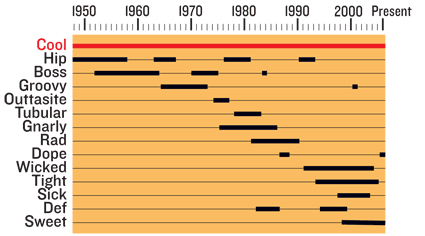
Source: http://images.fastcompany.com/magazine/107/next_essay_chart.gif
The virtual scrapbook and thoughts of an Australian high-school linguistics student...
Showing posts with label Teenspeak. Show all posts
Tuesday, October 4, 2011
Sunday, October 2, 2011
Analysis of 'lol'
David Mitchell talks about the modern use of the word 'lol'.
"I understand 'lol' to be, 'I acknowledge that you have made a joke and I wish to express my enjoyment of it'. and it's an excellent and compact way of saying it'.
Labels:
Discourse Analysis,
Language Change,
phatic,
Semantics,
sociolinguistics,
Technology,
Teenspeak,
Text talk
Teens ruining the english language? Please.
Many people have argued that the current generation (Gen Y) is ruining and degrading the English Language with texting and e-speak which deviates from the spelling and grammatical standards.
Of course, such notions are not true. in 1712, the great Jonathan Swift wrote that the English Language is beyond repair and suggested that there be an "Academie Anglaise" like the current "Academie Francaise" which would regulate and ultimately "save" the English Language.
300 years later and the language is not only surviving, but thriving.
Of course, such notions are not true. in 1712, the great Jonathan Swift wrote that the English Language is beyond repair and suggested that there be an "Academie Anglaise" like the current "Academie Francaise" which would regulate and ultimately "save" the English Language.
300 years later and the language is not only surviving, but thriving.
Labels:
Attitudes L-Change,
French,
grammar,
History,
Language Change,
Perscriptivism,
Quotes,
SE,
Technology,
Teenspeak
Saturday, October 1, 2011
The Exclamation Mark - Modern Usage
Things to note:
We continue the discussion of online English with a guest post from author, teacher and teacher trainer Lindsay Clandfield. Lindsay writes about the resurgence of the exclamation mark.
Great! It’s time for another post for this blog!
Looking back at those two sentences I see a liberal use of exclamation marks. What am I communicating with these? Is this something that is becoming more and more normal, or is it slightly… annoying? Let’s find out!
The Macmillan Dictionary defines the exclamation mark as follows:
And in informal writing online, exclamation marks abound. Here are some examples of my own from Twitter and Facebook updates, and even from emails.
Some have wondered if the issue of exclamation marks is about being excited when you write, and whether this is gender related. Research into email writing styles by Colley and Todd (2002) and Winn and Ruben (2001) both found that women used what were called markers of excitability (e.g. exclamation marks, multiple exclamation marks and caps) more than men did. This reminds me vaguely of many other studies of speech and writing relating to gender, in which women’s style tends to be often characterized in negative terms. Is this a sort of Men are from Mars, Women are from Venus approach to online writing?
Not necessarily, says Carol Waseleski, who did a more recent study of gender and exclamation marks in online communication on discussion lists. Using a more nuanced methodology, she found that while women did use exclamation marks a little more, these were not a sign of excitability, but of friendliness. And a recent guide to email etiquette by two American editors Shipley and Schwalbe argue that in the internet age more friendliness is what email needs. “Email is without affect,” they write. “It has a dulling quality that almost necessitates kicking everything up a notch just to bring it to where it would normally be.”
Well, I’m not so sure about that last bit. Surely it depends on the words you choose too? But it does seem that, on balance, the resurgence of the exclamation mark is looked on as something benign, or even beneficial. It has been saved!
Of course, this now begs the question of the return of other forms of punctuation. The use of capital letters to indicate that you are SHOUTING, or those three little dots called the ellipsis, which some of my colleagues told me they use far more than exclamation marks. That, however, may be the subject of another post …
References
Colley, A., & Todd, Z. (2002), Gender-linked differences in the style and content of e-mails to friends. Journal of Language and Social Psychology, 21 (4), 380-392.
Shipley, D & Shwalbey, W. (2207), Send: The Essential Guide to Email for Office and Home, Knopf
Waseleski, C. (2006), Gender and the use of exclamation points in computer-mediated communication: An analysis of exclamations posted to two electronic discussion lists. Journal of Computer-Mediated Communication, 11(4),
Winn, L., & Rubin, D. (2001), Enacting gender identity in written discourse: Responding to gender role bidding in personal ads. Journal of Language and Social Psychology, 20 (4), 393-418.
Thanks to my friends and colleagues on Facebook who contributed to this discussion.
Source: http://www.macmillandictionaryblog.com/online-writing-is-great
- Use of exclamation mark --> distinction between formal/informal more blurred
- Increased frequency of "..." in informal contexts = discourse function? hedging??
Online writing is great!!!
Posted by Lindsay Clandfield on September 26, 2011We continue the discussion of online English with a guest post from author, teacher and teacher trainer Lindsay Clandfield. Lindsay writes about the resurgence of the exclamation mark.
_________________
Great! It’s time for another post for this blog!
Looking back at those two sentences I see a liberal use of exclamation marks. What am I communicating with these? Is this something that is becoming more and more normal, or is it slightly… annoying? Let’s find out!
The Macmillan Dictionary defines the exclamation mark as follows:
The mark ! used in writing to show that someone says something suddenly and loudly because they are surprised, impressed, angry etc.In the Improve your Writing section, the dictionary goes on to say the following:
Exclamation marks are typical of informal writing and are not usually appropriate in more formal contexts such as academic or professional writing. Learners often overuse exclamation marks in formal writing, where it is usually better to end the sentence with a full stop.While it’s true that learners may overuse exclamation marks in formal writing, this practice may be spreading to both learners and native speakers in online writing. The distinction between formal and informal is becoming more and more blurred.
And in informal writing online, exclamation marks abound. Here are some examples of my own from Twitter and Facebook updates, and even from emails.
I return to Onestopenglish for the first time in 2 years!Novelists have been down on the use of exclamation marks. Elmore Leonard wrote that you should be allowed no more than 2 or 3 per 10,000 words of prose. F. Scott Fitzgerald said “Cut out all those exclamation marks. An exclamation mark is like laughing at your own jokes.” It’s not just novelists either. I did an informal study of friends and colleagues about the use of the exclamation mark. Some of the answers were quite critical, especially when you put too many in, or just hold down the ! key to show you really mean it:
Greetings from Brasilia, the created capital of Brazil which is less than 70 years old!
I’ve found Twitter invaluable in keeping in touch. Made lots of friends!
Enjoy the #IATEFL Poland conference!
Owl Hall is a book, a podcast play, a blog … a new experience!
See correspondence below. Result!
Watch for it soon on the Macmillan Brazil youtube channel!
Look forward to seeing you soon!
I do find exclamation marks rather irritating as I believe they are overused.However, the majority of respondents admitted that they thought exclamation marks were frequent and even helpful in online communication. Among the reasons listed in favour of exclamation marks were that they add friendly stress and emotion, soften communication, convey a “lightness” of touch or compensate for a lack of visual and tonal cues. It was also mentioned that this was a sign of your character.
With overuse, it loses its meaning (and it’s annoying).
Overuse just leads to ineffectiveness. If writing is packed with exclamation points, the exclamation points cease to mean anything.
Way overused. More than one is never called for.
But it sort of turns us into teenagers, no??!!
Some have wondered if the issue of exclamation marks is about being excited when you write, and whether this is gender related. Research into email writing styles by Colley and Todd (2002) and Winn and Ruben (2001) both found that women used what were called markers of excitability (e.g. exclamation marks, multiple exclamation marks and caps) more than men did. This reminds me vaguely of many other studies of speech and writing relating to gender, in which women’s style tends to be often characterized in negative terms. Is this a sort of Men are from Mars, Women are from Venus approach to online writing?
Not necessarily, says Carol Waseleski, who did a more recent study of gender and exclamation marks in online communication on discussion lists. Using a more nuanced methodology, she found that while women did use exclamation marks a little more, these were not a sign of excitability, but of friendliness. And a recent guide to email etiquette by two American editors Shipley and Schwalbe argue that in the internet age more friendliness is what email needs. “Email is without affect,” they write. “It has a dulling quality that almost necessitates kicking everything up a notch just to bring it to where it would normally be.”
Well, I’m not so sure about that last bit. Surely it depends on the words you choose too? But it does seem that, on balance, the resurgence of the exclamation mark is looked on as something benign, or even beneficial. It has been saved!
Of course, this now begs the question of the return of other forms of punctuation. The use of capital letters to indicate that you are SHOUTING, or those three little dots called the ellipsis, which some of my colleagues told me they use far more than exclamation marks. That, however, may be the subject of another post …
References
Colley, A., & Todd, Z. (2002), Gender-linked differences in the style and content of e-mails to friends. Journal of Language and Social Psychology, 21 (4), 380-392.
Shipley, D & Shwalbey, W. (2207), Send: The Essential Guide to Email for Office and Home, Knopf
Waseleski, C. (2006), Gender and the use of exclamation points in computer-mediated communication: An analysis of exclamations posted to two electronic discussion lists. Journal of Computer-Mediated Communication, 11(4),
Winn, L., & Rubin, D. (2001), Enacting gender identity in written discourse: Responding to gender role bidding in personal ads. Journal of Language and Social Psychology, 20 (4), 393-418.
Thanks to my friends and colleagues on Facebook who contributed to this discussion.
Source: http://www.macmillandictionaryblog.com/online-writing-is-great
Labels:
grammar,
Language Change,
Language Peeves,
Orthography,
POA,
Quotes,
Social Networking,
Technology,
Teenspeak,
Text talk
Tuesday, September 20, 2011
Language Change, Internet speak, neologisms
How the internet is changing language
16 August 2010 Last updated at 09:01 GMT
Zoe Kleinman
'To Google' has become a universally understood verb and many countries are developing their own internet slang. But is the web changing language and is everyone up to speed?
In April 2010 the informal online banter of the internet-savvy collided with the traditional and austere language of the court room.
Christopher Poole, founder of anarchic image message board 4Chan, had been called to testify during the trial of the man accused of hacking into US politician Sarah Palin's e-mail account.
During the questioning he was asked to define a catalogue of internet slang that would be familiar to many online, but which was seemingly lost on the lawyers.
At one point during the exchange, Mr Poole was asked to define "rickrolling".
"Rickroll is a meme or internet kind of trend that started on 4chan where users - it's basically a bait and switch. Users link you to a video of Rick Astley performing Never Gonna Give You Up," said Mr Poole.
"And the term "rickroll" - you said it tries to make people go to a site where they think it is going be one thing, but it is a video of Rick Astley, right?," asked the lawyer.
"Yes."
"He was some kind of singer?"
"Yes."
"It's a joke?"
"Yes."
The internet prank was just one of several terms including "lurker", "troll" and "caps" that Mr Poole was asked to explain to a seemingly baffled court.
But that is hardly a surprise, according to David Crystal, honorary professor of linguistics at the University of Bangor, who says that new colloquialisms spread like wildfire amongst groups on the net.
"The internet is an amazing medium for languages," he told BBC News.
"Language itself changes slowly but the internet has speeded up the process of those changes so you notice them more quickly."
People using word play to form groups and impress their peers is a fairly traditional activity, he added.
"It's like any badge of ability, if you go to a local skatepark you see kids whose expertise is making a skateboard do wonderful things.
"Online you show how brilliant you are by manipulating the language of the internet."
Super slang
One example of this is evident in Ukraine, where a written variation of the national tongue has sprung up on internet blogs and message boards called "padronkavskiy zhargon" - in which words are spelled out phonetically.
It is often used to voice disapproval or anger towards another commentator, says Svitlana Pyrkalo, a producer at the BBC World Service Ukrainian Service.
"Computer slang is developing pretty fast in Ukraine," she said.
The Mac and Linux communities even have their own word for people who prefer Microsoft Windows - віндузятники (vinduzyatnyky literally means "Windowers" but the "nyky" ending makes it derogatory).
"There are some original words with an unmistakably Ukrainian flavour," said Ms Pyrkalo.
The dreaded force-quit process of pressing 'Control, Alt, Delete' is known as Дуля (dulya).
"A dulya is an old-fashioned Ukrainian gesture using two fingers and a thumb - something similar to giving a finger in Anglo-Saxon cultures," she said.
"And you need three fingers to press the buttons. So it's like telling somebody (a computer in this case) to get lost."
Word play
For English speakers there are cult websites devoted to cult dialects - "LOLcat" - a phonetic and deliberately grammatically incorrect caption that accompanies a picture of a cat, and "Leetspeak" in which some letters are replaced by numbers which stem from programming code.
"There are about a dozen of these games cooked up by a crowd of geeks who, like anybody, play language games," said Professor Crystal.
"They are all clever little developments used by a very small number of people - thousands rather than millions. They are fashionable at the moment but will they be around in 50 years' time? I would be very surprised."
For him, the efforts of those fluent in online tongues is admirable.
"They might not be reading Shakespeare and Dickens but they are reading and cooking up these amazing little games - and showing that they are very creative. I'm quite impressed with these movements."
Txt spk
One language change that has definitely been overhyped is so-called text speak, a mixture of often vowel-free abbreviations and acronyms, says Prof Crystal.
"People say that text messaging is a new language and that people are filling texts with abbreviations - but when you actually analyse it you find they're not," he said.
In fact only 10% of the words in an average text are not written in full, he added.
They may be in the minority but acronyms seem to anger as many people as they delight.
Stephen Fry once blasted the acronym CCTV (closed circuit television) for being "such a bland, clumsy, rythmically null and phonically forgettable word, if you can call it a word".
But his inelegant group of letters is one of many acronyms to earn a place in the Oxford English Dictionary (OED).
The secret of their success is their longevity.
"We need evidence that people are using a word over a period of time," said Fiona McPherson, senior editor in the new words group at the OED.
She says the group looks for evidence that a word has been in use for at least five years before it can earn its place in the dictionary.
Such evidence comes in the form of correspondence from the public and trawling through dated material to find out when a term first started appearing.
Hence TMI (Too Much Information) and WTF (you may wish to look that one up for yourself) are in, while OMG (Oh My God) has yet to be included in the quarterly dictionary updates.
"Some people get quite exercised and say, 'do these things belong in our language?'," said Ms McPherson.
"But maybe this has always happened. TTFN [ta ta for now] is from the ITMA (It's That Man Again) radio series in the 1940s."
Word thief
There is no doubt that technology has had a "significant impact" on language in the last 10 years, says Ms McPherson.
Some entirely new words like the verb 'to google', or look something up on a search engine, and the noun 'app', used to describe programmes for smartphones (not yet in the OED), have either been recently invented or come into popular use.
But the hijacking of existing words and phrases is more common.
Ms McPherson points out that the phrase "social networking" debuted in the OED in 1973. Its definition - "the use or establishment of social networks or connections" - has only comparatively recently been linked to internet-based activities.
"These are words that have arisen out of the phenomenon rather than being technology words themselves," she added.
"Wireless in the 1950s meant a radio. It's very rare to talk about a radio now as a wireless, unless you're of a particular generation or trying to be ironic. The word has taken on a whole new significance."
For Prof Crystal it is still too early to fully evaluate the impact of technology on language.
"The whole phenomenon is very recent - the entire technology we're talking about is only 20 years old as far as the popular mind is concerned."
Sometimes the worst thing that can happen to a word is that it becomes too mainstream, he argues.
"Remember a few years ago, West Indians started talking about 'bling'. Then the white middle classes started talking about it and they stopped using it.
"That's typical of slang - it happens with internet slang as well."
Source: http://www.bbc.co.uk/news/technology-10971949 Technology reporter, BBC News
Labels:
Attitudes L-Change,
David Crystal,
Language and Media,
Language Change,
Language Peeves,
Neologisms,
Perscriptivism,
SE,
Slang,
Social Networking,
Teenspeak,
Text talk
Monday, September 12, 2011
+1 - google's version of facebook's 'like'
+1’tastic
When a number becomes a word
July 31, 2011|By Ben Zimmer
Labels:
Attitudes L-Change,
Buzzwords,
Language and Identity,
Language Change,
language debates,
Language Peeves,
Morphology,
Neologisms,
Orthography,
SE,
Semantics,
Technology,
Teenspeak
Tuesday, September 6, 2011
'chav' reclamation failed?
Why is 'chav' still controversial?
A new book claims the word "chav" is helping to reignite class war. The journalist Polly Toynbee calls it "the vile word at the heart of fractured Britain". Recently a peer caused a kerfuffle when she tweeted about being stuck in "chav-land". So almost a decade after its emergence, is chav really the most divisive word in Britain, asks Tom de Castella.
And for some commentators the word chav is now at the heart of Britain's obsession with class.
There has been much discussion over the origin of the term. The Romany word chavi - meaning child - was recorded in the 19th Century. Others argue it's from "Chatham average", a disparaging reference to the inhabitants of the Kent town.
There have always been regional labels equivalent to chav - skangers, spides, charvers, scallies and neds, respectively in Ireland, Northern Ireland, North East England, North West England and Scotland. But chav has somehow scaled regional barriers to become a national term of abuse.
When did 'chav' take off?
- The OED lists the first reference as a Usenet forum in 1998
- First recorded use in newspaper in 2002
- By 2004 word was in common currency
Driven by websites like Chavscum and Chavtowns, and soon picked up by the mainstream media, the word has also mutated into "chavtastic", "chavsters", "chavette", "chavdom".
There are plenty of people for whom the word is harmless. Daily Telegraph blogger James Delingpole argues it's merely an updating of "oik".
But more left-leaning commentators have seen it as shorthand for bashing the poor. In 2008 the Fabian Society urged the BBC to put it on their list of offensive terms.
"This is middle class hatred of the white working class, pure and simple," wrote Tom Hampsen, the society's editorial director. He also called on the Commission for Equality and Human Rights to take this kind of class discrimination seriously.
Her comment appalled the Guardian columnist Polly Toynbee who compared it to two of the most serious racial insults, noting that chav is seen as "acceptable class abuse by people asserting superiority over those they despise".
Now a new book - Chavs: the Demonization of the Working Class - argues the word is a coded attack on the poor. "As inequality has widened it's a way of people saying that the people at the bottom deserve to be there," says Owen Jones, the book's author.
The situation is complicated by the decline in the number of people identifying themselves as working class. A survey in March this year by research firm Britainthinks, suggested 71% of people define themselves as middle class.
"I saw the 'working class' tag used as a slur, equated with other class-based insults such as 'chav'," wrote researcher Deborah Mattinson.
A belief has grown that the aspirational "decent" working class has become middle class, Jones argues. According to this narrative, what is left behind is a "feckless rump" housed on estates, living off benefits or working in low status jobs at supermarkets, hairdressers or fast food outlets.
Where did the word come from?
Lexicographer Susie DentIt's likely that chav originates in the Romany word "chavi", recorded from the middle of the 19th Century.
In the 20th Century it was prominent in Kent, used among Chatham builders in the same way as mate. "Chatham average" is probably a later rationalisation.
Like many insults it's short and punchy. Its brevity lends itself easily to spin-offs, such as "'chavtastic", "chavsters", "chavette", "chavdom".
This century there is a new lexicon of tribal vocabulary that draws on "us and them" and the idea of a "peasant" underclass.
There is a long list of similar regional examples - skangers, spides, charvers, and neds, for the uneducated, lower-class, and vulgarly-dressed.
For a while it seemed like it might lose its sting. Some fashion houses were even rumoured to be contemplating using the term for a new line.
But the bite behind the caricature has persisted - the label is being used as a "catch-all" for people of a particular social class.
That view has been reinforced by "grotesque" sketches about chavs written by public school educated comedians like David Walliams and Matt Lucas, Jones says. A 2006 survey by YouGov suggested 70% of TV industry professionals believed that Vicky Pollard was an accurate reflection of white working class youth.
But Delingpole rejects Jones's analysis. "The left loves this constituency of the deserving poor, honest people who would dearly love to get a job if the system would only allow them to."
Chav for Delingpole is both a term of abuse for an "underclass" who won't work and also a wider term similar to how "yob" was used in the '70s. "It's a young person in their teens or 20s. It covers a multitude of characteristics. It's not even exclusively used about white people."
For the tabloids, the word is associated with loud or aggressive behaviour. Lottery winner Michael Carroll, the footballer Wayne Rooney, ex-glamour model Jordan, and Cheryl Cole have all been celebrated as "chav royalty". In 2005 Cole told Marie Claire: "I'm proud to be a chav if by that you mean working class made good."
Everyone's missing the point, argues Labour MP Stephen Pound. The term chav just shows how jealous middle Britain is about working class people having fun.
"Chav is an utterly misunderstood term. It is used in envy by the lily livered, privileged, pale, besuited bank clerk who sees people dressed up to the nines and going to the West End." It's no different, he argues to the Teddy Boys or Mods, youth style movements about asserting individual identity and confidence.
Mocking chavs' perceived bad taste and excess has become a popular sport.
In 2006 the Sun reported that Prince William and his fellow officers at Sandhurst dressed in chav fancy dress to celebrate finishing their first term. According to the paper, the future king "donned a loose-fitting top and bling jewellery then added an angled baseball cap and glare to complete his menacing lookalike of Lotto lout Michael Carroll".
Whatever the complicated arguments over class, there is always a suspicion for some that the words represents contempt for the "other".
"What makes Britain so hard to love is this term 'good taste'. When what they mean is 'my taste'," notes Pound.
Delingpole says chav is an acceptable word in polite society. "Of course you shouldn't worry about using it. All that happens when you put a word on the prohibited list is that another equally offensive one comes in to fill the gap."
Jones cannot even accept the word as a demarcator of taste. "If you mean bling then say bling," he says. The word chav "is deeply offensive" and should no longer be permitted as a smokescreen for class hatred. Jones disapproves of the word "toff", but asserts it is far less wounding as it mocks the powerful rather than the poor.
It's common practice these days to try to reclaim offensive terms, "queer" and "slut" being notable examples. But this is not the way to deal with the word chav, Jones says.
Ten years after it started filtering into the national consciousness, this term continues to be seen through the prism of Britain's complex class attitudes.
Source: http://www.bbc.co.uk/news/magazine-13626046
Labels:
Attitudes L-Change,
British English,
Euphemism/Dysphemism,
Language and Identity,
Off.Lang,
POA,
Politeness,
Political Correctness,
Semantics,
Slang,
Swear Words,
Teenspeak
Tuesday, April 26, 2011
usage of adverbial "all"
All about all
Apr 6th 2011, 16:43 by R.L.G. | NEW YORK
Christine Cavalier (@purplecar on Twitter) asks about "adverbial 'all'", as in "She was all mad" and "He was like, bleck, and all". She asked Language Log; Ben Zimmer, it turns out, had posted on "all" + adjective + "-y" ("all Olympic-y", "all judgy") in 2006. But here, a more direct stab at her subject.
First, as usual with this kind of "I've just noticed..." phenomenon, "all" as an adverb is plenty old: the OED lists, for example
(1425) Oryg. Cron. Scotl. (Royal) vi. 493 Hyr chyld-ill al suddanly Travalyd hyr sa angyrly.and
1793 R. Southey Triumph of Woman 63, in Wks. II. 7 All hopelessly our years of sorrow flow.I think Ms Cavalier is thinking of a certain teen usage that I've seen myself, but similar usages go back. I can almost hear a bored kid at the mall moaning "My years of sorrow have flowed all hopelessly, you know?" Its meaning doesn't seem to have changed much, but there may be a new lilt to it.
"And all" gets its own sub-entry:
c.and all: and everything else, and everything connected therewith, et cetera; hence , Too, also, as well (especially in dial. speech; Sc. ‘Woo'd an' married an' a'’).I think that last bit is supposed to be a Scottish example: "Wooed and married and all." Other citations include
a1554 J. Croke tr. Thirteen Psalms (1844) li. 18 The walles, and all, shalbe made newe...I'm intrigued by yet another "all". The characters in the wonderfully bizarre web comic Achewood use "all" in a way I haven't seen elswhere. Discussing the pros and cons of a camping trip, hard-living Ray and straight man Roast Beef argue back and forth:
1828 Scott Fair Maid of Perth v, in Chron. Canongate 2nd Ser. I. 133 With smithy, bellows, tongs, anvil, and all.
Ray: All laughin' and tellin' lies.Achewood is set in California. I don't know if this kind of "all" is native there, or native only to the strip. Any ideas from readers? The OED doesn't include this kind of "all". (Not yet, at least.)
Roast Beef [whose sentences never end in full stops]: All eatin' eggs out of the pan The eggs all not cooked all the way All ashes in the egg.
Ray: All meetin' some ladies! Invitin' 'em to our tent!
Roast Beef: All asleep with tarantulas on my face You all passed out and spoonin' me
*American usage, "don't get all hung over him like that".
Source: http://www.economist.com/blogs/johnson/2011/04/slang
Labels:
American English,
grammar,
History,
Language and Identity,
Regional Variation,
Semantics,
Slang,
sociolinguistics,
syntax,
Teenspeak
Gamer speak
Understanding Gamer Slang
Posted in: Nerd Trek Articles, Video Games
As I have grown older I find myself in situations where some of the slang being thrown around has become alien to me. A big part of this might be the fact that I refused to ever play WOW (World of Warcraft) and a lot of new slang has spawned (pun intended) from that game. My refusal to ever touch the game didn’t come for a dislike for MMORPGs, Fantasy worlds, or video games in general. The reason I did not want to partake in WOW was the great number of friends I had that did play and ceased to exist in reality with the rest of us. They stopped coming to real life RPG sessions like Dungeons and Dragons or Vampire because they preferred the online experience. There’s nothing wrong with that, to each their own- but I would rather play a RPG with real people in front of me than go online. The addiction factor is why I stayed away, because I am prone to such things! That said, I find myself playing tabletop RPGs with many people who are deep into these online games and also a bit younger than I. (I am in my early 30′s, they are in their early 20′s.) They use a lot of lingo I’m not quite familiar with.
I thought it wise to research the modern gaming slang and compile a list for those of you like I, who know nothing about how “Pro” this is, or how to cheer “w00t!” when we successfully accomplish a goal as a team. Here it is, your list of modern day computer and gaming slang!
MODERN DAY SLANG FOR DUMMIES:
RL = Real Life (The world that we humans live and exist in, not the internet or gaming world.)
BRB = Be Right Back
AFK = Away From Keyboard
BIO = Biological (Bathroom break)
ATM = At The Moment
OTW = On The Way
BTW = By The Way
TTYL = Talk To You Later
TYT = Take Your Time
NVM = Nevermind
TY = Thank You
YW = You’re Welcome
WB = Welcome Back
NP = No Problem
TYVM = Thank You Very Much
BBL = Be Back Later
LOL = Laugh Out Loud (In most cases those who wield this word are simply smiling in RL, not laughing.)
ROFL = Roll On Floor Laughing (In this case most likely the person is actually laughing out loud in RL.)
ROFLMAO = Roll On Floor Laughing My Ass Off (This means the person is laughing pretty hard in RL and most likely drawing the attention of other gamers in the room who ask “What’s so funny?”)
LMFAO = Laugh My Fat Ass Off (Variations of the above acronym could also include LMTAO – Laugh My Thin Ass Off, or LMAAO – Laugh My Average Ass Off depending on the person’s weight category either in the game or RL.)
W00t! = This is a cheer to signify an accomplishment. Usually used when with another person in the game or with a group.
WOOT! = This is a BIG cheer to signify a LARGE group accomplishment such as defeating a dragon or scoring a huge amount of loot!
FTW! = For The Win! (Signifying who will be the “winner” or an enthusiastic emphasis to the end of a comment, message, or post. Sometimes genuine, but often sarcastic.)
WOW = World of Warcraft (The most popular online game ever created. This game actually is a real life addiction for many people!)
Noob = A “newbie”, someone who is NEW to a game or particular situation.
MMORPG = Massively Multiplayer Online Role Playing Game (A game where hundreds, thousands, or millions of players log onto a game in a virtual world to explore, adventure, defeat enemies, and socialize with each other. Online games were first called MUDs Multi User Domain before graphic capability came along.) Ed- Before MUDs most “gamers” played tabletop Role-Playing games using books and paper and rolling dice, many still do (such as myself!).
ding! = An exclamation used by noobs on a MMORPG when they level up, most commonly in WOW. The world refers to a sound emitted from the speakers in WOW when you level up. This slang is used often by noobs, but used sparingly by long time players when they achieve a significant level such as 70 or 80 in which case they often post to their entire guild. A guild is a group of other players on the game which work as a team to overcome obstacles and gain notoriety.
WTG = Way to go!
OMG = “Oh my goodness”, “Oh my God, or “Oh my gosh”.
Gratz = Congratulations
leet or leetspeak = Combining words and numbers, this is often used to make easy to remember codes for WIFI (Wireless Internet Router connections) or simply for any online password. For example instead of “Password” one might type “Pa$$w0rd”. Another example is “I like to eat Spaghetti” and would translate into leet as “I l1ke 2 E@t $paghett!”.
? = What are you talking about?
??? = What the hell is that supposed to mean?
????? = Who the hell do you think you are? How dare you?
STFU = Shut the #%$# Up!
JK = Just Kidding
IAMF = It’s All My Fault
There are many more bits of slang to learn, but if you are a “noob” we will wait awhile and give you some time to absorb all of the above. I’ll add some more entries to this post as time goes on, or you are welcome to post a comment below and add your own.
I’m sure many of us X, Y, & Z generation kids are guilty of sending a text to someone in the same room or only a room away. As the years roll by, it will be interesting to see if the entire english language is eventually condensed down to acronyms which are used in everyday speaking. Will the world soon see oral communication so taxing that we will no longer speak with each other, but simply send text messages?
Let’s see if we “old timers” can keep up with all this new slang and the changing tides!
Happy Gaming!
Source: http://nerdtrek.com/understanding-gamer-slang/
Labels:
Colloquialisms,
Jargon,
Language and Identity,
Morphology,
Neologisms,
Semantics,
Slang,
Technology,
Teenspeak
Saturday, April 16, 2011
Stephen Fry on Language
For me, it is a cause of some upset that more Anglophones don’t enjoy language. Music is enjoyable it seems, so are dance and other, athletic forms of movement. People seem to be able to find sensual and sensuous pleasure in almost anything but words these days. Words, it seems belong to other people, anyone who expresses themselves with originality, delight and verbal freshness is more likely to be mocked, distrusted or disliked than welcomed. The free and happy use of words appears to be considered elitist or pretentious. Sadly, desperately sadly, the only people who seem to bother with language in public today bother with it in quite the wrong way.
They write letters to broadcasters and newspapers in which they are rude and haughty about other people’s usage and in which they show off their own superior ‘knowledge’ of how language should be. I hate that, and I particularly hate the fact that so many of these pedants assume that I’m on their side. When asked to join in a “let’s persuade this supermarket chain to get rid of their ‘five items or less’ sign” I never join in. Yes, I am aware of the technical distinction between ‘less’ and ‘fewer’, and between ‘uninterested’ and ‘disinterested’ and ‘infer’ and ‘imply’, but none of these are of importance to me. ‘None of these are of importance,’ I wrote there, you’ll notice – the old pedantic me would have insisted on “none of them is of importance”.
Well I’m glad to say I’ve outgrown that silly approach to language. Oscar Wilde, and there have been few greater and more complete lords of language in the past thousand years, once included with a manuscript he was delivering to his publishers a compliment slip in which he had scribbled the injunction: “I’ll leave you to tidy up the woulds and shoulds, wills and shalls, thats and whiches &c.” Which gives us all encouragement to feel less guilty, don’t you think?
There are all kinds of pedants around with more time to read and imitate Lynne Truss and John Humphrys than to write poems, love-letters, novels and stories it seems. They whip out their Sharpies and take away and add apostrophes from public signs, shake their heads at prepositions which end sentences and mutter at split infinitives and misspellings, but do they bubble and froth and slobber and cream with joy at language? Do they ever let the tripping of the tips of their tongues against the tops of their teeth transport them to giddy euphoric bliss? Do they ever yoke impossible words together for the sound-sex of it? Do they use language to seduce, charm, excite, please, affirm and tickle those they talk to? Do they? I doubt it.
They’re too farting busy sneering at a greengrocer’s less than perfect use of the apostrophe. Well sod them to Hades. They think they’re guardians of language. They’re no more guardians of language than the Kennel Club is the guardian of dogkind.
The worst of this sorry bunch of semi-educated losers are those who seem to glory in being irritated by nouns becoming verbs. How dense and deaf to language development do you have to be? If you don’t like nouns becoming verbs, then for heaven’s sake avoid Shakespeare who made a doing-word out of a thing-word every chance he got.
He TABLED the motion and CHAIRED the meeting in which nouns were made verbs. New examples from our time might take some getting used to: ‘He actioned it that day’ for instance might strike some as a verbing too far, but we have been sanctioning, envisioning, propositioning and stationing for a long time, so why not ‘action’? ‘Because it’s ugly,’ whinge the pedants. It’s only ugly because it’s new and you don’t like it. Ugly in the way Picasso, Stravinsky and Eliot were once thought ugly and before them Monet, Mahler and Baudelaire. Pedants will also claim, with what I am sure is eye-popping insincerity and shameless disingenuousness, that their fight is only for ‘clarity’.
This is all very well, but there is no doubt what ‘Five items or less’ means, just as only a dolt can’t tell from the context and from the age and education of the speaker, whether ‘disinterested’ is used in the ‘proper’ sense of non-partisan, or in the ‘improper’ sense of uninterested. No, the claim to be defending language for the sake of clarity almost never, ever holds water. Nor does the idea that following grammatical rules in language demonstrates clarity of thought and intelligence of mind. Having said this, I admit that if you want to communicate well for the sake of passing an exam or job interview, then it is obvious that wildly original and excessively heterodox language could land you in the soup.
I think what offends examiners and employers when confronted with extremely informal, unpunctuated and haywire language is the implication of not caring that underlies it. You slip into a suit for an interview and you dress your language up too. You can wear what you like linguistically or sartorially when you’re at home or with friends, but most people accept the need to smarten up under some circumstances – it’s only considerate. But that is an issue of fitness, of suitability, it has nothing to do with correctness. There no right language or wrong language any more than are right or wrong clothes. Context, convention and circumstance are all.
Labels:
Attitudes L-Change,
British English,
grammar,
History,
Humour,
Language and Identity,
Language Change,
Language Peeves,
Orthography,
Perscriptivism,
POA,
Quotes,
SE,
Teenspeak
Sunday, April 10, 2011
Language change + peeves - Opinion
Language clarity can be a mark of individualism
Brendan Black
March 11, 2011I'm not ashamed to admit that I love dictionaries, not only for correcting spelling or meaning, but also as a repository of history. Perusing an old dictionary is like a vertical tasting of wine, where it is possible to see semantic "growth" (if any), such as with "gay", "cool", "shit" or "junk". They are a useful way to help annoy others by dropping into conversation such words as "sacerdotalism", "de rigueur", "onomatopoeia" or "Schadenfreude". They are a reminder that English has been influenced by many other languages, such as Latin, French and Greek, and has developed beyond its origins in the Germanic language family. But mostly, they illustrate that we have many wonderful words at our disposal, if we care to learn and use them.
Since the advent of the internet, the art of careful, considered, "asynchronous" letter-writing has all but disappeared, replaced by the possibility of (or necessity for) 24-hour, "synchronous" communication, full of acronyms, misspellings and misuses, and seemingly the need, in many people, to speak or write in as few letters, words or sentences as possible (oh, the irony).
What do we lose when we put brevity before eloquence, sloppiness before precision, speed before deliberation? Of course, that's a value judgment, as Facebook status updates, text messages, Tweets and forum posts are generally concerned with relaying information, not poetry or prose, and are usually informal. Yet some say that our current predilection for using digital means to converse is resulting in (or caused by — chicken and the egg) the dumbing-down of society. We shall see if the film Idiocracy becomes truly prophetic and if we end up going full circle, communicating again with grunts.
It is doubtless that at all stages of history, changes in language have been met with resistance, with those using less traditional, more current forms seen as "mentally deficient" or incapable of coherent language use — even without any evidence of their full engagement with literacy. It seems nothing's new, only the changes appear to be happening at a more rapid pace and people seem to be getting more annoyed about it. Or accepting, depending on your point of view. Changes in the "appropriate" accent and register for Australian television can be seen in the move from Received Pronunciation (also known as "BBC English") and relatively formal spoken language in the 1950s to an abundance of presenters speaking with broad, "ocker" accents and informal language varieties.
As I stated in a recent article, all languages change, mainly to suit the needs of their users, and English is no different. But while informal varieties move further and further away from standard English, we still have a plethora of beautiful, useful words at our disposal — and standard English is in relatively little danger of being "destroyed", due in most part to it being a standardised, fairly inflexible language variety. Again, the beauty of words is subjective, as some may derive great pleasure from Wordsworth or Dylan Thomas, or from hearing "mellifluous" or "efflorescence", while others think "poo" and "fart" are golden.
If I can try to convince people of anything, language-wise, it would be that a desire to expand one's vocabulary does not mean poring over dictionaries, becoming a "nerd", or attending postmodern poetry recitals in burnt-out warehouses. It means opening oneself to the beauty and power of language, whether it be through poetry, prose, film, literature or any other medium where language is celebrated as an end in itself (and that might include Playboy, I mean, of course the articles). With a greater propensity to use or understand language, one can better understand and discuss the world. It's no surprise that many of the authors, poets and screenwriters who best delineate human experience also have a tremendous grasp of how to use language — to excite, to shock, to persuade.
Judging by some of the comments to my last article, people have strong views on "proper" language use, even in informal environments. While I feel that language change is a natural process, I, too, feel frustrated when people make simple mistakes, such as confusing "there", "they're" and "their", or not realising (or caring) what punctuation is. I've seen blocks of words from teenagers (and adults) that resemble stream of consciousness blather by Absinth-infected writers, only without the wit.
With so much communication now taking place online, it seems the rules have changed; spelling words incorrectly, shortening them or using no punctuation does not matter, as people will still work out what we're saying, and only a minority will care about the errors. I agree with this, to a point. A failure to use clear language can mean our point is unclear or we are judged as being careless, illiterate or worse. The judgment of others may seem irrelevant to some, but when trying to acquire gainful employment, for example, decisions can be made on even the smallest details, and one's literacy level is not immune.
A life spent in informal speech or writing means that words like accept/except, affect/effect, then/than, to/too dessert/desert, passed/past, and stationary/stationery are easily confused. I've lost count of how many times I've seen should, would or could with "of" rather than "have". Some may class these as capital offences, or pettiness on my part, but the real "crime" seems to be a loss of conviction in one's words, where "close enough is good enough".
I realise that any efforts of mine to urge others to value literacy will be welcomed by some yet met with resistance or indifference by others; I won't convince them to value words, just as they won't convince me "dat rytin lyk dis" is quicker, easier or a useful way to express individualism.
Brendan Black is a Melbourne writer who has a background in linguistics study.
Since the advent of the internet, the art of careful, considered, "asynchronous" letter-writing has all but disappeared, replaced by the possibility of (or necessity for) 24-hour, "synchronous" communication, full of acronyms, misspellings and misuses, and seemingly the need, in many people, to speak or write in as few letters, words or sentences as possible (oh, the irony).
What do we lose when we put brevity before eloquence, sloppiness before precision, speed before deliberation? Of course, that's a value judgment, as Facebook status updates, text messages, Tweets and forum posts are generally concerned with relaying information, not poetry or prose, and are usually informal. Yet some say that our current predilection for using digital means to converse is resulting in (or caused by — chicken and the egg) the dumbing-down of society. We shall see if the film Idiocracy becomes truly prophetic and if we end up going full circle, communicating again with grunts.
It is doubtless that at all stages of history, changes in language have been met with resistance, with those using less traditional, more current forms seen as "mentally deficient" or incapable of coherent language use — even without any evidence of their full engagement with literacy. It seems nothing's new, only the changes appear to be happening at a more rapid pace and people seem to be getting more annoyed about it. Or accepting, depending on your point of view. Changes in the "appropriate" accent and register for Australian television can be seen in the move from Received Pronunciation (also known as "BBC English") and relatively formal spoken language in the 1950s to an abundance of presenters speaking with broad, "ocker" accents and informal language varieties.
As I stated in a recent article, all languages change, mainly to suit the needs of their users, and English is no different. But while informal varieties move further and further away from standard English, we still have a plethora of beautiful, useful words at our disposal — and standard English is in relatively little danger of being "destroyed", due in most part to it being a standardised, fairly inflexible language variety. Again, the beauty of words is subjective, as some may derive great pleasure from Wordsworth or Dylan Thomas, or from hearing "mellifluous" or "efflorescence", while others think "poo" and "fart" are golden.
If I can try to convince people of anything, language-wise, it would be that a desire to expand one's vocabulary does not mean poring over dictionaries, becoming a "nerd", or attending postmodern poetry recitals in burnt-out warehouses. It means opening oneself to the beauty and power of language, whether it be through poetry, prose, film, literature or any other medium where language is celebrated as an end in itself (and that might include Playboy, I mean, of course the articles). With a greater propensity to use or understand language, one can better understand and discuss the world. It's no surprise that many of the authors, poets and screenwriters who best delineate human experience also have a tremendous grasp of how to use language — to excite, to shock, to persuade.
Judging by some of the comments to my last article, people have strong views on "proper" language use, even in informal environments. While I feel that language change is a natural process, I, too, feel frustrated when people make simple mistakes, such as confusing "there", "they're" and "their", or not realising (or caring) what punctuation is. I've seen blocks of words from teenagers (and adults) that resemble stream of consciousness blather by Absinth-infected writers, only without the wit.
With so much communication now taking place online, it seems the rules have changed; spelling words incorrectly, shortening them or using no punctuation does not matter, as people will still work out what we're saying, and only a minority will care about the errors. I agree with this, to a point. A failure to use clear language can mean our point is unclear or we are judged as being careless, illiterate or worse. The judgment of others may seem irrelevant to some, but when trying to acquire gainful employment, for example, decisions can be made on even the smallest details, and one's literacy level is not immune.
A life spent in informal speech or writing means that words like accept/except, affect/effect, then/than, to/too dessert/desert, passed/past, and stationary/stationery are easily confused. I've lost count of how many times I've seen should, would or could with "of" rather than "have". Some may class these as capital offences, or pettiness on my part, but the real "crime" seems to be a loss of conviction in one's words, where "close enough is good enough".
I realise that any efforts of mine to urge others to value literacy will be welcomed by some yet met with resistance or indifference by others; I won't convince them to value words, just as they won't convince me "dat rytin lyk dis" is quicker, easier or a useful way to express individualism.
Brendan Black is a Melbourne writer who has a background in linguistics study.
Source: http://www.theage.com.au/opinion/society-and-culture/language-clarity-can-be-a-mark-of-individualism-20110311-1bqn0.html
Labels:
Attitudes L-Change,
code-switching,
grammar,
Language and Identity,
Language Change,
Language Peeves,
Neologisms,
Orthography,
Perscriptivism,
Quotes,
Register,
SE,
Semantics,
Slang,
Teenspeak
Monday, April 4, 2011
Plain English Foundation - 2010
Australian company, Plain English Foundation released its annual 'words and phrases of the year' for 2010.
There was new business jargon, such as ‘thought showers’, ‘strategic staircases’, and
According to Foundation Executive Director Dr Neil James, “The best you can say about
See full list of words/phrases here.
There was new business jargon, such as ‘thought showers’, ‘strategic staircases’, and
According to Foundation Executive Director Dr Neil James, “The best you can say about
See full list of words/phrases here.
these words is that they dress up something simple just to sound impressive. At their worst,
they are deliberately trying to obscure reality or paper over the unpleasant.”‘disintermediation’. There was classic spin doctoring, such as ‘removal pathways’ (deportation) and the ‘investment in human capital’ (a new tax). Our teenagers contributed ‘maggoted’ and text initialisms such as ‘HMU’. And not to be outdone, the academics this year came up with ‘agonistic respect’ and ‘flexibilising’. This year, the Foundation also decided to nominate a winner—a word or phrase that encapsulates the worst elements of our public language.
“For our inaugural worst word or phrase of the year, we couldn’t go past the main slogan of the Australian Labor Party’s Federal election campaign: ‘moving forward’,” Dr James said.
“Just when we thought this business cliché had dropped from use, Julia Gillard robotically repeated the phrase ‘moving forward’ more than 20 times during her announcement of the election,” Dr James said. “It showed how the election was driven more by focus-group research than political leadership. The public can tell the difference.”
“The problem with a phrase like this is that it hints vaguely at progress without committing to anything concrete. Politicians can sound positive without being held to account for breaking a promise.”
‘Moving forward’ was a narrow winner in a strong field. See below for the full list of the Plain English Foundation’s worst words and phrases of 2010.
Labels:
Australian English,
Buzzwords,
Corporate Language,
Humour,
Language and Media,
Language and Politics,
Language Change,
language debates,
Language Peeves,
Neologisms,
Semantics,
Teenspeak
2011 More Neologisms
Other new words in the OED
24th March 2011
Off the menu
As the culinary appetites of the English-speaking world grow ever more diverse, loan words referring to new cuisines are a perennial source of new OED entries. The March 2011 update sees us adding such far-flung items as banh mi n. (also known as a Vietnamese sandwich n.), taquito n. (a crisp-fried Tex-Mex snack), and kleftiko n. (a Greek dish of slow-cooked lamb). Dishes from the English-speaking world are also in evidence, with new entries for the classic English dessert Eton mess n., the American doughnut hole n., and that emblem of West Coast US sushi culture, the California roll. And speaking of food, the OED now acknowledges the ten- (or three-, five- etc.) second rule [second n.1 Additions (b)], which allows for the eating of a delicious morsel that has fallen to the floor, provided that it is retrieved within the specified period of time.
♥ to heart
The new sense added to heart v. in this update may be the first English usage to develop via the medium of T-shirts and bumper-stickers. It originated as a humorous reference to logos featuring a picture of a heart as a symbol for the verb love, like that of the famous ‘I ♥ NY’ tourism campaign. Our earliest quote for this use, from 1984, uses the verb in ‘I heart my dog’s head’, a jokey play on bumper stickers featuring a heart and a picture of the face of a particular breed of dog (expressing a person’s enthusiasm for, say, shih-tzus) which itself became a popular bumper sticker. From these beginnings, heart v. has gone on to live an existence in more traditional genres of literature as a colloquial synonym for ‘to love’.
From a land down under
The OED aims to cover lexical developments from throughout the English-speaking world. In this update, a few new items from Australian English enter the dictionary for the first time: flat white n., a style of espresso drink with finely textured foamed milk; tragic n., a ‘boring or socially inept person, esp. one with an obsessive interest or hobby’; and yidaki n., an Australian Aboriginal term for the musical instrument better known in English as a didgeridoo.
Mad hatters
The new entry for tinfoil hat n. recounts how the shiny chapeau began its life with only festive connotations. However, in 1986, just over a century after its first attestation as an innocent party favour, the tinfoil hat migrated to a more sinister milieu, popularly associated with conspiracy theories suggesting that such headwear could protect the wearer from mind control or surveillance. This association, in turn, led to the development of a depreciative attributive use, designating people regarded as paranoid or delusional, and to the adjectival compound tinfoil-hat-wearing, also included in this update.
Figures of speech
There are two main types of muffin in the English-speaking world: the flat round yeasted variety (known in North America as an English muffin), and the traditional American type, small cakes baked in cup-shaped tins and having a characteristic cap where the batter rises above the rim. It is to this latter sort that OED’s new entry for muffin top n. refers, denoting in its first sense the top portion of such a muffin, or sometimes a muffin cooked in a special shallow tin so that it consists exclusively of this top part, without the soggy bottom whose relative undesirability once inspired an episode of Seinfeld. The second sense is figurative, referring to a protuberance of flesh above the waistband of a tight pair of trousers (cf. spare tyre n., love handle n.), which may sometimes be attributed to an excessive appreciation for muffin tops in the literal sense.
The vocabulary of drunkenness is immense, and has been since at least the time of the famous Drinker’s Dictionary (1737) in Benjamin Franklin’s Pennsylvania Gazette. To that vast lexicon we now add the term lashed adj., along with the complementary phrase on the lash (engaged in a bout of drinking). Which of these terms came first remains uncertain. As is often the case for items which developed in spoken language, the written evidence probably lags behind the oral usage; the earliest example editors were able to find for lashed (1997) just edges out on the lash (1998), but further research could reverse that order.
Other colourful slang and colloquial terms entering the dictionary in this update include cream-crackered adj. (rhyming slang for ‘knackered’, that is exhuasted); smack talk n. (boastful or insulting banter); fnarr fnarr int. and adj (a representation of a lecherous snigger popularized in the comic magazine Viz and used adjectivally to denote crude sexual innuendo); pap n. 5 and v.3, shortenings of paparazzo; dot-bomb n. (a failed internet company); and couch surfing n. (the practice of spending the night on other people’s couches in lieu of permanent housing).
Also in this update:
la-la land n. can refer either to Los Angeles (in which case its etymology is influenced by the common initialism for that city), or to a state of being out of touch with reality—and sometimes to both simultaneously.
non-dom n., short for non-domiciled, refers to a person living in a country in which he or she is not legally domiciled, usually in order to accrue tax advantages. The related terms non-domicile n. and non-domiciled adj. also enter the OED in this update.
fabless adj. looks like it might be a denigrating term for someone who is insufficiently fabulous, but the ‘fab’ comes not from fab adj., but from fabrication, and the word describes a technology company which does not do its own manufacturing.
Other entries of note include dotted-line n. (an indirect reporting relationship); the faux-German lumpenintelligentsia n., suicide door n., bogus caller n., happy camper n., and shroud-waving n. and adj.
Katherine Connor Martin, OED
Labels:
Australian English,
British English,
Buzzwords,
Language and Identity,
Language and Media,
Language Change,
Language Variation,
Neologisms,
Semantics,
Slang,
Technology,
Teenspeak,
Text talk
2011 Neologisms
New initialisms in the OED
24th March 2011OMG and LOL, FYI
For the March 2011 release of OED Online, we have selected for publication a number of noteworthy initialisms—abbreviations consisting of the initial letters of a name or expression. Some of these—such as OMG [OMG int. (and n.) and adj.]: ‘Oh my God’ (or sometimes ‘gosh’, ‘goodness’, etc.) and LOL [LOL int. and n./2]: ‘laughing out loud’—are strongly associated with the language of electronic communications (email, texting, social networks, blogs, and so on). They join other entries of this sort: IMHO (‘in my humble opinion’) [IMHO at I n./1], TMI (‘too much information’) [TMI at T n.], and BFF (‘best friends forever’) [BFF at B n.], among others.
Of course in such a context initialisms are quicker to type than the full forms, and (in the case of text messages, or Twitter, for example) they help to say more in media where there is a limit to a number of characters one may use in a single message. OMG and LOL are found outside of electronic contexts, however; in print, and even in spoken use (see, for example, the 2003 quotation for LOL int.), where there often seems to be a bit more than simple abbreviation going on. The intention is usually to signal an informal, gossipy mode of expression, and perhaps parody the level of unreflective enthusiasm or overstatement that can sometimes appear in online discourse, while at the same time marking oneself as an ‘insider’ au fait with the forms of expression associated with the latest technology.
As such usage indicates, many people would consider these recent coinages, from the last 10 or 20 years, and associate them with a younger generation conversant with all forms of digital communications. As is often the case, OED’s research has revealed some unexpected historical perspectives: our first quotation for OMG is from a personal letter from 1917; the letters LOL had a previous life, starting in 1960, denoting an elderly woman (or ‘little old lady’; see LOL n./1); and the entry for FYI [FYI phr., adj., and n.], for example, shows it originated in the language of memoranda in 1941.
Rise of the Wag
This release also contains another initialism—an acronym, in fact (acronyms being initialisms which are pronounced as words rather than letter by letter)—less connected to online media, although it is certainly used on them. Wag [WAG n./4] is notable for the extremely fast journey from its introduction to the language to its use as usual English vocabulary. In 2002, the Sunday Telegraph reported that the staff at the England footballers’ pre-World Cup training camp referred to the players’ partners collectively as ‘Wags’, from the initial letters of ‘wives and girlfriends’. The term then remained relatively dormant, except for a small and brief revival around the time of Euro 2004, before the 2006 World Cup in Germany saw an explosion of usage, as the women, including Victoria Beckham and Colleen McLoughlin (now Colleen Rooney), had a high profile of their own, and were a visible element (especially to the media) of the England team’s presence in their base, Baden-Baden. Debates raged in the newspapers about whether the women’s presence was ‘distracting’ the footballers, alongside an equal fascination with what they were buying and wearing.
Such was the exposure the term received in this period that it became a byword for the female partners of male professionals (in football and in other spheres), often connoting a glamorous or extravagant lifestyle and a high media profile. By 2007, as the OED’s quotation paragraph shows, a general readership could be expected to understand sentences such as ‘dresses that, unless you're a Wag, are best worn with small heels instead of stilettos’ and ‘And not only did the darts WAGs attend tournaments, they had to do so without drinking’; sentences that, ten years ago, would have been utterly baffling. It is quite uncommon for new words to reach such a level of ubiquity in such a short time after their first appearance, and that the word Wag has done so perhaps demonstrates not so much its own inherent usefulness or catchiness as the influence that the print media, especially in its coverage of big stories such as the World Cup, can still have on the ways in which language is used, even in the age of social networking.
Graeme Diamond, OED
Labels:
Buzzwords,
grammar,
History,
Humour,
Language and Identity,
Language Change,
Lexicology,
Morphology,
Neologisms,
Orthography,
Semantics,
Technology,
Teenspeak,
Text talk
'heart' (vb. trans) makes it into OED!?
Have you no ♥?
I did decide to blog because I was briefly confused by one piece of what seemed to be genuinely surprising news: that the dictionary had included an entry for ♥, pronounced "heart", and defined as a transitive verb meaning "to love". That would be weird—what other pronounceable symbols might be included? But that's apparently not the case. There is no headword for ♥. The dictionary merely included a new sense of "heart" under that word, not the symbol. People have been writing "heart" as a transitive verb for a thousand years (meaning roughly "to hearten"), and in this new sense for a while. The entry includes these citations:
Update: But you can see a member of the new-words group on the dictionary staff explaining a bit of the thinking behind "heart" and "OMG" here.
Source: http://www.economist.com/blogs/johnson/2011/03/lexicography
Mar 26th 2011, 14:20 by R.L.G. | LONDON
MOST of the attention about the Oxford English Dictionary's recent additions have focused on the internet initialisms that they chose: LOL, OMG and the like. This is such non-news I wasn't even going to blog it, the responses were so predictable: grouches calling it embarrassing, dictionary-makers and descriptivists saying that this is exactly what dictionaries are for. This script was written at least as long ago as 1961, when Webster's Third included "ain't", and yet people never tire of it. Maybe it's just a comfort thing. Points go to Alexandra Petri at the Washington Post for at least trying to say something new: "It's like Yoda trying to sext you." Unfortunately, Ms Petri's wrong on the facts: "The Oxford English Dictionary...is supposed to have dignity." No, it's supposed to collect the words people use, and publish them with their definitions and histories. This is why it includes just about every rude and ugly word you can think of and some you can't. I just tried to stump it with some highly filthy slang terms I wasn't sure the OED people had gotten round to. It turns out they have.
I did decide to blog because I was briefly confused by one piece of what seemed to be genuinely surprising news: that the dictionary had included an entry for ♥, pronounced "heart", and defined as a transitive verb meaning "to love". That would be weird—what other pronounceable symbols might be included? But that's apparently not the case. There is no headword for ♥. The dictionary merely included a new sense of "heart" under that word, not the symbol. People have been writing "heart" as a transitive verb for a thousand years (meaning roughly "to hearten"), and in this new sense for a while. The entry includes these citations:
[1983 Associated Press (Nexis) 16 Nov., From Berlin to the Urals, teen-agers wear T-shirts reading, ‘Elvis’, ‘Always Stoned’, and ‘I (heart) New York’.
1984 About Helmet Visor Screws in net.cycle (Usenet newsgroup) 26 June, Joe ‘I heart my dogs [sic] head’ Weinstein.
1986 Daily Collegian (Pennsylvania State Univ.) 14 Feb. 2/3, I just want to say to my Bunny Boo I Heart you Kathleen.
1998 Houston Chron. 10 May (Chronilog section) 7/1, I think he's so cute. I heart him to bits.
2003 Time Out N.Y. 7 Aug. 77/1 If you heart dance like DJ Scott does, then hie thee down to this little drink spot tonight.
2009 A. Ham et al. Middle East (Lonely Planet) (ed. 6) 141/1 We heart the brownies (E£4).
So the OED included some words people use. Nothing to see here.2010 Observer 18 July 13/4, I hearted Take That‥with a teary passion that was deemed unbecoming in a Jesus and Mary Chain fan.
Update: But you can see a member of the new-words group on the dictionary staff explaining a bit of the thinking behind "heart" and "OMG" here.
Source: http://www.economist.com/blogs/johnson/2011/03/lexicography
Labels:
Attitudes L-Change,
Buzzwords,
Language and Identity,
Language Change,
language debates,
Language Peeves,
Lexicology,
Morphology,
Orthography,
Semantics,
syntax,
Teenspeak,
Text talk
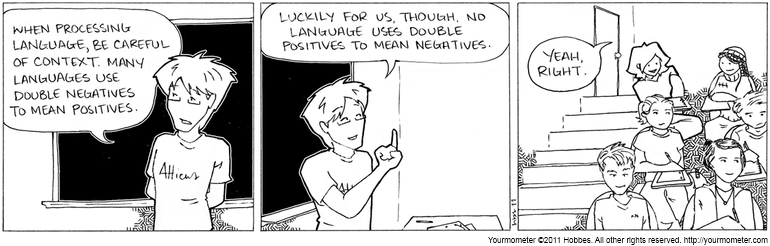
Yeah right = double positive???
Double positives
April 4, 2011 @ 2:49 pm
An old joke, attributed originally to Sidney Morgenbesser, is replayed in cartoon form at YourMometer for 3/31/2011:
Labels:
Attitudes L-Change,
Comics,
grammar,
Language and Identity,
syntax,
Teenspeak
Tuesday, March 29, 2011
I know, right!? - politeness marker, reduce social distance
"I know, right?"

It seems that we language bloggers haven't been holding our end up on this one. Back in 2007, Dave's Midlife Blog looked in vain on Language Log and Language Hat for an analysis of the phrase that Jeremy uses in the last panel:
All he could find was some peeving on Le Mot Juste:
Source: http://languagelog.ldc.upenn.edu/nll/?p=3057
March 29, 2011 @ 9:16 am
Today's Zits:
It seems that we language bloggers haven't been holding our end up on this one. Back in 2007, Dave's Midlife Blog looked in vain on Language Log and Language Hat for an analysis of the phrase that Jeremy uses in the last panel:
When the phrase “I know” is used in English […], it signifies assent and acceptance of the point of view of a conversational partner. It’s a fairly confident assertion of acknowledgement, of agreement.
On the other hand, the questioning “right?” stuck onto the end of a sentence is a request of affirmation of an assertion and a simultaneous invitation to disagreement. Right? Don’t you think so? Do you agree with me?
So when a young speaker (and I’ve only heard this phrase used by speakers under the age of 25) combines the two, it seems to be a simultaneous assertion of confidence and an instant pulling back of that confidence so as not to seem too pushy. It seems to ask for a continuation of the conversation. If the interlocutors continue the conversation, it may branch into areas of disagreement, but so far they are of the same mind.
I tried to find a discussion of this on Language Log without success; likewise with Language Hat.
All he could find was some peeving on Le Mot Juste:
And what does it even mean? That you have an opinion, but you need my permission to validate it? Don't ask me if you know immediately after you tell me you know. Either you know or you don't know. The next time you say, "I know, right," expect me to say, "no, you're wrong. You obviously don't know, so don't waste my time trying to convince me you do."
This analysis didn't satisfy Dave — as he sensibly observed,
I don’t think that would actually happen in conversation, because I don’t think the phrase would be uttered if there weren’t already some basic agreement present …
There's apparently something new here, as suggested by the fact that this phrase now has several Urban Dictionary entries and its own initialism — but what is it that's new? The New Thing is certainly not the idea of agreeing with someone's opinion and then appearing to ask them to confirm it again, as further validation rather than as an expression of doubt. Ways of doing exactly that have been around for a long time, without (as far as I know) anyone noticing or complaining. Thus in William Archer's 1890 translation of Henrik Ibsen's A Doll's House:
This pattern is a common one — you can find it in William Dean Howells 1907 play A Previous Engagement:
Or in Agatha Christie's 1959 crime novel The Cat Among the Pigeons:
Now, the same sort of peeves ought to apply to these cases as well. When someone has just offered an opinion, and you've agreed with it, how can asking them to confirm the evaluation reinforce your agreement rather than subtracting from it?
We can see the answer in passages where the author tells us more about the thoughts and feelings of the participants in the exchange. Thus Alexandra Potter, The Two Lives of Miss Charlotte Merryweather:
Charlotte and Beatrice are "mirroring" feelings back and forth. In this context, the question "isn't it?" is an invitation to continue the process, and it therefore intensifies the shared evaluation rather than attenuating it. And you can see the same process in stereotyped "right?" examples like this one:

So why do people react when "right?" is used for this purpose instead of "isn't it?" Well, the obvious answer is that they're not used to it. This usage, or at least its frequency, may be something new. As usual, we should check for the "recency illusion", but there's no question that many people perceive this as a new (over-)usage. Thus in a November 2010 forum discussion in response to the prompt "describe your classmates" one young person characterized four of them as "'Gee like OMG totally right?' kind [of] girls".
In addition, this mirroring or intensifying "right?" can be used in a much wider range of circumstances than the mirroring or intensifying "isn't it?". Thus in Greg David, "Tek finds love", TVGuide 8/18/2009:
We can't idiomatically substitute "I know, really, isn't it?" in this case, because the evaluation being mirrored ("I like that you shot the devil horns") doesn't make an antecedent available for the it of "isn't it?".
So OK, Dave, it's four years late, but there you go.
Update — someone felt strongly enough about this to create and post an elaborate youtube peeve "Stop Saying 'I know, right?'" and an associated Facebook group. Neither one seems to have gotten a lot of traction. In a more sympathetic vein, here are some acted examples from this video:
There's apparently something new here, as suggested by the fact that this phrase now has several Urban Dictionary entries and its own initialism — but what is it that's new? The New Thing is certainly not the idea of agreeing with someone's opinion and then appearing to ask them to confirm it again, as further validation rather than as an expression of doubt. Ways of doing exactly that have been around for a long time, without (as far as I know) anyone noticing or complaining. Thus in William Archer's 1890 translation of Henrik Ibsen's A Doll's House:
Nora. Ony think! my husband has been made Manager of the Joint Stock Bank.
Mrs. Linden. Your husband! Oh, how fortunate!
Nora. Yes, isn't it? A lawyer's position is so uncertain, you see, especially when he won't touch any business that's the least bit . . . shady, as of course Torvald won't; and in that I quite agree with him.
Mrs. Linden. Your husband! Oh, how fortunate!
Nora. Yes, isn't it? A lawyer's position is so uncertain, you see, especially when he won't touch any business that's the least bit . . . shady, as of course Torvald won't; and in that I quite agree with him.
This pattern is a common one — you can find it in William Dean Howells 1907 play A Previous Engagement:
Mrs. Winton: "How delightful! Why, it's quite like something improper!
Mr. Camp: "Yes, isn't it?"
Or in Agatha Christie's 1959 crime novel The Cat Among the Pigeons:
'That's very vague, Miss Rich.'
'Yes, isn't it?'
'Yes, isn't it?'
Now, the same sort of peeves ought to apply to these cases as well. When someone has just offered an opinion, and you've agreed with it, how can asking them to confirm the evaluation reinforce your agreement rather than subtracting from it?
We can see the answer in passages where the author tells us more about the thoughts and feelings of the participants in the exchange. Thus Alexandra Potter, The Two Lives of Miss Charlotte Merryweather:
Her jaw drops. "Oh my gosh that's just . . ." She trails off, words failing her momentarily, before coming alive again. "Splendid!" she gushes finally. "Simply splendid!" She beams at me, almost trembling with excitement.
Watching her reaction it suddenly throws my own into contrast. She's absolutely right. It is splendid. Though I'd probably choose to describe it as fantastic, I think, bemused by Beatrice's choice of adjective.
"I know, isn't it?" I enthuse, mirroring her excitement.
"Absolutely. It's amazing," she whoops, …
Charlotte and Beatrice are "mirroring" feelings back and forth. In this context, the question "isn't it?" is an invitation to continue the process, and it therefore intensifies the shared evaluation rather than attenuating it. And you can see the same process in stereotyped "right?" examples like this one:
So why do people react when "right?" is used for this purpose instead of "isn't it?" Well, the obvious answer is that they're not used to it. This usage, or at least its frequency, may be something new. As usual, we should check for the "recency illusion", but there's no question that many people perceive this as a new (over-)usage. Thus in a November 2010 forum discussion in response to the prompt "describe your classmates" one young person characterized four of them as "'Gee like OMG totally right?' kind [of] girls".
In addition, this mirroring or intensifying "right?" can be used in a much wider range of circumstances than the mirroring or intensifying "isn't it?". Thus in Greg David, "Tek finds love", TVGuide 8/18/2009:
TVGuide.ca: I’m sorry you got eliminated so soon.
Tek Moore: Yeah, it’s a shame, but it’s all right.
TVG: I like that you shot the devil horns as you walked down the hallway though; was there a significance to doing that?
TM: I know, really, right? I was relieved to be done. I know that I can cook, but I was having some serious malfunctions cooking in Hell’s Kitchen… it was so stressful and so tough… it was kind of like, ‘OK, I can breathe easy now’ once I knew I was finished. I left with a positive attitude.
Tek Moore: Yeah, it’s a shame, but it’s all right.
TVG: I like that you shot the devil horns as you walked down the hallway though; was there a significance to doing that?
TM: I know, really, right? I was relieved to be done. I know that I can cook, but I was having some serious malfunctions cooking in Hell’s Kitchen… it was so stressful and so tough… it was kind of like, ‘OK, I can breathe easy now’ once I knew I was finished. I left with a positive attitude.
We can't idiomatically substitute "I know, really, isn't it?" in this case, because the evaluation being mirrored ("I like that you shot the devil horns") doesn't make an antecedent available for the it of "isn't it?".
So OK, Dave, it's four years late, but there you go.
Update — someone felt strongly enough about this to create and post an elaborate youtube peeve "Stop Saying 'I know, right?'" and an associated Facebook group. Neither one seems to have gotten a lot of traction. In a more sympathetic vein, here are some acted examples from this video:
Source: http://languagelog.ldc.upenn.edu/nll/?p=3057
Labels:
Attitudes L-Change,
Comics,
Descriptivism,
Discourse Analysis,
Humour,
Language and Identity,
Language Change,
Language Peeves,
Semantics,
Slang,
sociolinguistics,
Teenspeak
Friday, March 11, 2011
Speak it with Conviction! - Taylor Mali
Speak with Conviction in Typography: Poem by Taylor Mali
February 16, 2011
Things to note:
- Language of Gen-Y moving towards "invisible interrogatives" where declaratives and imperatives are becoming interrogative at the end
- eg. "This hot dog is so good even when it's like cold(?)"/
- eg. "My mobile phone has an awesome ringtone when it's not being used by you, (okay?)"/
- eg. "Don't think I'm a nerd just 'cause I've noticed this, (okay?)"/
- Increased use of High Rising Terminal
- Seeks to include, "I'm just like inviting you to join me on the bandwagon of my own uncertainty"
- Vagueness and ambiguous phrases are used.
- eg. "we are the most aggressively inarticulate generation, to come along since you know, a long time ago"
- eg. "Declarative sentences, so called because they used to like you know, declare things that used to be true, okay? As opposed to other things that are like totally, you know, not?"
Source: http://aggslanguage.wordpress.com/2011/02/16/speak-with-conviction-in-typography-poem-by-taylor-mali/
Labels:
American English,
Attitudes L-Change,
Humour,
Language and Identity,
Language Change,
Language Peeves,
Perscriptivism,
Slang,
sociolinguistics,
syntax,
Teenspeak
Doodle Jump bad English...
From the "Challenge" function of Doodle Jump:
I got up to 16869 in Doodle Jump!!!! Try to beath that!!!
Doodle Jump is so ADDICTING! I am hooked. This game is unstoppable. Period. Get it on the iTunes App Store if you still don't have it and let's see who can get higher!
note use of "addicting" instead of "addictive
I got up to 16869 in Doodle Jump!!!! Try to beath that!!!
Doodle Jump is so ADDICTING! I am hooked. This game is unstoppable. Period. Get it on the iTunes App Store if you still don't have it and let's see who can get higher!
note use of "addicting" instead of "addictive
Labels:
American English,
grammar,
Slang,
syntax,
Teenspeak
Thursday, March 10, 2011
Lynne Truss - Prescriptivist attitudes
Lynne Truss - Eats, Shoots & Leaves
Eats, Shoots & Leaves: The Zero Tolerance Approach to Punctuation is a non-fiction book written by Lynne Truss, the former host of the BBC Radio 4's Cutting a Dash programme. In the book, published in 2003, Truss bemoans the state of punctuation in the United Kingdom and the United States and describes how rules are being relaxed in today's society. Her goal is to remind readers of the importance of punctuation in the English language by mixing humour and instruction.
A panda walks into a café. He orders a sandwich, eats it, then draws a gun and proceeds to fire it at the other patrons. 'Why?' asks the confused, surviving waiter amidst the carnage, as the panda makes towards the exit. The panda produces a badly punctuated wildlife manual and tosses it over his shoulder.
'Well, I'm a panda,' he says, at the door. 'Look it up.'
The waiter turns to the relevant entry in the manual and, sure enough, finds an explanation. 'Panda. Large black-and-white bear-like mammal, native to China. Eats, shoots and leaves.'
Labels:
Attitudes L-Change,
books,
grammar,
Humour,
Language Change,
Language Peeves,
Orthography,
Perscriptivism,
Slang,
Teenspeak