Showing posts with label Register. Show all posts

Tuesday, September 6, 2011

Auxiliaries and imperatives

Wednesday, July 06, 2011


making suggestions

I'm at the conference of the International Pragmatics Association in Manchester (UK) this week, and I was interested to see that there's a poster in the poster session (which is already posted, though the session's not till tomorrow) on directive speech acts in AmE and BrE. 'Directive speech act' means an utterance that is intended to get someone to do something. Being an impatient sort, I've looked up the author of the paper, Ilka Flöck of Carl von Ossietzky Universität Oldenburg, and found an earlier paper by her on another aspect of the issue. The PDF is here, if you'd like to read it yourself.

The British (and English people, more specifically) are often stereotyped as being very indirect in their style--that is, implying their meanings rather than saying exactly what they mean. (The stereotypical British use of irony is a classic example of this--saying the opposite of what one means in order to implicate one's true meaning.) Americans, on the other hand, are often stereotyped as being very direct--brash or bossy, even.

So, what happens when people from these cultures make suggestions? For her study, Flöck defines suggestions as follows:
A speech act is understood as a suggestion when the following conditions apply:
- The speaker (S) wants the hearer (H) to consider the action proposed.
- S and H know that H is not obliged to carry out the action proposed by S.
- S believes that the suggestion is in the interest of H.
- S may or may not include herself in the proposed action  (Flöck 2011: 69)
Flöck looked for suggestions in two corpora of spoken English: the Santa Barbara Corpus of Spoken American English and the British component of the International Corpus of English. Skipping to the end, she found that:
Apart from modest preferences for one or the other head act or modification strategy, no major differences between the two varieties could be observed. Unlike other speech acts, suggestions might therefore not have a strong potential for intercultural misunderstanding.  (Flöck 2011: 79; emphasis added)
That is, on the whole, the British and Americans do not differ in whether they prefer direct or indirect strategies for suggestions. What Flöck did find were some differences in how the indirect strategies are phrased, with the British modifying their requests more (using 'upgraders' and 'downtoners') and Americans relying more on the 'head' of the suggestion--the unadorned sentence and its verb phrase in particular.

Now, I do not want to claim that I am not bossy. I'm a first-born. I'm a teacher. Of course I'm bossy. But at the same time, I do not perceive myself as being anywhere near as bossy as a certain Englishman thinks I am. And I suspect that this might be because of some of the different preferences for phrasing Flöck noticed.  One difference was in the modal verbs used in suggestions. British speakers used more modals of obligation (should, shall), while Americans tended toward(s) can, but Americans also used more Why don't you...?  (Note: the fact that you say either is not counterevidence to this! Both cultures use all these strategies--but at different rates in the corpora.)

The British-preferred modals of obligation are considered by Flöck to be more direct.  That is, they're communicating the directive meaning: 'I think you should do this'. Can on the other hand, is (arguably--depending on how you like your modal verb analysis) ambiguous between a weak obligatory meaning and a capability meaning: i.e. 'you are able to do this and therefore you have the option to do it'. My question is: might should-preferers perceive can as too ambiguous for use in this context, or find its option-giving meaning to be insincere? Or am I basing too much of my hypothesi{z/s}ing on the fact that my husband thinks I'm bossy?

I can also see that Why don't you... might be perceived as bossy. It has no modal at all. It sounds like it's implying that the other person should have already thought of doing the suggested thing.

And I think (but these kinds of self-reportings are notoriously [BrE] dodgy) that I use can (e.g. Can you do it this way? You can try this.*) a bit and that I use Why don't you a lot more than BH would. And when he either automatically does the suggested thing or takes issue with me being bossy, I sometimes say: Wait a minute! It was just a question/suggestion! 

The British indirectness tends to come from the use of modifiers, such as with understaters like a bit, to begin with, for the moment and downgraders like just, perhaps, at least, maybe, probably. With these markers missing, no wonder British people (for it's probably more than just BH) find me bossy.

Because I'm away from my books and because it's hard to google research on US/UK interactions,** I haven't anything more hard-evidency to offer you about mutual stereotypes of bossiness or about suggestion styles. My suspicion is that Americans are more likely to expect negotiation to follow suggestions, whereas the British are more likely to expect compliance (possibly with a bit of griping about it afterwards--this fits with the British complaint culture: see this or this, for example). 

Flöck's paper here at IPrA compares her corpus results to what people do in the classic pragmatics research tool: the Discourse Completion Task (essentially, a written role-play).  And I'll just say, it looks like the DCT doesn't do very well.  Go Corpus Linguistics!

Before I leave, to the long-suffering Better Half: Happy Anniversary!


* Could is not in Flöck's modal comparison chart. I'm assuming that when she says can, she means can and not can/could, but I might be wrong about that. For me, could is much more natural in suggestions than can, and it's a bit more indirect).

** Because one gets everything on American-Chinese interactions that happen to cite something from the British Journal of Psychology and so on and so forth.

References
Flöck, Ilka (2011) "Suggestions in British and American English. A corpus-linguistic study." Paper presented at the 33rd annual meeting of the German Linguistic Society 2011 [Deutsche Gesellschaft für Sprachwissenschaft, DGfS], Göttingen, February 2011. 

Flöck, Ilka (2011) "‘Don't tell a great man what to do’: Directive speech acts in American and British English conversations." Poster presented at the 12th International Pragmatics Conference, Manchester, July 2011

Source: http://separatedbyacommonlanguage.blogspot.com/2011/07/making-suggestions.html

Double Voice Discourse (Baxter) - Women management hedging

Women told to speak their minds to get on in boardrooms

Study shows that language used by female executives in meetings harms their prospects

Women – including those who work in senior positions for some of the country's leading firms – are held back from reaching the very highest levels in business because of the difficulties they find in striking the right tone of language during high pressure meetings.

The claim is made by linguistics expert Dr Judith Baxter, who undertook an 18-month study into the speaking patterns of men and women at meetings in seven major well-known companies, including two in the FTSE-100.

The research found that women were four times more likely than men to be self-deprecating, use humour and speak indirectly or apologetically when broaching difficult subjects with board members in order to avoid conflict. And it doesn't always work.

Baxter said such language, which the study describes as "double voice discourse" (DvD), was used because women were often heavily outnumbered on boards. As a result, senior women engage in a kind of linguistic second guessing, adjusting their language to make the right impact on colleagues. Examples included beginning comments with phrases such as "I am probably speaking out of turn, but…" and "Sorry to cut across you like that but…"

When employed effectively, this kind of language could be a useful tool to manipulate those around them, she claimed, but self-deprecation and an apologetic style were risky because striking a wrong note could lead to appearing defensive and weak.

Baxter, a lecturer in applied linguistics at Aston University, said women were left open to accusations that they were not fully in control of their arguments, which could lead to a complete loss of authority during meetings. "They have to work really hard to hit the right note with their colleagues", she said. "I have seen a woman use all the wrong linguistic strategies, and she lost the room".

Baxter said she had heard one woman director, who had spoken just twice in a meeting, say: "Sorry, sorry, I'm talking too much, I'm talking too much."

According to the annual Female FTSE Board report from Cranfield University School of Management, the proportion of women on the boards of FTSE-100 companies is only 12.5%, a marginal rise on the previous year.

Baxter said: "I found very few differences between men and female leadership language, but there was this one key difference, which I call double-voice discourse. Women use this when they are facing criticism or when handling conflict. While men tend to direct and straight talking and if they are confrontational it is regarded as nothing personal, women avoid being directly confrontational and use a range of strategies to preserve a range of alliances, if not friendships, to achieve their agenda.

"I am not saying that women are more sharing and caring than men. I am not saying they are more altruistic. They are doing it to achieve their own agenda."

But Baxter added that the difficulty in mastering such language not only made it difficult for women to progress, but may put a lot of women off aiming for the top positions.

Baxter said women appeared to use DvD only when greatly outnumbered by men. Karren Brady, West Ham United FC's vice chair and star of BBC show The Apprentice, did not need to use the linguistic tricks, she had noticed.

But Helena Morrissey, 44, recently named one of the most influential woman in the City, who oversees investments worth £47bn as well as her family of nine children, said she recognised Baxter's findings from her own experiences. "It is hard to generalise because there is a spectrum, but actually the women I have worked with over the years certainly don't seek confrontation and would tend to try to avoid it, which would be consistent with this pre-empting of criticism and anxiety, I suppose; hedging, using humour to soften things.

"There are some men who enjoy a good fight, enjoy confrontation, but I don't think I have met any women who want to spark an argument, while I have seen men in the context of mainly male-orientated boardrooms or senior discussion almost seem to push somebody to have that discussion in a quite confrontational way. It is not only that women speak differently, but they are also trying to avoid what will happen next, and this is their style to get there."

Morrissey, the chief executive of money management firm Newton, said she did not want women to start acting like men, but they should be conscious of their language.

"It may be seen as a bit of weakness on the part of women, because you are not playing the game in the same way. Maybe subconsciously there is a feeling that this person isn't as decisive, can't hold her own, is unsure of her arguments," she said.

"Don't say 'you aren't going to like this'; just say it and know that is not making yourself be like the man. You will get your point across and no one is going to think badly [of you]. Well they might, but that is all part of the discussion and the hammer and tongues."

Source: http://www.guardian.co.uk/uk/2011/jun/19/women-language-boardroom-study

Ellipsis to convey informality

Out of the red with the green stuff

Posted by on June 22, 2011

The language of money and the environment overlap in the word green. In a previous post, I wrote about how some businesses have turned to greentailing because it can be both economically and environmentally sound. Now the “green economy” is spreading to unexpected quarters: a recent article in Time magazine reports that Sicily’s mafia want in on the act.

The article discusses clean energy and dirty money, phrases that draw on particular metaphors I’ve written about before. Its title mentions the mafia’s “hunger for power”, a metaphor that refers in this instance to renewable energy but is apt in other ways. For one thing, when we talk about money, we often talk metaphorically about food, as Diane Nicholls’s article shows. Also, Italy is where the Slow Food movement, which promotes green living, is said to have begun.

There is an obligatory joke about how the mafia cares only for “the other kind of green”, meaning money. This nickname owes to the iconic U.S. dollar. The dollar has related slang terms like green stuff, long green and greenback, the last of which originally referred to notes printed in green and black on the back that were created during the American Civil War.

Many countries use dollars in their national currency, but greenback refers exclusively to U.S. dollars, as far as I know. A character in Saul Bellow’s A Silver Dish said: “A check? Hell with a check. Get me the greenbacks.” Notice how the informal tone in this dialogue is also conveyed through ellipsis. Normally we hear more complete versions of the idiom: “to hell with” or “the hell with”. Dropping the first word – sending us straight to hell, so to speak – stresses the casualness of the speaker’s delivery.

Green is not the only colour used in money talk. When people or companies owe money, they are said to be in the red. Then they need more green to get out of the red and into the black. The correspondence with roulette wheel colours is coincidental – and a little unfortunate, since going for broke can leave you broke (and blue) unless you’re very lucky, and especially if you’re green.


Source: http://www.macmillandictionaryblog.com/out-of-the-red-with-the-green-stuff

The English Subjunctive

S is for Subjunctive

12 06 2011
 
“Damn the subjunctive!”  Mark Twain is alleged to have said.  “It brings all our writers to shame”. It’s not clear what Twain’s particular beef was – whether misuse, overuse or underuse.   But my question is this: is there a subjunctive?  Or is it simply a mythical beast?

Of course, anyone who has struggled with French or Spanish or Latin has struggled with the subjunctive. It is, after all, the iconic grammar McNugget. Here, for example, is Alice Kaplan (1993) on the subject:
The subjunctive has a schoolyard reputation for extreme formality since it’s the last verb form people learning the grammar sequence – second year.  I remember my feelings of expertise when I could rattle off my tongue, ‘Il va falloir que je m’en aille’ (I’m going to have to go now), and glide out of the room.  The subjunctive is really something else; realm of doubt, desire, fear and trembling before language  ( p. 146).
But is there a subjunctive in English? Conventional wisdom says that there is, but it’s a mere relic of its former self.  Carter & McCarthy (2006), for instance, have this to say: “The subjunctive mood is a non-factual mood and is very rare in English… The subjunctive occurs only in very formal style.  It involves the base form of the verb, with no inflections” (p. 307).  Which makes me wonder: if it is uninflected, is it eligible for a label at all – or is it simply a hangover from attempts to describe English grammar in classicist terms?
Crystal (2003) hardly deigns to acknowledge it:
In modern English, the examples which come nearest to the subjunctive occur in ‘hypothetical’ constructions of the type if she were going (cf. if she was going), in certain formulae (e.g. So be it!),  and in some clauses introduced by that (especially in American English, e.g. I insist that he go to town) (p. 442).
Just how rare is it? Mindt (2000) has the stats:
Subjunctives are most frequent in fictional texts (c. 0.2 cases per 1,000 words), less frequent in spoken conversations (c. 0.1 cases per 1,000 words), and extremely rare in expository prose (c. 0.02 cases per 1000 words).
Between 70% and 80% of all subjunctives are cases of were. Subjunctives represented by the base form be are very rare. (p.197)
By way of comparison, here (from the same source) are the stats – per 1000 words – for progressive forms and imperatives, compared with the subjunctive – which, remember, is represented predominantly by hypothetical were:
progressive formsimperativessubjunctive
fiction4.820.2
spoken conversation5.22.80.1
expository prose2.20.80.02
In an earlier, corpus-based study, Charles Fries (1940) found that the subjunctive was used in fewer than 20% of the contexts in which it might be expected, and, even in American English, there was a preference for constructions with should: I insist that he should go, rather than I insist that he go. Fries concluded (70 years ago!) that “in general the subjunctive has tended to disappear from use” (p. 106).

All of which reminds me of a scene from the award-winning French film Entre Les Murs. Here’s how it is recounted in the English translation of the book (Bégaudeau 2009):
“And what is the imperfect of the subjunctive?”
They didn’t know.  I explained.  I wrote il faut que j’aille, and then il fallait que j’allasse. They all laughed.
“Oh lala, old-timey.”
“All right, it’s true that these days people don’t care much about the imperfect of the subjunctive.  You’ll come across it in books, and even then not very often. In spoken language, no one uses it.  Except very snobby people” (p. 172).
So, has the subjunctive in English suffered a similar fate? Not entirely. It still occurs in some coursebooks. Here, for example, is a panel form a U.S. published advanced text (Finnie, 2003 – click to enlarge):


When, if ever, did you last teach the subjunctive?

References:
Bégaudeau, F. 2009. The Class. NY: Seven Stories Press.
Carter, R.  & McCarthy, M.  2006. Cambridge Grammar of English. Cambridge: Cambridge University Press.
Crystal, D.  2003.  A Dictionary of Linguistics and Phonetics (5th edition). Oxford: Blackwell.
Finnie, R. 2003. Grammar Booster 4. Boston, MA: Heinle ELT.
Fries, C. 1940. American English Grammar.  Tokyo: Maruzen.
Kaplan, A. 1993. French Lessons. Chicago: University of Chicago Press.
Mindt, D. 2000. An Empirical Grammar of the English Verb System. Berlin: Cornelsen

Source: http://scottthornbury.wordpress.com/2011/06/12/s-is-for-subjunctive/

Monday, May 30, 2011

First names, offensive language, demeaning

Use of first names

Your friendly global villain

May 4th 2011, 18:15 by G.L. | NEW YORK
BREATHLESS American TV presenters, I notice, have been saying "Osama" rather than "Bin Laden" a little more often. The Newseum's daily cull of the world's front pages on May 2nd and May 3rd shows that while most used the surname, some "Osama is dead", "How Osama was killed" and "Usáma je mrtev" headlines are also scattered about.

What is it about very nasty people that makes us use their first names as though they were our buddies? And why some but not others? "Osama", "Saddam" and "Fidel" are common, yet no "Josef" or "Adolf". No "Muammar" either, not even after he started having citizens strafed from helicopters.
First-name terms are obviously a way to diminish a feared enemy, especially in the triumph of his death or downfall. But merely being a bad hat isn't enough, it seems: he has to be extensively demonised before meriting the treatment, so maybe Libya's mad, bad colonel just hasn't been in anyone's sights for long enough. And if a man is too evil—on the massacre-of-millions scale—then such jolly familiarity apparently becomes bad taste. Stalin was Uncle Joe once, before the truth came out.

Some first names are used more for convenience than for condemnation. Diplomats and journalists sometimes talk in their convivial insider way of "Bashar" (al-Assad), but that's mainly to distinguish him from his father, the Lion of Syria, whose troops massacred perhaps 20,000 at one sitting but was never "Hafez". On the other hand, some first names may be too common to use. "Robert" won't substitute for "Mugabe", and there are too many Omars besides al-Bashir and Augustos other than Pinochet.

Other villains with short familiar names aren't necessarily following the Osama-Saddam-Fidel pattern. Napoleon was a royal name, like Elizabeth or Victoria; Mao, of course, a surname; and Pol Pot a nom de guerre. Nicaraguans refer to "Daniel", but that's only in Nicaragua, where everyone knows which Daniel they mean, and both Mr Ortega's supporters and his detractors use it in equal measure. (For that matter, this is true of Mr Castro too.)

For the not-so-villainous, people may use first names out of love (Winston), but more often, again, out of need. Hillary is Hillary mainly to distinguish her from the other Clinton whose shadow she can never quite escape, though there is a trace of male chauvinism in it too. Bibi and Condi are nicknames, as was Monty, so I feel they don't quite count. And Newt... well, how can anyone resist Newt?

* Offensive language: titles. By using first name titles where social distance is great, it demeans the subject and reduces the indimidation.

Source: http://www.economist.com/blogs/johnson/2011/05/use_first_names

Tuesday, May 10, 2011

Who'da thunk it?

Who’d a thunk it?

Posted by Michael Rundell on April 04, 2011


Has anyone noticed the recent fashion for this expression? The full version is ‘Who would have thunk it?’, where thunk is used as a pseudo-archaic past participle of think (by analogy with drink/drunk). This rhetorical question (similar to ‘Would you believe it?’) can be used to express genuine surprise:
Two games and nul points for Inter after their home defeat to Bayern Munich. Who’d have thunk it?
But, just as often, it is heavily ironic:
Dr Una Coales BA (Hons), MD, FRCS, MRCGP told us that ten years of binge drink is not good for you! Who would have thunk it?
The more standard version (‘Who would have thought it?’) is used in similar ways:
The Magazine now is in its 13th year – who would have thought it! (genuine surprise, not irony)
I heard one of the classics on the BBC the other day: “Two paintings have been stolen by thieves”. Who’d have thought it – thieves stealing something? (irony)
What is noticeable, though, is that version with thunk appears only rarely in its fully spelled-out form. Of the 60 odd hits in our corpus, only a handful appear as ‘Who would have (or who’d have) thunk it?’. Much more common are cases like this:
A sort of socialism among the Monte Carlo class. Who’d a thunk it?
Even the original line-up of Dinosaur Jr will be back on stage together this summer – who’d of thunk it?
He finds that he can have plenty of fun just being friends with a girl (who da thunk?) without being intimate.
It seems that, once someone opts for the form thunk instead of thought, they are already committed to a ‘nonstandard’ usage – so why not go the whole hog?
Where did it come from? One theory is that it was used by the ventriloquist Edgar Bergen – who had radio shows in the 1940s and 1950s – as the catchphrase of his not very bright dummy Mortimer Snerd. But whether Bergen actually invented the expression isn’t clear.
At any rate, the verb is showing signs of escaping from its fixed phrase, and being used as a straight alternative to thought:
Q: Your thoughts on playing the sold-out Roxy in Atlanta in a few weeks? A: Never woulda thunk it.
Didn’t sleep well, feeling a bit sick after learning that what I’d thunk was a rabbit that we barbecued was actually a corgi.
The ground was being prepared. We would have open reviews where the unthinkable would be thunk.
And in a final (?) development, Google has quite a few instances of the same form being used with the rare verb unthink (to put a thought out of your mind):
Thanks for a thought that can’t be unthunk.
Who ever would have thunk it could be so versatile?

Source: http://www.macmillandictionaryblog.com/whod-a-thunk-it

Changing Taboos

'Anti-slut' movement plans London protest march next month

Benedict Moore-Bridger
9 May 2011
 
A Canadian policeman who told women to stop dressing like "sluts" to avoid being attacked has sparked a worldwide protest movement which could see more than 3,000 people join a march in London next month.

Pc Michael Sanguinetti was giving a talk on health and safety to a group of students at Osgoode Hall Law School in Toronto when he reportedly told them: "You know, I think we're beating around the bush here. I've been told I'm not supposed to say this - however, women should avoid dressing like sluts in order not to be victimised."

He later apologised and was disciplined by the Toronto police, although he remains on duty.
Criticism of the officer's comment led to a "SlutWalk" by protesters in Toronto last month, and other cities in Canada and the US have seen similar demonstrations.

The organisers said they wanted to reappropriate the word "slut" to fight a culture of "fear and victimisation", and some marchers wore provocative clothing to emphasise that no one deserves to be attacked. Thousands are now expected to join a SlutWalk from Trafalgar Square to Hyde Park on June 4, at the same time as rallies in Chicago and Amsterdam.

The London protest is being organised by Anastasia Richardson, who was angry about Pc Sanguinetti's comment. Miss Richardson, 17, of Oxfordshire, said: "People say it was a throwaway line, but if someone hears about a case of sexual assault or rape, the questions asked are 'Are you sure you didn't ask for it?' 'What were you wearing?' 'How drunk were you?' The problem is it puts blame on the victim and that attitude is insidious.

"There is a lot of controversy around the name, but anyone can be called a slut - it's used to victimise and scare people." She added: "I was not expecting the London one to be so big but it has really resonated with a lot of people. My family are being really supportive and I've been in touch with all the other organisers. It has become a bit of a phenomenon."

The SlutWalk London website states more should be done to protect victims. It adds: "All over the world, women are constantly made to feel like victims, told they should not look a certain way, should not go out at night, should not go into certain areas, should not get drunk, should not wear high heels or make up, should not be alone with someone they don't know.

"Not only does this divert attention away from the real cause of the crime - the perpetrator - but it creates a culture where rape is OK, where it's allowed to happen."


Source: http://www.thisislondon.co.uk/standard/article-23948119-anti-slut-movement-plans-london-protest-march-next-month.do

*juxtapose against Youtube comments: eg. 'Dear replay button, sorry for raping you'. 'I totally raped the replay button' = Changing taboos over time (2011)

Monday, May 9, 2011

Obama address post-Bin Laden death

The White House Blog

Osama Bin Laden Dead
Posted by Macon Phillips on May 02, 2011 at 12:16 AM EDT

Tonight, President Obama addressed the Nation to announce that the United States has killed Osama bin Laden, the leader of al Qaeda.  Watch or read his full remarks below, and learn more from the transcript of the White House briefing call afterwards.

11:35 P.M. EDT

     THE PRESIDENT:  Good evening.  Tonight, I can report to the American people and to the world that the United States has conducted an operation that killed Osama bin Laden, the leader of al Qaeda, and a terrorist who’s responsible for the murder of thousands of innocent men, women, and children.

It was nearly 10 years ago that a bright September day was darkened by the worst attack on the American people in our history.  The images of 9/11 are seared into our national memory -- hijacked planes cutting through a cloudless September sky; the Twin Towers collapsing to the ground; black smoke billowing up from the Pentagon; the wreckage of Flight 93 in Shanksville, Pennsylvania, where the actions of heroic citizens saved even more heartbreak and destruction.

And yet we know that the worst images are those that were unseen to the world.  The empty seat at the dinner table.  Children who were forced to grow up without their mother or their father.  Parents who would never know the feeling of their child’s embrace.  Nearly 3,000 citizens taken from us, leaving a gaping hole in our hearts.

On September 11, 2001, in our time of grief, the American people came together.  We offered our neighbors a hand, and we offered the wounded our blood.  We reaffirmed our ties to each other, and our love of community and country.  On that day, no matter where we came from, what God we prayed to, or what race or ethnicity we were, we were united as one American family.

We were also united in our resolve to protect our nation and to bring those who committed this vicious attack to justice.  We quickly learned that the 9/11 attacks were carried out by al Qaeda -- an organization headed by Osama bin Laden, which had openly declared war on the United States and was committed to killing innocents in our country and around the globe.  And so we went to war against al Qaeda to protect our citizens, our friends, and our allies.

Over the last 10 years, thanks to the tireless and heroic work of our military and our counterterrorism professionals, we’ve made great strides in that effort.  We’ve disrupted terrorist attacks and strengthened our homeland defense.  In Afghanistan, we removed the Taliban government, which had given bin Laden and al Qaeda safe haven and support.  And around the globe, we worked with our friends and allies to capture or kill scores of al Qaeda terrorists, including several who were a part of the 9/11 plot.

Yet Osama bin Laden avoided capture and escaped across the Afghan border into Pakistan.  Meanwhile, al Qaeda continued to operate from along that border and operate through its affiliates across the world.

And so shortly after taking office, I directed Leon Panetta, the director of the CIA, to make the killing or capture of bin Laden the top priority of our war against al Qaeda, even as we continued our broader efforts to disrupt, dismantle, and defeat his network.

Then, last August, after years of painstaking work by our intelligence community, I was briefed on a possible lead to bin Laden.  It was far from certain, and it took many months to run this thread to ground.  I met repeatedly with my national security team as we developed more information about the possibility that we had located bin Laden hiding within a compound deep inside of Pakistan.  And finally, last week, I determined that we had enough intelligence to take action, and authorized an operation to get Osama bin Laden and bring him to justice.

Today, at my direction, the United States launched a targeted operation against that compound in Abbottabad, Pakistan.  A small team of Americans carried out the operation with extraordinary courage and capability.  No Americans were harmed.  They took care to avoid civilian casualties.  After a firefight, they killed Osama bin Laden and took custody of his body.

For over two decades, bin Laden has been al Qaeda’s leader and symbol, and has continued to plot attacks against our country and our friends and allies.  The death of bin Laden marks the most significant achievement to date in our nation’s effort to defeat al Qaeda.

Yet his death does not mark the end of our effort.  There’s no doubt that al Qaeda will continue to pursue attacks against us.  We must –- and we will -- remain vigilant at home and abroad.

As we do, we must also reaffirm that the United States is not –- and never will be -– at war with Islam.  I’ve made clear, just as President Bush did shortly after 9/11, that our war is not against Islam.  Bin Laden was not a Muslim leader; he was a mass murderer of Muslims.  Indeed, al Qaeda has slaughtered scores of Muslims in many countries, including our own.  So his demise should be welcomed by all who believe in peace and human dignity.

Over the years, I’ve repeatedly made clear that we would take action within Pakistan if we knew where bin Laden was.  That is what we’ve done.  But it’s important to note that our counterterrorism cooperation with Pakistan helped lead us to bin Laden and the compound where he was hiding.  Indeed, bin Laden had declared war against Pakistan as well, and ordered attacks against the Pakistani people.

Tonight, I called President Zardari, and my team has also spoken with their Pakistani counterparts.  They agree that this is a good and historic day for both of our nations.  And going forward, it is essential that Pakistan continue to join us in the fight against al Qaeda and its affiliates.

The American people did not choose this fight.  It came to our shores, and started with the senseless slaughter of our citizens.  After nearly 10 years of service, struggle, and sacrifice, we know well the costs of war.  These efforts weigh on me every time I, as Commander-in-Chief, have to sign a letter to a family that has lost a loved one, or look into the eyes of a service member who’s been gravely wounded.

So Americans understand the costs of war.  Yet as a country, we will never tolerate our security being threatened, nor stand idly by when our people have been killed.  We will be relentless in defense of our citizens and our friends and allies.  We will be true to the values that make us who we are. And on nights like this one, we can say to those families who have lost loved ones to al Qaeda’s terror:  Justice has been done.

Tonight, we give thanks to the countless intelligence and counterterrorism professionals who’ve worked tirelessly to achieve this outcome.  The American people do not see their work, nor know their names.  But tonight, they feel the satisfaction of their work and the result of their pursuit of justice.

We give thanks for the men who carried out this operation, for they exemplify the professionalism, patriotism, and unparalleled courage of those who serve our country.  And they are part of a generation that has borne the heaviest share of the burden since that September day.

Finally, let me say to the families who lost loved ones on 9/11 that we have never forgotten your loss, nor wavered in our commitment to see that we do whatever it takes to prevent another attack on our shores.

And tonight, let us think back to the sense of unity that prevailed on 9/11.  I know that it has, at times, frayed.  Yet today’s achievement is a testament to the greatness of our country and the determination of the American people.

The cause of securing our country is not complete.  But tonight, we are once again reminded that America can do whatever we set our mind to.  That is the story of our history, whether it’s the pursuit of prosperity for our people, or the struggle for equality for all our citizens; our commitment to stand up for our values abroad, and our sacrifices to make the world a safer place.

Let us remember that we can do these things not just because of wealth or power, but because of who we are:  one nation, under God, indivisible, with liberty and justice for all.

Thank you.  May God bless you.  And may God bless the United States of America.


Source: http://www.whitehouse.gov/blog/2011/05/02/osama-bin-laden-dead

Obama speech death Bin Laden

'We Removed the Taliban’?

May 2, 2011 2:23 P.M.
By Andrew C. McCarthy

One aspect of President Obama’s speech last night — part of the “If it’s on my watch I did it, if it’s on Bush’s watch we did it” theme — is particularly grating. Obama said:

Over the last 10 years, thanks to the tireless and heroic work of our military and our counterterrorism professionals, we’ve made great strides in [the war against al Qaeda]. We’ve disrupted terrorist attacks and strengthened our homeland defense.  In Afghanistan, we removed the Taliban government, which had given bin Laden and al Qaeda safe haven and support. 

I pass over for now the fact that “we” disrupted terrorist attacks and strengthened our homeland defense by tactics like interrogation and stepped up surveillance that Obama has disparaged. Obama brags that “we” removed the Taliban. But “we” did that a decade ago. In recent months, the Obama policy has actually been to negotiate with the Taliban — i.e., to encourage Karzai to negotiate with the Taliban — with an eye toward integrating the Taliban in Afghanistan’s final political settlement. And that was even before Karzai’s regime allowed 500 Taliban members — including scores of commanders — to escape from a prison in Kandahar a few days ago so they can rejoin the jihad.

We removed the Taliban?

Sunday, May 8, 2011

Need for Plain English

Take big, wonderful and startling ideas and make them comprehensible

You've got metaphor, analogy and imagery at your disposal, and a lexicon that would be the envy of Shakespeare. Tim Radford reveals the secrets of good science writing

Cobbe portrait of William Shakespeare
Shakespeare deployed around 30,000 different words. Biology alone has added 60,000 new words to the language. Photograph: Oli Scarff/Getty

Science writing would be easy if it were not for two problems: the ideas and the words. The ideas are quite often either counterintuitive, unimaginable or just very difficult (think special relativity, cosmic inflation, dark matter, quantum states, epigenetics or almost anything to do with cell biology) and the words are unfamiliar, misleading or simply hostile: how many non-scientists do you know who instantly understand what you mean by an alpha particle, a sodium ion channel, a phenotype or Mesozoic?

The ideas, however, are also part of the delight. Science writers get the chance to compose sentences that have never been written before. How many poets, sports reporters or political correspondents ever have that privilege?

But the words really are a problem. In the first place, there are an awful lot of scientific words. According to a casual aside in a Nature review two years ago, biology alone has added 60,000 new words to the Oxford English Dictionary. Shakespeare composed all his sonnets, plays and poems with a lexicon of little more than 30,000 words.

Some scientific words are coinages, some of them are existing words with new meanings, and some of them represent ideas that are as freshly minted as the words themselves: that is, they are not in a dictionary at all.
So a science writer has at some point to become a translator; to convert science into journalism without, if possible, using journalese; to take big, wonderful and startling ideas and make them comprehensible with help from metaphor, analogy and imagery, but if possible without using the hand-me-down language of cliché. So that rules out the missing link, the Holy Grail, the magic bullet and Pandora's Box for a start.

To be of any use, a science writer has to deliver something that does not necessarily induce apoplexy in his scientifically trained readership, but at the same time keeps the lay reader glued to the text. This has its own dangers: science isn't simple, but newspaper paragraphs and news bulletin scripts have to be vivid, clear and headlong – in a word, simple, with few asides for proviso or caveat.

Bloggers have the luxury of the optional hyperlink, but they too must write something that will bring their fans back to the web page. In a 450-word account of palaeontological discovery, biomimetic experiment or exoplanet identification, the science writer must navigate between the rock of scientific rigour and the hard place of Ben Goldacre's Bad Science column.

Why go to all that trouble? Alas, science journalism is not a take-it-or-leave it activity. Science is funded by the public, for the public good: in a democracy, journalists have an obligation to report on scientific advance, however baffling. So the hapless hack must decide what the story is, and then write it.

A writer's first duty is always to the reader (without a reader, who says you are a writer?) but unless what you write is also right, why bother? So as Albert Einstein is supposed to have once said, in what I have always imagined was advice to science journalists: "Everything should be made as simple as possible, but not simpler."

Thanks Albert. You've been a big help.

Source: http://www.guardian.co.uk/science/blog/2011/apr/13/secrets-good-science-writing

Sunday, April 10, 2011

Language change + peeves - Opinion

Language clarity can be a mark of individualism

Brendan Black
March 11, 2011

    I'm not ashamed to admit that I love dictionaries, not only for correcting spelling or meaning, but also as a repository of history. Perusing an old dictionary is like a vertical tasting of wine, where it is possible to see semantic "growth" (if any), such as with "gay", "cool", "shit" or "junk". They are a useful way to help annoy others by dropping into conversation such words as "sacerdotalism", "de rigueur", "onomatopoeia" or "Schadenfreude". They are a reminder that English has been influenced by many other languages, such as Latin, French and Greek, and has developed beyond its origins in the Germanic language family. But mostly, they illustrate that we have many wonderful words at our disposal, if we care to learn and use them.

    Since the advent of the internet, the art of careful, considered, "asynchronous" letter-writing has all but disappeared, replaced by the possibility of (or necessity for) 24-hour, "synchronous" communication, full of acronyms, misspellings and misuses, and seemingly the need, in many people, to speak or write in as few letters, words or sentences as possible (oh, the irony).

    What do we lose when we put brevity before eloquence, sloppiness before precision, speed before deliberation? Of course, that's a value judgment, as Facebook status updates, text messages, Tweets and forum posts are generally concerned with relaying information, not poetry or prose, and are usually informal. Yet some say that our current predilection for using digital means to converse is resulting in (or caused by — chicken and the egg) the dumbing-down of society. We shall see if the film Idiocracy becomes truly prophetic and if we end up going full circle, communicating again with grunts.
    It is doubtless that at all stages of history, changes in language have been met with resistance, with those using less traditional, more current forms seen as "mentally deficient" or incapable of coherent language use — even without any evidence of their full engagement with literacy. It seems nothing's new, only the changes appear to be happening at a more rapid pace and people seem to be getting more annoyed about it. Or accepting, depending on your point of view. Changes in the "appropriate" accent and register for Australian television can be seen in the move from Received Pronunciation (also known as "BBC English") and relatively formal spoken language in the 1950s to an abundance of presenters speaking with broad, "ocker" accents and informal language varieties.

    As I stated in a recent article, all languages change, mainly to suit the needs of their users, and English is no different. But while informal varieties move further and further away from standard English, we still have a plethora of beautiful, useful words at our disposal — and standard English is in relatively little danger of being "destroyed", due in most part to it being a standardised, fairly inflexible language variety. Again, the beauty of words is subjective, as some may derive great pleasure from Wordsworth or Dylan Thomas, or from hearing "mellifluous" or "efflorescence", while others think "poo" and "fart" are golden.

    If I can try to convince people of anything, language-wise, it would be that a desire to expand one's vocabulary does not mean poring over dictionaries, becoming a "nerd", or attending postmodern poetry recitals in burnt-out warehouses. It means opening oneself to the beauty and power of language, whether it be through poetry, prose, film, literature or any other medium where language is celebrated as an end in itself (and that might include Playboy, I mean, of course the articles). With a greater propensity to use or understand language, one can better understand and discuss the world. It's no surprise that many of the authors, poets and screenwriters who best delineate human experience also have a tremendous grasp of how to use language — to excite, to shock, to persuade.

    Judging by some of the comments to my last article, people have strong views on "proper" language use, even in informal environments. While I feel that language change is a natural process, I, too, feel frustrated when people make simple mistakes, such as confusing "there", "they're" and "their", or not realising (or caring) what punctuation is. I've seen blocks of words from teenagers (and adults) that resemble stream of consciousness blather by Absinth-infected writers, only without the wit.

    With so much communication now taking place online, it seems the rules have changed; spelling words incorrectly, shortening them or using no punctuation does not matter, as people will still work out what we're saying, and only a minority will care about the errors. I agree with this, to a point. A failure to use clear language can mean our point is unclear or we are judged as being careless, illiterate or worse. The judgment of others may seem irrelevant to some, but when trying to acquire gainful employment, for example, decisions can be made on even the smallest details, and one's literacy level is not immune.

    A life spent in informal speech or writing means that words like accept/except, affect/effect, then/than, to/too dessert/desert, passed/past, and stationary/stationery are easily confused. I've lost count of how many times I've seen should, would or could with "of" rather than "have". Some may class these as capital offences, or pettiness on my part, but the real "crime" seems to be a loss of conviction in one's words, where "close enough is good enough".

    I realise that any efforts of mine to urge others to value literacy will be welcomed by some yet met with resistance or indifference by others; I won't convince them to value words, just as they won't convince me "dat rytin lyk dis" is quicker, easier or a useful way to express individualism.

    Brendan Black is a Melbourne writer who has a background in linguistics study.


    Source: http://www.theage.com.au/opinion/society-and-culture/language-clarity-can-be-a-mark-of-individualism-20110311-1bqn0.html

    Monday, April 4, 2011

    Obama and Buzzwords

    ‘Make no mistake,’ Obama is a big fan of his own catchphrases

    .
    BY ANTHONY DECEGLIE AND JENNY MERKINMONDAY, MARCH 28, 2011
    .
    Statistics gathered by the Global Language Monitor reveal that Obama has said it 2,924 times since he was sworn into office more than two years ago.
    .
    Other signature Obama sayings include “Here’s the deal” (1,450 times) and “Let me be clear,” (1,066 times). In a nod to the tough financial times he has faced, the president’s fifth most popular motto is “It will not be easy.”

    Obama’s reheated rhetoric has recently come under fresh scrutiny. Parts of his speech warning Libyan dictator Moammar Gadhafi to honor the United Nations’ cease-fire pact were strikingly similar to the words spoken by President George W. Bush when he launched military strikes in Afghanistan.


    “Our goal is focused. Our cause is just. And our coalition is strong,” Obama said. Bush, nearly a decade earlier: “Your mission is defined. Your objectives are clear. Your goal is just.”

    Make no mistake, The Daily is hoping Obama lifts his creative game and “wins the future” (another rhetorical crutch) when it comes to this public speaking deal. Although we understand it will not be easy.

    Scale of Top Sayings (Source: The Global Language Monitor, as of March 25)

    #1 “Make no mistake” — 2,924 times
    #2 “Win the future” — 1,861 times; 9 times in his 2011 State of the Union address
    #3 “Here’s the deal” — 1,450 times
    $4 “Let me be clear” — 1,066 times
    #5 “It will not be easy” — 1,059 times

    Tuesday, March 29, 2011

    Euphemisms going a bit far...

    "New unexpected life events provider" — doesn't.

    Instead, as the body of the email explained,

    Unexpected Life Events includes Short Term Disability, Long Term Disability, and Life & AD&D Insurance….

    Also, "AD&D" is "Accidental Death and Dismemberment", not "Advanced Dungeons and Dragons".


    Source: http://languagelog.ldc.upenn.edu/nll/?p=3052

    Tuesday, March 15, 2011

    Text talk and Standard English

    “Standard English” and Social Power


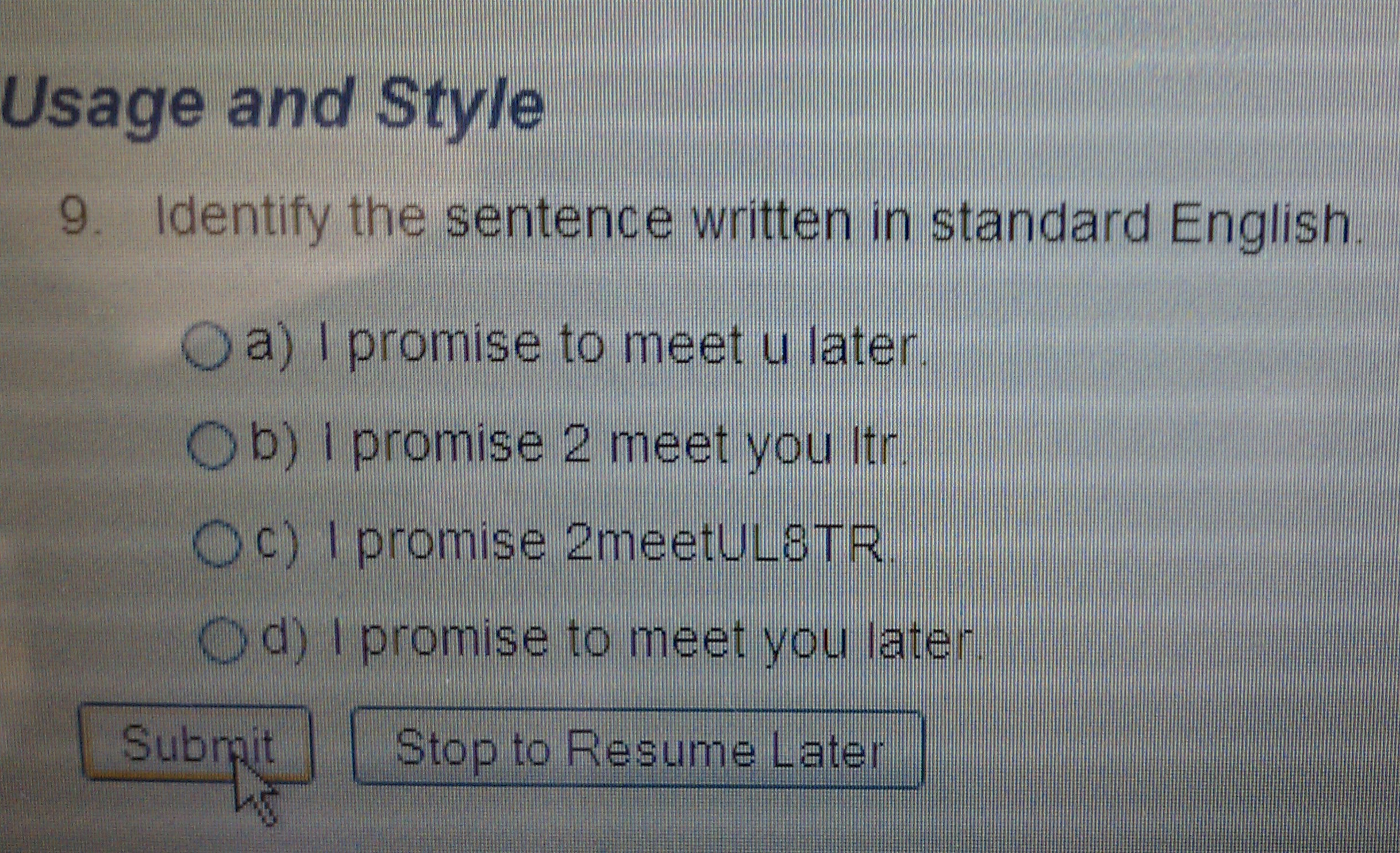
    Malia Green, taking a writing diagnostic test while enrolled in Junior College, came across the following question:


    The question was part of Pearson’s MyWritingLab, self-described as “a complete online learning program [that] provides better practice exercises to developing writers.”

    I have heard rumor that young people have been adopting shorthand tweet-type language as “standard English,” using it in communications with professors and in their academic papers.  The inclusion of this question in Pearson’s test suggests that this may, indeed, be a widespread phenomenon and that young adults may not necessarily know the difference between the English most of their parents grew up with and the English they have encountered in this brave new world.

    Despite the fact that each of the answers will make sense to anyone familiar with text-ese, the correct answer on the Pearon’s test is clearly d).  So, are the answers a) through c) actually wrong?  Who gets to decide what “standard English” is anyway?

    The whole thing reminds me of the controversies over African American Vernacular English, better known as “ebonics,” in the 1990s.  The idea that some people “talk right” and some people do not is an excellent way to justify prejudice.  Perhaps an employer largely chooses not to hire black people, not because they’re black, of course, but because they don’t “talk right.”  Is the outcome significantly different?  And who decides what “talking right” sounds like anyway? Well, the people who have the power to do so… and they typically side with themselves.

    So, is text-ese wrong?  Only according to those who are making the rules (and Pearson’s tests).  And what do you want to bet that those young people who are taught to differentiate between the kind of English they are allowed to use in texts and the kind they are allowed to use in “proper” communication are class privileged, on average?  And disproportionately white, accordingly?

    So, who decides the future of English?  And will “2″ and “u” be words in it, or not?


    Source: http://thesocietypages.org/socimages/2011/02/02/standard-english-and-social-power/

    Register

    Hey Professor

    Posted by Stan Carey on March 15, 2011 


    Stephen wrote an entertaining post recently about linguistic registers. In communication, a register generally has to do with what Macmillan Dictionary defines as “the type of language that you use in a particular situation or when communicating with a particular group of people”. (It can also refer to voice quality in phonetics, which is similar to its meaning in music theory.)

    In sociolinguistics, register is often about how formal your language is. By convention, there are situations where formality is expected. Introduced to someone for the first time, we might offer a casual “How’s it going?” or a less breezy “Hello, how do you do?” It depends on what seems appropriate. We tend to make this decision automatically if we are tuned in to cultural norms. In unfamiliar languages, it can be easy to forget the T–V distinction if we’re not used to applying it.

    Someone I know who began tutoring in university told me something that surprised me: some of her students seem to have little or no awareness of these nuances in their correspondence. They use the same colloquial expressions and tone in emails to their professors that they use in text messages to their friends. For example, they might begin semi-formal emails with the words “Hey Professor”, and see nothing untoward about this.
    In other words, they seem to lack what’s called “code switching” ability. Many people have a local dialect they replace with more standard English in certain circumstances. This is an example of code switching. Other examples are what bilingual people do when they change languages, and the way people switch between work jargon and a more everyday variety of speech.

    As I wrote in a comment on the Sociological Images blog, where the subject was raised, I would have thought switching registers would come naturally to third-level students. Evidently not, in some cases. As Stephen noted, it’s a tricky area. Language usage is closely tied to cultural notions of correctness that can be outdated or dubious, and English does seem to be becoming less formal generally. (See Baba Brinkman & Professor Elemental’s popular rap about this.) I have no time for pompous formality, but I’m not sure that “Hey” is the best default address to professors unless they have indicated its acceptability. Am I getting old?


    Source: http://www.macmillandictionaryblog.com/hey-professor

    Saturday, March 12, 2011

    Church Bulletin Bloopers

    Here is a collection of humorous church bulletin bloopers (typographical errors) ...


    Evening massage - 6 p.m.

    Don't let worry kill you. Let the church help.

    Thursday night ... pot luck supper. Prayer and medication will follow.

    Remember in prayer the many who are sick of our church.

    For those of you who have children and don't know it, we have a nursery down stairs.

    Weight Watchers will meet at 7 PM at the First Presbyterian Church. Please use large double door at the side entrance.

    Eight new choir robes are currently needed, due to the addition of several new members and to the deterioration of some older ones.

    The Senior Choir invites any member of the congregation who enjoys sinning to join the choir.

    At the evening service, the sermon topic will be "What is Hell?" Come early and listen to our choir practice.

    This afternoon there will be a meeting in the south and north ends of the church. Children will be baptised at both ends.

    Tuesday at four there will be an ice cream social. All ladies giving milk please come early.

    The ladies of the church have cast off clothing of every kind. They may be seen in the church basement Friday.

    The Reverend Merriwether spoke briefly, much to the delight of the congregation.

    The pastor will preach his farewell message, after which the choir will sing,  ‘Break Forth Into Joy."

    Due to the Rector's illness, Wednesday's healing services will be discontinued until further notice.

    The eighth-graders will be presenting Shakespeare's Hamlet in the church basement on Friday at 7 p.m. The congregation is invited to attend this tragedy.

    The concert held in Fellowship Hall was a great success. Special thanks are due to the minister's daughter, who laboured the whole evening at the piano, which as usual fell upon her.

    Men's Prayer Breakfast. No charge, but your damnation will be gratefully accepted.

    This morning’s sermon: “Jesus walks on the water”. Tonight’s sermon: “Where is Jesus?”

    During this morning’s meeting, be sure to smile and say hell to someone new.

    Ladies, don’t forget our rummage sale. Here’s a good chance to get rid of those things not worth keeping. Bring your husband along.


    [Source Unknown]