Showing posts with label syntax. Show all posts

Tuesday, October 4, 2011

SE - poor grammar disrupts flow of discourse

By Barbara Gunn
Posted Jun 22, 2011 @ 07:24 PM

Is English, as we know it, dead?

    Yes, according to Washington Post columnist Gene Weingarten.
"The end came quietly when a reader castigated the newspaper for having written that Sasha Obama was the youngest daughter of the president and first lady rather than the younger daughter. The letter writer called the first couple the 'Obama's.' This constituted an illiterate proofreading of an illiterate criticism of an illiteracy ..." and, Weingarten concluded, "English, already severely weakened, died of shame."

    Not so fast, Mr. Weingarten. Maybe the patient can be revived. Who cares, except maybe a few newspaper columnists, former teachers of grammar, and those few copy editors who are still employed? Others may have some lingering memories of the differences between contractions and plurals, agreement of subject and verb, misplaced modifiers, dangling participles, and even, ugh, a teacher who insisted on diagramming sentences and perhaps something called "parsing." Those teachers red-penciled every spelling, punctuation, and usage error when it was quite clear what you meant. Who needs that?

    Some probably thought "spell check" would save English. It might have saved Sarah Palin some backtracking had she checked "refudiate" and been able to choose "repudiate" or "refuse" or George W. Bush with "fundamentaries" or "educationalizing."

    A different type of error occurred when spell check failed to stop a newsletter of mine stating a publication was not available when it should have stated it was now available.

 Spell check allows some amusing errors. Who would want to spoil the fun of discovering "spade" female cats are for sale or that men now have a choice of treatments for "prostrate" cancer?

    Newspapers have had to cut back on expenses for copy editors, but one would think Oprah could afford the best. Yet, consider this sentence from one of her news releases: "The audience was made up of some of who the programs called its most loyal viewers." A copy editor might change "who" to "whom" but would probably reword the sentence to read: "The audience was made up of some of the program's most loyal viewers."

    There is another poorly written sentence in Dr. Phil's column in the November 2010 Oprah magazine: "Explain to your mother that you will continue to provide the highest-quality care you can afford her with." Rewritten, this would be "Explain to your mother that you will continue to provide her with the highest quality care you can afford."

    The Oprah examples are not only ungrammatical, they stop the flow of the passage, forcing the reader to pause and think, "How was that again?"
    Some more errors someone someplace should have corrected:

"The fact of the matter is..." (White House spokesman), a redundancy similar to Judge Judy's pet peeve, "Basically."

"For Michele and I..." (President Obama), a compound object of the preposition; thus, "for Michele and for me."

"Two pair of eyeglasses" (Vision World), pair is singular; "one pair, two pairs."

"Lots of tension between Simon and I" (Ellen DeGeneres), compound object of preposition; thus, "between Simon and me."

    Those of us who bemoan grammatical errors and awkward sentences may not save English, but maybe another group will: employers.

    An employer might overlook or not recognize some of the fine points of grammar that annoy columnists and teachers, but why take that chance?

Barbara Gunn is an Oak Ridge resident and frequent columnist.


Source: http://www.oakridger.com/columnists/x898078904/Can-English-be-resuscitated

Saturday, October 1, 2011

"bogus grammatical rules"

A foolish consistency

Posted by on September 28, 2011

No doubt you’re familiar with the following line from Ralph Waldo Emerson’s essay on self-reliance: “A foolish consistency is the hobgoblin of little minds”. In a comment to my recent post about hopefully, Marc Leavitt quoted it in relation to the strange persistence of outdated and unfounded rules of grammar and usage.

Most people know the kind of bogus grammar rules I mean: Don’t start a sentence with a coordinating conjunction; Don’t end a sentence with a preposition; Don’t split infinitives. Usage myths are less widely known but circulate perennially in writing circles and among those who enjoy collecting pet peeves. For example: you can’t say drive slow or different than; decimate can’t mean destroy most of; aggravate can’t mean irritate; and so on.

The last two – complaints about decimate and aggravate – fall prey to the etymological fallacy: that a word should or must mean what it meant originally or long ago, and maybe in another language altogether. The fallacy does not take account of linguistic change, and rests on the false idea that words cannot or should not change their meanings.

These restrictions have no basis in grammatical correctness, yet they have survived for generations, passed on from teacher to pupil or stickler to stickler-in-waiting. They have been called “classroom folklore” (Joseph M. Williams), “Miss Thistlebottom’s Hobgoblins” (Theodore M. Bernstein), and “zombie rules” (Arnold Zwicky).

We don’t have to like or use new words and usages. I don’t use literally to intensify figurative statements, because it weakens its literal sense – and what other word means literally so literally? But I don’t gnash my teeth over people using it loosely; people have been using literally non-literally, sometimes literarily, for literally centuries. Besides, it can be funny.

Growing up, I developed a temporary dislike for singular data, but it didn’t take much research and reflection (and yes, data) for me to realise that there’s nothing inherently wrong with it. So I’m fine with either form, depending on context. Notice that no one complains about singular agenda or stamina nowadays. But please, resist singular criteria for now.

Correctness is primarily a matter of convention, and conventions change. Consistency should be applied only as far as common sense carries it. If we want to do justice to words, it’s necessary sometimes to adapt to shifts in their meaning and usage, and to update our ideas of what’s acceptable, where, and why.

Source: http://www.macmillandictionaryblog.com/a-foolish-consistency

Wednesday, September 7, 2011

Spelling, online shopping, prestige

Spelling mistakes 'cost millions' in lost online sales


An online entrepreneur says that poor spelling is costing the UK millions of pounds in lost revenue for internet businesses.

Charles Duncombe says an analysis of website figures shows a single spelling mistake can cut online sales in half.

Mr Duncombe says when recruiting staff he has been "shocked at the poor quality of written English".
Sales figures suggest misspellings put off consumers who could have concerns about a website's credibility, he says.

The concerns were echoed by the Confederation of British Industry (CBI), whose head of education and skills warned that too many employers were having to invest in remedial literacy lessons for their staff.
Written word

Mr Duncombe, who runs travel, mobile phones and clothing websites, says that poor spelling is a serious problem for the online economy.
 
"Often these cutting-edge companies depend upon old-fashioned skills," says Mr Duncombe.

And he says that the struggle to recruit enough staff who can spell means that this sector of the economy is not as efficient as it might be.

Figures from the Office for National Statistics published last month showed internet sales in the UK running at £527m per week.

"I know that industry bemoaning the education system is nothing new but it is becoming more and more of a problem with more companies going online.

"This is because when you sell or communicate on the internet, 99% of the time it is done by the written word."

Mr Duncombe says that it is possible to identify the specific impact of a spelling mistake on sales.
He says he measured the revenue per visitor to the tightsplease.co.uk website and found that the revenue was twice as high after an error was corrected.

"If you project this across the whole of internet retail, then millions of pounds worth of business is probably being lost each week due to simple spelling mistakes," says Mr Duncombe, director of the Just Say Please group.

Spelling is important to the credibility of a website, he says. When there are underlying concerns about fraud and safety, then getting the basics right is essential.

"You get about six seconds to capture the attention on a website."

When recruiting school and university leavers, Mr Duncombe says too many applications have contained spelling mistakes or poor grammar.

"Some people even used text speak in their cover letter," he says.

Even among those who appeared to be able to spell, he says that a written test, without access to a computer spellchecker, revealed further problems with spelling.

William Dutton, director of the Oxford Internet Institute at Oxford University, says that in some informal parts of the internet, such as Facebook, there is greater tolerance towards spelling and grammar.

"However, there are other aspects, such as a home page or commercial offering that are not among friends and which raise concerns over trust and credibility," said Professor Dutton.

"In these instances, when a consumer might be wary of spam or phishing efforts, a misspelt word could be a killer issue."

James Fothergill, the CBI's head of education and skills, said: "Our recent research shows that 42% of employers are not satisfied with the basic reading and writing skills of school and college leavers and almost half have had to invest in remedial training to get their staff's skills up to scratch.

"This situation is a real concern and the government must make the improvement of basic literacy and numeracy skills of all school and college leavers a top priority."

Source: http://www.bbc.co.uk/news/education-14130854

Grammar and Prestige - Ernst and Young

It’s lost its apostrophe! ‘It’s’ or ‘Its’?

Posted by on July 21, 2011


A new report on the potential of solar energy, by leading business consultants Ernst & Young,  tells us (p.11) that ‘increased efficiency of manufacturing and improvements in non poly silicon costs has lead to cost reductions overall’  Aaargh: the old lead vs. led problem: they sound the same (in some meanings, at least) but the past tense and participle of the verb ‘to lead’ is led.  But worse than this is the Executive Summary which the report opens with, where we read that:
Due to it’s relative simplicity as a passive asset, solar has been observed as an entry point for large corporates.
This should of course say ‘due to its relative simplicity …’.  Maybe I’m just being pedantic, but for me the authority of the report was somewhat diminished by these basic errors. Sure, there are plenty of texts where mistakes like this don’t really matter, but it’s reasonable to expect that a serious report, from an organisation whose motto is ‘Quality In Everything We Do’, should get these things right.

Having said that, it isn’t surprising that this is one of the commonest of all punctuation errors in English. The problem lies in the fact that we use apostrophes for two different functions: either to show either possession (a genitive), or to indicate the omission of one or more letters – but this simple ‘rule’ doesn’t apply in the case of the pronoun it. (Apostrophes are sometimes also used to form plurals, as in ‘the word committee contains two m’s, two t’s, and two e’s', or ‘in the 1960′s’,  but these uses are – or should be – very rare.) So we can say My sister’s baby (possession: the baby that belongs to my sister), or My sister’s a baby (omission: my sister IS a baby), or My sister’s had a baby (omission again: my sister HAS had a baby).

When attached to a noun (or to someone’s name) ‘S can have all these uses. But confusingly, this doesn’t happen when we’re using the word it. In this case, the ‘S can only be used to indicate omission (for IT IS or IT HAS: It’s been a hard day’s night), but not to show possession. To show possession, we use its without an apostrophe: It’s lost its handle. Why? There is no logic in this – but it’s a mistake to expect language to be logical. Indeed the OED reports that its was (as we would expect) formed from IT and the possessive or genitive ‘S
and [was] at first commonly written it’s, a spelling retained by some to the beginning of the 19th c.
So the form its is relatively modern and (says the OED) ‘does not appear in any of the works of Shakespeare published in his lifetime’.

I hope that clears things up, but perhaps all this is another argument for a proposal made in one of our earlier postings: that apostrophes should be abolished altogether, on the grounds that they cause more harm than good.

Source: http://www.macmillandictionaryblog.com/its-lost-its-apostrophe-its-or-its

Apposition

Apposition

Apposition is a grammatical construction in which two elements, normally noun phrases, are placed side by side, with one element serving to define or modify the other. When this device is used, the two elements are said to be in apposition. For example, in the phrase "my friend Alice", the name "Alice" is in apposition to "my friend".


Restrictive versus non-restrictive

Apposition can either be restrictive, or non-restrictive where the second element parenthetically modifies the first.

In a non-restrictive appositive the second element parenthetically modifies the first without changing its scope. Non-restrictive appositives are not crucial to the meaning of the sentence. In a restrictive appositive, the second element limits or clarifies the foregoing one in some crucial way. For example in the phrase "my friend Alice", "Alice" specifies to which friend the speaker is referring and is therefore restrictive. On the other hand, in the above example: "my wife, a nurse by training, ..." the parenthetical "a nurse by training" does not narrow down the subject, but rather provides additional information about the subject, namely, "my wife". In English, a non-restrictive appositive must be preceded or set off by commas, while a restrictive appositive is not set off by commas.

Not all restrictive clauses are appositives. For example, Alice in "Bill's friend Alice ..." is an appositive noun; Alice in "Bill's friend, whose name is Alice, ..." is not an appositive but, rather, the predicate of a restrictive clause. The main difference between the two is that the second explicitly states what an apposition would omit: that the friend in question is named Alice. If the meaning is clear "Bill's friend Alice" can be used ("Bill was here with his friend. [other remarks] Bill's friend Alice...").

The same words can change from restrictive to non-restrictive (or vice versa) depending on the speaker and context. Consider the phrase "my brother Nathan". If the speaker has more than one brother, the name Nathan is restrictive as it clarifies which brother. However, if the speaker has only one brother, then the brother's name is parenthetical and the correct way to write it is: "my brother, Nathan, ...". If it is not known which is the case, it is safer to omit the restrictive commas: "John's brother Nathan" is acceptable whether or not John has more brothers, unlike "John's brother, Nathan".


Appositive genitive (possession)

In several languages, the same syntax which is used to express such relations as possession can also be used appositively. Examples include:
  • In English:
    • "Appositive oblique", a prepositional phrase with of as in: the month of December, the sin of pride, or the City of New York. This has also been invoked as an explanation for the double genitive: a friend of mine.[3]
    • The ending -'s as in "In Dublin's Fair City". This is uncommon.

Source: http://en.wikipedia.org/wiki/Appositive

Intensive pronoun 'myself'

In English

An intensive pronoun is a pronoun used to add emphasis to a statement; for example, "I did it myself." While English intensive pronouns use the same form as reflexive pronouns, an intensive pronoun is different from a reflexive, because the pronoun can be removed without altering the meaning of the sentence. An intensive noun works with the antecedent, the word the pronoun replaces. For example, compare "I will do it myself", where "myself" is intensive and can be removed without changing the meaning, to "I nominated myself", where "myself" fills the necessary role of direct object.example:He himself is to blame.(Himself is used to emphasize he);)


Source: http://en.wikipedia.org/wiki/Intensive_pronoun

Tuesday, September 6, 2011

Ellipsis to convey informality

Out of the red with the green stuff

Posted by on June 22, 2011

The language of money and the environment overlap in the word green. In a previous post, I wrote about how some businesses have turned to greentailing because it can be both economically and environmentally sound. Now the “green economy” is spreading to unexpected quarters: a recent article in Time magazine reports that Sicily’s mafia want in on the act.

The article discusses clean energy and dirty money, phrases that draw on particular metaphors I’ve written about before. Its title mentions the mafia’s “hunger for power”, a metaphor that refers in this instance to renewable energy but is apt in other ways. For one thing, when we talk about money, we often talk metaphorically about food, as Diane Nicholls’s article shows. Also, Italy is where the Slow Food movement, which promotes green living, is said to have begun.

There is an obligatory joke about how the mafia cares only for “the other kind of green”, meaning money. This nickname owes to the iconic U.S. dollar. The dollar has related slang terms like green stuff, long green and greenback, the last of which originally referred to notes printed in green and black on the back that were created during the American Civil War.

Many countries use dollars in their national currency, but greenback refers exclusively to U.S. dollars, as far as I know. A character in Saul Bellow’s A Silver Dish said: “A check? Hell with a check. Get me the greenbacks.” Notice how the informal tone in this dialogue is also conveyed through ellipsis. Normally we hear more complete versions of the idiom: “to hell with” or “the hell with”. Dropping the first word – sending us straight to hell, so to speak – stresses the casualness of the speaker’s delivery.

Green is not the only colour used in money talk. When people or companies owe money, they are said to be in the red. Then they need more green to get out of the red and into the black. The correspondence with roulette wheel colours is coincidental – and a little unfortunate, since going for broke can leave you broke (and blue) unless you’re very lucky, and especially if you’re green.


Source: http://www.macmillandictionaryblog.com/out-of-the-red-with-the-green-stuff

The English Subjunctive

S is for Subjunctive

12 06 2011
 
“Damn the subjunctive!”  Mark Twain is alleged to have said.  “It brings all our writers to shame”. It’s not clear what Twain’s particular beef was – whether misuse, overuse or underuse.   But my question is this: is there a subjunctive?  Or is it simply a mythical beast?

Of course, anyone who has struggled with French or Spanish or Latin has struggled with the subjunctive. It is, after all, the iconic grammar McNugget. Here, for example, is Alice Kaplan (1993) on the subject:
The subjunctive has a schoolyard reputation for extreme formality since it’s the last verb form people learning the grammar sequence – second year.  I remember my feelings of expertise when I could rattle off my tongue, ‘Il va falloir que je m’en aille’ (I’m going to have to go now), and glide out of the room.  The subjunctive is really something else; realm of doubt, desire, fear and trembling before language  ( p. 146).
But is there a subjunctive in English? Conventional wisdom says that there is, but it’s a mere relic of its former self.  Carter & McCarthy (2006), for instance, have this to say: “The subjunctive mood is a non-factual mood and is very rare in English… The subjunctive occurs only in very formal style.  It involves the base form of the verb, with no inflections” (p. 307).  Which makes me wonder: if it is uninflected, is it eligible for a label at all – or is it simply a hangover from attempts to describe English grammar in classicist terms?
Crystal (2003) hardly deigns to acknowledge it:
In modern English, the examples which come nearest to the subjunctive occur in ‘hypothetical’ constructions of the type if she were going (cf. if she was going), in certain formulae (e.g. So be it!),  and in some clauses introduced by that (especially in American English, e.g. I insist that he go to town) (p. 442).
Just how rare is it? Mindt (2000) has the stats:
Subjunctives are most frequent in fictional texts (c. 0.2 cases per 1,000 words), less frequent in spoken conversations (c. 0.1 cases per 1,000 words), and extremely rare in expository prose (c. 0.02 cases per 1000 words).
Between 70% and 80% of all subjunctives are cases of were. Subjunctives represented by the base form be are very rare. (p.197)
By way of comparison, here (from the same source) are the stats – per 1000 words – for progressive forms and imperatives, compared with the subjunctive – which, remember, is represented predominantly by hypothetical were:
progressive formsimperativessubjunctive
fiction4.820.2
spoken conversation5.22.80.1
expository prose2.20.80.02
In an earlier, corpus-based study, Charles Fries (1940) found that the subjunctive was used in fewer than 20% of the contexts in which it might be expected, and, even in American English, there was a preference for constructions with should: I insist that he should go, rather than I insist that he go. Fries concluded (70 years ago!) that “in general the subjunctive has tended to disappear from use” (p. 106).

All of which reminds me of a scene from the award-winning French film Entre Les Murs. Here’s how it is recounted in the English translation of the book (BĂ©gaudeau 2009):
“And what is the imperfect of the subjunctive?”
They didn’t know.  I explained.  I wrote il faut que j’aille, and then il fallait que j’allasse. They all laughed.
“Oh lala, old-timey.”
“All right, it’s true that these days people don’t care much about the imperfect of the subjunctive.  You’ll come across it in books, and even then not very often. In spoken language, no one uses it.  Except very snobby people” (p. 172).
So, has the subjunctive in English suffered a similar fate? Not entirely. It still occurs in some coursebooks. Here, for example, is a panel form a U.S. published advanced text (Finnie, 2003 – click to enlarge):


When, if ever, did you last teach the subjunctive?

References:
Bégaudeau, F. 2009. The Class. NY: Seven Stories Press.
Carter, R.  & McCarthy, M.  2006. Cambridge Grammar of English. Cambridge: Cambridge University Press.
Crystal, D.  2003.  A Dictionary of Linguistics and Phonetics (5th edition). Oxford: Blackwell.
Finnie, R. 2003. Grammar Booster 4. Boston, MA: Heinle ELT.
Fries, C. 1940. American English Grammar.  Tokyo: Maruzen.
Kaplan, A. 1993. French Lessons. Chicago: University of Chicago Press.
Mindt, D. 2000. An Empirical Grammar of the English Verb System. Berlin: Cornelsen

Source: http://scottthornbury.wordpress.com/2011/06/12/s-is-for-subjunctive/

Tuesday, May 10, 2011

Who'da thunk it?

Who’d a thunk it?

Posted by Michael Rundell on April 04, 2011


Has anyone noticed the recent fashion for this expression? The full version is ‘Who would have thunk it?’, where thunk is used as a pseudo-archaic past participle of think (by analogy with drink/drunk). This rhetorical question (similar to ‘Would you believe it?’) can be used to express genuine surprise:
Two games and nul points for Inter after their home defeat to Bayern Munich. Who’d have thunk it?
But, just as often, it is heavily ironic:
Dr Una Coales BA (Hons), MD, FRCS, MRCGP told us that ten years of binge drink is not good for you! Who would have thunk it?
The more standard version (‘Who would have thought it?’) is used in similar ways:
The Magazine now is in its 13th year – who would have thought it! (genuine surprise, not irony)
I heard one of the classics on the BBC the other day: “Two paintings have been stolen by thieves”. Who’d have thought it – thieves stealing something? (irony)
What is noticeable, though, is that version with thunk appears only rarely in its fully spelled-out form. Of the 60 odd hits in our corpus, only a handful appear as ‘Who would have (or who’d have) thunk it?’. Much more common are cases like this:
A sort of socialism among the Monte Carlo class. Who’d a thunk it?
Even the original line-up of Dinosaur Jr will be back on stage together this summer – who’d of thunk it?
He finds that he can have plenty of fun just being friends with a girl (who da thunk?) without being intimate.
It seems that, once someone opts for the form thunk instead of thought, they are already committed to a ‘nonstandard’ usage – so why not go the whole hog?
Where did it come from? One theory is that it was used by the ventriloquist Edgar Bergen – who had radio shows in the 1940s and 1950s – as the catchphrase of his not very bright dummy Mortimer Snerd. But whether Bergen actually invented the expression isn’t clear.
At any rate, the verb is showing signs of escaping from its fixed phrase, and being used as a straight alternative to thought:
Q: Your thoughts on playing the sold-out Roxy in Atlanta in a few weeks? A: Never woulda thunk it.
Didn’t sleep well, feeling a bit sick after learning that what I’d thunk was a rabbit that we barbecued was actually a corgi.
The ground was being prepared. We would have open reviews where the unthinkable would be thunk.
And in a final (?) development, Google has quite a few instances of the same form being used with the rare verb unthink (to put a thought out of your mind):
Thanks for a thought that can’t be unthunk.
Who ever would have thunk it could be so versatile?

Source: http://www.macmillandictionaryblog.com/whod-a-thunk-it

Tuesday, April 26, 2011

usage of adverbial "all"

All about all

Apr 6th 2011, 16:43 by R.L.G. | NEW YORK

First, as usual with this kind of "I've just noticed..." phenomenon, "all" as an adverb is plenty old: the OED lists, for example
(1425)    Oryg. Cron. Scotl. (Royal) vi. 493   Hyr chyld-ill al suddanly Travalyd hyr sa angyrly.
and
1793    R. Southey Triumph of Woman 63, in Wks. II. 7   All hopelessly our years of sorrow flow.
I think Ms Cavalier is thinking of a certain teen usage that I've seen myself, but similar usages go back. I can almost hear a bored kid at the mall moaning "My years of sorrow have flowed all hopelessly, you know?" Its meaning doesn't seem to have changed much, but there may be a new lilt to it.
"And all" gets its own sub-entry:
 c.and all: and everything else, and everything connected therewith, et cetera; hence , Too, also, as well (especially in dial. speech; Sc. ‘Woo'd an' married an' a'’).
I think that last bit is supposed to be a Scottish example: "Wooed and married and all."  Other citations include
a1554    J. Croke tr. Thirteen Psalms (1844) li. 18   The walles, and all, shalbe made newe...
1828    Scott Fair Maid of Perth v, in Chron. Canongate 2nd Ser. I. 133   With smithy, bellows, tongs, anvil, and all.
I'm intrigued by yet another "all".  The characters in the wonderfully bizarre web comic Achewood use "all" in a way I haven't seen elswhere.  Discussing the pros and cons of a camping trip, hard-living Ray and straight man Roast Beef argue back and forth:
Ray: All laughin' and tellin' lies.
Roast Beef [whose sentences never end in full stops]:  All eatin' eggs out of the pan  The eggs all not cooked all the way  All ashes in the egg.
Ray:  All meetin' some ladies! Invitin' 'em to our tent!
Roast Beef:  All asleep with tarantulas on my face  You all passed out and spoonin' me
Achewood is set in California.  I don't know if this kind of "all" is native there, or native only to the strip.  Any ideas from readers? The OED doesn't include this kind of "all". (Not yet, at least.)

*American usage, "don't get all hung over him like that".

Source: http://www.economist.com/blogs/johnson/2011/04/slang

Friday, April 15, 2011

Extensive use of "do"

What are you doing?

Posted by Sharon Creese on January 13, 2011 


It seems that over time, our language is becoming more forceful, even more aggressive. We talk about ‘getting‘ a cup of coffee instead of ‘having’ one, and we also now ‘do’ things that we used to just ‘visit’.

In the past, it was a bit of a joke to say let’s do lunch, but these days, that’s exactly what we do do. We don’t just have lunch, which suggests a nice quiet, relaxing breaking of bread amongst friends. We do lunch, aggressively and with purpose. There are time constraints, dietary requirements and unspoken protocols on what can and can’t be discussed. We make sure the lunch has no doubt that it’s been done.

It’s the same with holidays. We used to say this summer, I’m going to Egypt to see the pyramids. Now it’s I’m off to Egypt – going to do the pyramids. Or I’m going to do South America during my gap year. Do what to it, one wonders?

It seems to be all part of the same problem; the need to do everything as aggressively as possible, just to prove we’ve done it. It’s no longer enough just to go somewhere, we have to be sure we’ve wrung every last vestige of interest out of it, by doing it. (And anyone who thinks they’ve exhausted the possibilities for interest in somewhere by one visit, no matter how aggressively they approach it, is deluding themself.)

It all feels faintly exploitative somehow, to do things and places in that way, but maybe that’s the point; ours is now such a consumerist society that we look at everything, including places and experiences, as things to be devoured. I don’t like it though; I much prefer the it’s the journey, not the destination that’s important school of thought. To get the most out of something, you don’t have to do it to death and you don’t have to prove that you’ve done it.

So I think I’ll stick with seeing the pyramids, travelling South America and having lunch, thank you very much.


Source: http://www.macmillandictionaryblog.com/what-are-you-doing

Monday, April 4, 2011

Grammar Glossary

33 Terms Every True Grammar Geek Should Know

Even the most vocal detractor of language lessons knows the difference between a noun and a pronoun. But it takes a special kind of grammar aficionado to pick up on the intricacies between the various verbs and plethora of pronouns. As with every passion, linguistics comes with its own unique vocabulary challenging fans to memorize them all. Hundreds more exist beyond these 33, but they certainly make for an amusing start! Especially that "eggcorn…"
  1. Adverbials: Though not the same as those –ly adverbs with which all English speakers are familiar, these word clusters perform an identical function.
  2. Affixes: Prefixes, suffixes and infixes are all known collectively as "affixes," or morphemes added to words to change their meanings around.
  3. Allophone: For such an intimidating, but thoroughly fun to say, word, allophone actually sports a pretty straightforward definition. It simply means a different way to pronounce the same sound.
  4. Ambigram: These words can be quite a bit of fun, especially for children. Ambigrams can be read the same regardless of whether or not they're upside-down or right side-up!
  5. Anaphora: Everyone uses anaphora, regardless of whether or not they recognize it. The phrase references pronouns related to nouns previously found in a sentence or paragraph.
  6. Anti-Language: A Clockwork Orange fans have a great example of anti-language at their disposal. This concept takes actual words and phrases, but changes their meanings around so only those "in the know" understand the true intentions.
  7. Apposition: Apposition is little more than the act of using an appositive, the definition of which can be found below.
  8. Appositive: Nouns or noun phrases used to further describe and clarify the main subjects are known as appositives.
  9. Cataphora: The opposite of anaphora, cataphora involves a pronoun referencing a more specific noun found later in the text.
  10. Dangling Modifiers: This is a modifier (of course) that just doesn't jive with the rest of the sentence, as it's unclear what object the subject references. All it takes is a bit of editing to help the common mistake start making sense.
  11. Definite Article: English only has one definite article — "the." When used with a noun, it denotes the specifics of what speakers mean.
  12. Deontic Modality: Deontic modality uses a modal verb to indicate permission. Sentences involving "can" and "cannot" are particularly adroit examples.
  13. Disjunct: "Fortunately, "unfortunately" and their ilk all express some sort of opinion in adverb form, thus making them disjuncts.
  14. Dynamic Modality: Sentences practicing dynamic modality only reflect facts, never opinions. For example, the previous sentence defining dynamic modality is an example of…well…dynamic modality.
  15. Eggcorn: Yes, there's plenty of laughs to be had at the name, with most of them unsuitable for an academic website. Its true definition, sadly, is not so humorous. Eggcorns happen when people accidentally write homophones or other similar words in place of the one they really mean.
  16. Emphatic Forms: Used when discussing verbs, emphatic forms (also known as emphatic moods or tenses) combine the past or present tense of "do" — an auxiliary verb – with the base form of the primary verb.
  17. Epistemic Modality: Unlike dynamic modality, the epistemic variety reflects attitudes and opinions rather than the cold, hard facts.
  18. Homograph: Even non-grammar geeks are aware of homophones, but language aficionados take it one step further and talk of homographs. These are words spelled the same, but sporting entirely different meanings and connotations.
  19. Indefinite Articles: "A" and "an" are the two indefinite articles used in English. Speakers and writers use them to indicate singular nouns with plural varieties.
  20. Malapropism: This grammatical phenomenon can make for some pretty entertaining (or, alternately, terrible) jokes, as they involve switching around similar-sounding words with different definitions.
  21. Meiosis: Any students who've ever taken a biology class might think "meiosis" sounds eerily similar to some of the concepts found in their cellular studies. In actuality, though, it's merely a synonym for irony and understatement.
  22. Metaplasm: It sounds like science fiction, but metaplasm as a concept has its feet planted firmly in terran soil. The term means a word modification involving altered syllables and sounds.
  23. Metonymy: Metonymies are pretty much the same thing as a symbol, where words or phrases symbolize a far broader concept.
  24. Modal Verbs: These verbs, such as "could," "would," "should" and "need," reflect intention, obligation, possibility, necessity and similar concepts.
  25. Morpheme: A "morpheme" is the smallest possible word or phrase with an understood meaning. Prefixes and suffixes make for the best examples.
  26. Participle: The word gets bandied about as a particularly funny grammar term — and for good reason — but good luck getting many people to explain what it is. A present participle adds -ing to the end of a verb, while a past adds -ed, and both can be used as adjectives as well.
  27. Passive Voice: No, it's not what a dominatrix loves to hear on a daily basis. The passive voice combines a "to be" verb and a past participle to emphasize the more important components of a sentence.
  28. Phonemes: "Phoneme" is just a fancy synonym for "syllable," the shortest sound in any given language. Peruse the phonetic alphabet for the best examples!
  29. Quantifier: Any word used to indicate the amount or number of a noun is known as a "quantifier." This is one of the easier grammatical terms to remember!
  30. Reflexive Pronouns: When the complement and the subject of a verb align, reflexive pronouns result. They're easy to spot, too! Just look for pronouns with -self tacked onto the end.
  31. Synecdoche: When a small portion of something is utilized as a representation of the whole, grammar fans are looking at a synecdoche.
  32. Tmesis: Also known as an infix, the tmesis is a word of phrase placed in the middle of a word to change its meaning or add emphasis. Ned Flanders and his persistent abuse of "diddly" makes for the best example of this grammatical phenomenon.
  33. Zero Article: As its name implies, the zero article is a grammatical term meaning the absence of either a definite or an indefinite article in a sentence.

Source: http://www.onlinecollegesanduniversities.net/blog/2011/33-terms-every-true-grammar-geek-should-know/

'heart' (vb. trans) makes it into OED!?

Have you no ♥?

Mar 26th 2011, 14:20 by R.L.G. | LONDON

I did decide to blog because I was briefly confused by one piece of what seemed to be genuinely surprising news: that the dictionary had included an entry for ♥, pronounced "heart", and defined as a transitive verb meaning "to love". That would be weird—what other pronounceable symbols might be included?  But that's apparently not the case. There is no headword for ♥.  The dictionary merely included a new sense of "heart" under that word, not the symbol. People have been writing "heart" as a transitive verb for a thousand years (meaning roughly "to hearten"), and in this new sense for a while. The entry includes these citations:
    [1983    Associated Press (Nexis) 16 Nov.,   From Berlin to the Urals, teen-agers wear T-shirts reading, ‘Elvis’, ‘Always Stoned’, and ‘I (heart) New York’.
    1984    About Helmet Visor Screws in net.cycle (Usenet newsgroup) 26 June,   Joe ‘I heart my dogs [sic] head’ Weinstein.
    1986    Daily Collegian (Pennsylvania State Univ.) 14 Feb. 2/3,   I just want to say to my Bunny Boo I Heart you Kathleen. 
    1998    Houston Chron. 10 May (Chronilog section) 7/1,   I think he's so cute. I heart him to bits.
    2003    Time Out N.Y. 7 Aug. 77/1   If you heart dance like DJ Scott does, then hie thee down to this little drink spot tonight.
    2009    A. Ham et al. Middle East (Lonely Planet) (ed. 6) 141/1   We heart the brownies (E£4).
    2010    Observer 18 July 13/4,   I hearted Take That‥with a teary passion that was deemed unbecoming in a Jesus and Mary Chain fan.
So the OED included some words people use.  Nothing to see here.

Update: But you can see a member of the new-words group on the dictionary staff explaining a bit of the thinking behind "heart" and "OMG" here.


Source: http://www.economist.com/blogs/johnson/2011/03/lexicography

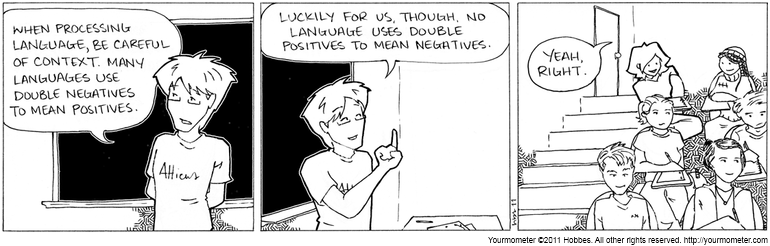
Yeah right = double positive???

Double positives

Why function words are necessary...

The synod decided

Thursday, March 31, 2011

"stylistic language"?? or just plain bad English??

“We’re like carnies, always out there trying to sell some idea,” another writer, who sees Michels, and whose husband, also a writer, sees Stutz, told me.

Source: http://www.newyorker.com/reporting/2011/03/21/110321fa_fact_goodyear?currentPage=4

Tuesday, March 29, 2011

Negation does not negate!!

Why are negations so easy to fail to miss?

February 26, 2004

Over the past month or so, a series of posts here have sketched an interesting psycholinguistic problem, and also hinted at a new method for investigating it. The problem is that people often get confused about negation. More exactly, the problem is to define when and how and why people get confused about negation, not only in intepreting sentences but also in creating them. The method is "Google psycholinguistics": the analysis of internet text as a corpus, as a supplement to more traditional methods like picture description, reaction time measurements or eye tracking.

This all started with could care less. It's clear that this phrase has become an idiom, meaning "don't care", even if it's not clear exactly how the not disappeared from the apparent source cliché couldn't care less. In this Language Log post from last month, Chris Potts discusses a range of other examples where the presence or absence of negation seems to leave the meaning (in some sense) unchanged. For example: "That'll teach you (not) to tease the alligators."

Followups in our pages and elsewhere (here, here, here, here, here) discussed many cases of developments of a different kind, where extra negations create an interpretation at odds with what the writer or speaker meant. An antique and canonical example (cited by Kai von Fintel) is "No head injury is too trivial to ignore." The literal meaning is the opposite of what the author wants it to be, but this is not irony or sarcasm -- the author is just confused. The extra negations are sometimes explicit negative words (like not and no) and sometimes implicit parts of words with negative meanings (like refute, fail, avoid and ignore). Generally the result has at least two negatives, and often a scalar limit, conditional, hypothetical, or other irrealis construction as well.

In fact, this description is predictive -- if you think of a construction that meets these conditions, and check with Google or Altavista, you will generally find lots of examples whose literal meaning is clearly the opposite of what the writer intended.

The obvious hypothesis is that it's hard for people to calculate the meaning of phrases with several negatives (perhaps especially in combination with things like scalar limits and hypotheticals). The implicit negation in words like fail and ignore may be especially difficult to untangle. This explains why the errors are not detected and corrected: we accept an interpretation that is a priori the plausible one, even though it's incompatible with the sentence as written or spoken, because it's too hard to work out the semantic details.

However, this may not provide an adequate explanation for why the errors are so commonly made in the first place. The pattern is predictive of errors, but it doesn't predict how common the errors will be, either in themselves or by comparision to "correct" interpretations of the same pattern.

In this post, Geoff Pullum mentions the particular case of "fail to miss" used to mean simply "miss." A little internet search shows that this sequence is moderately common (around 2,400 ghits for "fail/failed/failing to miss", or one per 1.8 million pages), and that when it occurs, it is almost always used in the "wrong" meaning:
Miss Goodhandy doesn't fail to miss an opportunity to humiliate Steve, and gives him a few good swats with the jockstrap's thick elastic waistband.
Although his attendance at school was still very poor, Stanley never failed to miss a movie at the local theaters.
Canceling a few flights here and there seems like a good trade-off because the results of failing to miss a real threat are so severe.
This is sure to be a killer tournament, don't fail to miss it!
It seems to me that there are several different psycholinguistic questions here: why do most people not even notice the problem in sentences like this? why do people stick in the extra "fail to" in the first place, given that the sentences mean what their authors intend if they just leave it out? why are uses of "fail to miss" so often accompanied by an additional negative ("doesn't fail to miss", "never failed to miss", etc.)? and why do people hardly ever use "fail to miss" to mean "fail to miss"?

In fact, almost the only internet examples of "correct" usage of fail to miss are copies of this famous passage:
This is what The Hitchhiker’s Guide to the Galaxy has to say on the subject of flying: There is an art, or, rather, a knack to flying. The knack lies in learning how to throw yourself at the ground and miss. Pick a nice day and try it. All it requires is simply the ability to throw yourself forward with all your weight, and the willingness not to mind that it's going to hurt.
That is, it's going to hurt if you fail to miss the ground. Most people fail to miss the ground, and if they are really trying properly, the likelihood is that they will fail to miss it fairly hard. Clearly, it is the second part, the missing, which presents the difficulties.
Douglas Adams offers us a clue here, I think: you can fail to do something only if you first intended to do it. It's relatively rare for people to intend to miss something, but missing things is generally easy to do, so when you try to miss something, you usually succeed (and you might describe what you did as avoiding rather than missing, anyhow). Therefore, failing to miss things just doesn't come up very often. Perhaps this hole in the semantic paradigm leaves a sort of vacuum that bad fail to miss rushes to fill?

We can test this idea with "fail to ignore", because ignoring things is often both desirable and hard to do, and failing to ignore things is therefore an event that we often may want to comment on. There are certainly plenty of "wrong" interpretations of fail to ignore:
The Judge Institute is a building that no-one in Cambridge can fail to ignore. Much has been written about its jelly-baby hues, its pyramid-like proportions, and its metamorphosis from the husk of Old Addenbrooke's. (context)
Progressive thinkers and activists need to consider the practical implications of these principles. Good people of the world cannot fail to ignore them.
In New York, state Sen. Michael Balboni (R-Mineola) is circulating a proposal based on the original California bill, and plans to introduce the measure in the next 10 days. "Various industries in New York are looking at our legislation," said Balboni legislative assistant Tom Condon. "We have to ask, are all these lawsuits beneficial to our economy? And we can't fail to ignore possible negligent conduct from these manufacturers. It's a difficult issue."
but there are plenty of "correct" interpretations as well:
[T]he chapter points out the pitfalls that are likely when making decisions: ignoring opportunity costs, failing to ignore sunk costs, and focusing only on some of the relevant costs.
He managed somehow to answer their questions, trying and failing to ignore the addictive joy of a kindred spirit touching his.
The story of a black lawyer who tried and failed to ignore his race.
And "fail to ignore" is also less common (in both right and wrong interpretations) than "fail to miss" (about 1200 ghits to 2400 -- though the verb miss is also about twice as common as the verb ignore). In any case, the counts are large enough (tens of millions for the basic words such as fail, miss and ignore, and thousands for phrases such as fail to miss, fail to ignore) that one could imagine fitting some simple statistical models for the generation process that would permit testing different answers to some of the questions asked above.

As another example, consider the counts in the table below

to underestimate
to overestimate
impossible
972
3,620
hard
1,720
5,820
difficult
841
6,030

Nearly all the "to underestimate" cases are logically mistaken substitutes for "to overestimate":It is impossible to underestimate the long-term impact of Phoebe Muzzy’s ’74 longstanding role as an Annual Fund volunteer.
It is almost impossible to underestimate the importance of rugby to the South African nation in terms of its self-esteem on the world stage.
It's impossible to underestimate Lucille Ball's importance to the new communications medium.
It's impossible to underestimate the value of early diagnosis of breast cancer. (BBC)
Why are these mistakes so common? Why are correctly-interpreted uses of "impossible/hard/difficult to underestimate" so rare -- except in discussions of the mistaken ones? Is there a connection between these two facts?

Google psycholinguistics may point the way to the answers, despite its obvious and severe practical and theoretical difficulties as a methodology.
 
[Update: Fernando Pereira observes that "[f]or those of us skiers who spend a considerable time in the trees, the chance of 'failing to miss' is why we wear helmets". However, the single result of searching for |"fail to miss" wilderness ski| failed to produce any other correct uses:
The clay like soil of the Adirondacks makes it difficult for water to run off and creates these mud holes that can cause you to sink up over your knees if you fail to miss a rock or log when crossing.
This may be sampling error, but apparently it's not enough to do something where missing things can be both difficult and desirable. Seriously, I think in this situation people are more likely to use the word avoid. I couldn't find any examples involving skiers and trees, but there are plenty of cases in a slightly generalized frame, e.g.
Low-hangng [sic] branches and limbs can be a problem for boaters who fail to avoid getting caught in them.
Finally, while checking all this out, I found this amusing piece (entitled "Do not fail to avoid neglecting this post") about the difficulties of calculating the polarity of summaries of SCOTUS decisions. ]


Source: http://itre.cis.upenn.edu/~myl/languagelog/archives/000500.html

Monday, March 21, 2011

Verbing 'blog' = YES!! / NOO!!

Verbing "blog"

Mar 16th 2011, 20:52 by G.L. | NEW YORK

A READER, davidnwelton, took me to task a few days ago for writing "I'll blog the experience" in my first post from the South-by-Southwest Interactive technology conference:
Can I make a suggestion for the Economist's style guide? Can you guys simply "write" about things? I don't care whether it's on line, or in the paper copy, or delivered to my Kindle, or if you etch it out in stone - it's writing and just because it's available on line doesn't mean it merits a new word, especially one that sounds like a problem that only a skilled plumber can resolve.
Ouch, and touché. I will confess that, immersed as I was in geek culture, I used "blog" not only as a verb (which we in fact do fairly often at The Economist) but as a transitive one. I searched for "blog the", one marker of transitive use, on our site, and while I can't be sure because the search also returns, for instance, "blog. The" and "blog, the", it seems I am probably alone in this sin. If our style-book editor learned of it he would surely roll his eyes and buy davidnwelton a stiff drink.

All the same, it's clear that outside our little haven of linguistic purity, the verb "blog", like "tweet" and "email", is developing its own rules of syntax. You can "blog about", "blog from" or just "blog" a conference (especially if you're "live-blogging" it). As evidence, below are two graphs from Google's wonderful Ngram Viewer, showing the prevalence of "blog" and "blog the" in books published in English from 2000 to 2008. While the prevalence of "blog" doesn't reveal how often the word is used as a noun and how often as a verb, the fact that "blog the" (the ngram viewer, unlike regular Google searches, distinguishes it from "blog, the" et al) increases at a similar relative rate suggests that the verbification of "blog" was roughly contemporaneous with the adoption of the word itself.

Prevalence of


Prevalence of


Source: http://www.economist.com/blogs/johnson/2011/03/geek-speak

Blogs and language peeves

Check out this blog

Mar 18th 2011, 14:22 by R.L.G. | NEW YORK

MY COLLEAGUE posted Friday about "blog" as a transitive verb, which he rightly suspects our style editor would frown on, and which many other people dislike too. I don't particularly share the dislike of "I'll blog the conference" or "we'll live-blog the speech."  But I have another "blog" problem. If I said "Check out this blog" to you, most blog habituĂ©s would say "ooh, new blog, let me add it to my RSS reader," perhaps, expecting a continuing sequence of posts on something interesting.  I use "blog" to refer to Johnson, Democracy in America, Free Exchange and so on. But many people use "blog", the count noun, to mean a post. For them, this blog is called "Check out this blog," not "Johnson."

We sometimes peeve against peevology here on Johnson, yet this usage is a real peeve of mine. I can't shake it. Why do people say "oh, I'll write you a quick blog on that"?  There's a nice noun, "post", that fills that role. Most bloggers, I think, use "post" and "blog" the way I do, but a minority (I just heard it from a colleague this morning) use "blog" the way that makes me clench my jaw a bit. There's probably not much I can do except wait for usage to settle, though. Blogs are still pretty new.

I hereby declare today an occasional Peeve Friday. Safely vent your own (perhaps-hard-to-justify, yet) unshakable peeves in the comments. It's a beautiful day in New York, and I'm hardly in a bad mood, so keep it clean and lighthearted. But we all have something that annoys like a canker sore every time we hear it. Let's hear yours.


Source: http://www.economist.com/blogs/johnson/2011/03/count_nouns

Subjunctive = Irrealis Mood

Linguistic therapy


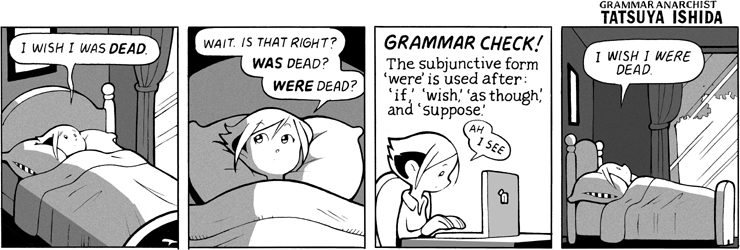
But in fact there's more here to distract Monique from her depression than the simple question of whether to say "I wish I were" or "I wish I was". As Geoff Pullum noted in a comment on a Language Log post back in 2004, this use of were

… isn't actually the subjunctive. People often call the "were" of "I wish I were" subjunctive, but that term is much better used (as in The Cambridge Grammar of the English Language) for the construction with "be" seen in "I demand that it be done." The "were" form is often wrongly called a past subjunctive, but of course "it were done" is not a past tense of "it be done". The difference between the two is that the subjunctive construction occurs with any verb: "I demand that this cease" is a subjunctive (notice "this cease", not "this ceases"). The relic form in "I were" is only available for "be". For all other verbs you use the preterite: "I wish I went to New York more often." The Cambridge Grammar calls the "were" form the irrealis form. It is surviving robustly in expressions like "if I were you", but even there it has a universally accepted alternate "if I was you", and there is no semantic distinction there to preserve.

And she should feel OK about her original mode of expression, as I noted in the same post, quoting the American Heritage Book of English Usage:

… over the last 200 years even well-respected writers have tended to use the indicative was where the traditional rule would require the subjunctive were. A usage such as If I was the only boy in the world may break the rules, but it sounds perfectly natural.

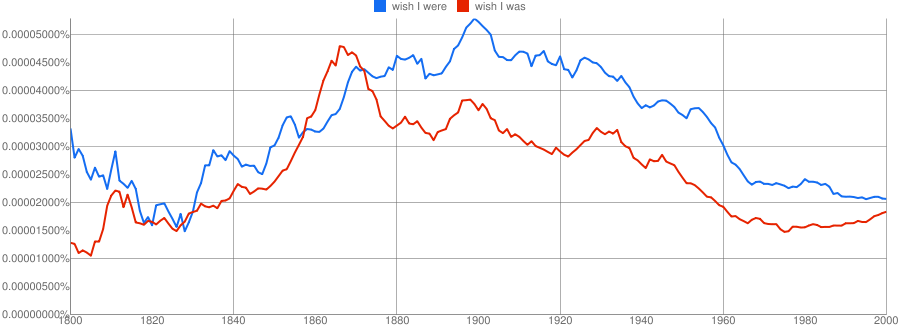
In fact, rather than looking up the "rule" in some grammar scold's list, she could have discovered this puzzling graph of her choice's history:


This is turn would raise a host of other questions: Why did "wish I was" surge to the front in the late 1860s? Why did "wish I were" regain the lead, peaking in 1900? And what about the larger shape of the  Great Victorian Wistfulness Bubble, with that long climb from 1830 and the subsequent decline in both of these expressions?

With any luck, by the time Monique  finished exploring these questions online, she'd be too tired to be depressed.

Update — Well, if we're going to get serious about this (and LL commenters are a pretty earnest and sober bunch, it seems), then we should start by reading what Arnold Zwicky had to say in response to Geoff's comment: "'Losing' 'the subjunctive'", 7/11/2004.


Source: http://languagelog.ldc.upenn.edu/nll/?p=3038